Tuesday, 26 August 2014

The Half Moon pub 'will reopen'..... one day

* The below was written prior to me finding this sign on the corner door of the Half Moon. I don't know when it went up but it was bone dry, unlike the rest of London. It would appear the Half Moon pub is being squatted. I'm hoping to be corrected.


It’s a terribly sad sight to see the beautiful Half Moon pub in Herne Hill closed. The pub's beautiful doors have not been opened to welcome a paying customer since the awful flood of August 2013 and rumours about its fate swirl endlessly around. Some claim to have heard it is going to be converted into an Asda, or a Tesco Metro, or maybe into a Wetherspoons clone or simply turned into flats. 
Thankfully the truth is a little simpler than that; the most likely outcome is that it will, one day, reopen as a pub. To understand why, below is the Half Moon’s entry on English Heritage’s Listed Buildings Register:
Public house. Dated 1896 on gable. Red brick in Flemish bond with rubbed brick, artificial stone, terracotta dressings; ground-floor with polished granite columns. Mansarded roofs of various descriptions, all turnerised. STYLE: Jacobeathan Revival. 
PLAN: rectangular corner plan, with corner itself chamfered. 
EXTERIOR: 3 storeys stepping down to 2 to left and rear. Seven-window range, one-window range at corner and five-window range to return. Five flat-arched entrances, that to corner designed as the main one. All windows are flat-arched unless otherwise stated. Ground floor treated as pilastrade of Composite order, supporting an entablature, which is topped by a pediment over each entrance. In the centre of main elevation a bulbous attached column supports a 1st-floor balcony set under a canted, open porch which is, in turn, topped by a truncated gable and a 2nd-floor balcony with pierced strapwork parapet. This ensemble set in a full-height, round-arched recess, pierced at top by a Serlian window with panelled over spandrel. The 4th to 6th window ranges are treated as a single Dutch-gabled bay with scrolled parapets and finials. A 1st-floor porch in the corner range with Elizabethan-style columns; round-arched window; window above set in aedicule consisting of pedimented hood that projects above eaves of high mansard roof, topped by a bellcote, which crowns the corner range. 2nd-window range on return treated as a gabled bay. Entrance porch with polished granite columns to rear of return elevation. On the main elevation, 1st-floor windows in the 3rd- and 7th-window ranges are tripartite and round-arched. The 2nd-floor windows alternate with round-arched recesses; the windows have scrolled aprons and plaques of brick cut and rubbed to resemble swags. High hipped roof to 2nd-window range which projects slightly to form a bay. High stacks to centre and end walls, some with floral decoration. To the rear of the return there is a single square stack in the plain of the outer wall. 
INTERIOR: public bar intact; original panelling and coloured glass; etched mirrors of original design. Some mirrors with painted decoration of good quality depicting birds and flowers. The proliferation of ornament across the surface of this building gives the whole a sense of vital unity through their sheer number, a design approach characteristic of large public houses built c1895. 
Such is the admiration of this building, not only is the exterior of the pub Grade II* listed, so too is the interior. This makes it very difficult to adapt for other uses. Any applicant would have to convince Southwark Council that the site couldn't operate as a viable pub once more; an extremely difficult proposition to establish considering the Half Moon's long service. An attempt to convert the pub into a supermarket, for example - the sorry fate of far too many pubs - would inevitably lead to dramatic interior changes and is almost guaranteed  to spark ferocious local opposition and also objections from English Heritage. Sadly, such a fate befell befell the George IV, in Brixton Hill recently. A lovely pub but not one, as far as I can see, benefitted from a heritage listing. It had also had a more troubled recent history which made it much harder for the council to resist the advance of Tesco, despite a vigorous campaign to save it. It is now another pointless Tesco Metro store.
The Dulwich Estate, owners of the Half Moon Pub, do have redevelopment plans for the building; it seems likely to have been these plans which led to the previous leaseholder, Robert Harrison, leaving the pub in March 2013. In an interview with journalist Jason Tate, Mr Harrison said:
I left the Half Moon in March 2013. My leased had expired and the landlord had not offered me a new one. I spent seven years at the Half Moon and during that time I gave my best attention to the upkeep and well-being of the premises. I would have liked the opportunity to continue - there was much more that could have been done - but unfortunately the landlords had other plans for the building.
(The full interview can be found here, search 'Half Moon Pub Remembered' and it should come up.)


The flood which closed the doors of the Half Moon
But The Dulwich Estate are committed to reopening the pub.
'When the pub was flooded it coincided with The Dulwich Estate's plans to redevelop the pub and provide flats on the upper floors,' John E Major, the chief executive of The Dulwich Estate, told me in a brief conversation.
He acknowledged that is was 'a beautiful building but it is not in great condition and it needs a lot of careful restoration'. The previous tenants have given up the pub and The Dulwich Estate are now in discussions with planning at Southwark Council about the way forward. While the Herne Hill Forum estimates the pub will reopen in June 2015, 'there is no target date to get it back open, it all depends on the planning process', Mr Major said, though he added:
'Obviously, it's in our interests to get it reopen again as a functioning pub as soon as possible.'
And the future of live music provision at the venue is still not decided either.
'Whether there is a music venue depends on the future tenant. Soundproofing could be done to enable the music venue to remain.'
Past experience suggests that the planning battle could be a fraught. A consultation was held in April 2013 about parts of the building being turned into flats and, according to the Herne Hill Society, 'local residents were concerned over the loss of the function rooms on the upper floors and, more particularly, the impact on the live music performances, an important tradition at the Half Moon. Could they ever be compatible with residential flats?'
There's a long way to go then, but hopefully, not too far in the distance future, I will, along with other fans of the pub, walk in to the familiar bar, order a pint and settle back to enjoy one of the finest pubs in London.

Wednesday, 20 August 2014

'Will no one rid me of these turbulent priests'


David Cameron has a problem with bishops. Several of these troublesome fellows have spent the last few weeks castigating the government for failing to do enough to help Iraqi Christians.

As the influence and terror of the Islamic State has grown, Christians, along with the ancient Yazidi community, have faced a very stark choice; either to convert, flee or die. The threat of genocide is real. In the last week, horrifying reports have emerged that captured Yazidi men, women and children, refusing to convert, have been buried alive. Reuters reporter Humeyra Pamuk, for example, spoke to Samo Ilyas Ali – one of those who fled – who recounted what happened when IS forces entered his village and started digging holes in the ground:

‘We did not understand. Then they started to put people in those holes, those people were alive.

‘After a while we heard gunfire. I can’t forget that scene. Women, children, crying for help. We had to run for our lives, there was nothing to be done for them.’

It is against this background that the bishops have spoken so forcibly and implored the government to offer asylum to Christians, fleeing from places like Mosul and Qaraqosh, where Christian heritage dates back 1,600 years.

The Bishop of Manchester, the Right Reverend David Walker, told The Observer

‘We would be failing to fulfil our obligations were we not to offer sanctuary. Having intervened so recently and extensively in Iraq, we have, even more than other countries, a moral duty in the UK. Given the vast amounts of money that we spent on the war in Iraq, the tiny cost of bringing some people fleeing for their lives to this country and allowing them to settle – and who, in due course, would be an asset to our society – would seem to be minuscule.’

Bishop of Worcester, Dr John Inge, added:

‘I would be very disturbed if the government refused to do anything. The situation in Iraq is absolutely horrendous. It would sit very ill at ease with our values if nothing were to be offered. I am disappointed nothing has transpired so far.’

The pressure continues; in the last couple of days, the Bishop of Leeds, the Rt Rev. Nicholas Baines, has written to the Prime Minister, with the support of the Archbishop of Canterbury, asking for the government's policy towards Iraq to be clarified. Cuttingly, one of his questions reads:

'The focus by both politicians and media on the plight of the Yazidis has been notable and admirable. However, there has been increasing silence about the plight of tens of thousands of Christians who have been displaced, driven from cities and homelands, and who face a bleak future. Despite appalling persecution, they seem to have fallen from consciousness, and I wonder why. Does your government have a coherent response to the plight of these huge numbers of Christians whose plight appears to be less regarded than that of others? Or are we simply reacting to the loudest media voice at any one particular time?'

And the other day, the hugely admirable Canon Andrew White, from Baghdad's St George's Church - a man who has surely done more to promote a positive of Britain and its best values in Iraq than any other - appeared on the Today programme to add his voice to those campaigning to offer asylum to up to 30,000 Iraqi Christians:

'Christianity [in Iraq] could be nearly dead and Britain has refused asylum to any Iraqi and now we are desperate. It is a matter of life and death.'

Yet, despite the urgency of the situation and the vocal interventions, the government has remained remarkably silent on the issue; it almost seems as though they're embarrassed. After the first article appeared in The Observer, this was the comment which came from the government:

‘The UK has a proud record of offering sanctuary to those who need it. Every claim for asylum is carefully considered on its individual merits.’

This frankly pathetic, inadequate, statement hardly does justice to the horror of the situation.

It is, of course, true that, historically, Britain has opened its doors to the oppressed; Charles II allowed the Huguenots, escaping the Catholic Church in France, to settle here in the 17th century; more than 100,000 Eastern European Jews settled in the late 19th century, escaping persecution, particularly in Russia; and in the 1972, many Ugandan Asians came here after being expelled by Idi Amin.

But is the claim still justified? Let's just glimpse at a few recent cases

1 - More than 2.5million have fled the fighting in Syria, packing into refugee camps in Jordan, Lebanon and Turkey. Britain has taken 500.

2 - The government has fought bitterly against demands to allow Afghan interpreters, who worked with British forces during the recent war, to come here and escape the obvious dangers they face. Reluctantly, they have agreed about half of the 1,200 interpreters who were still working with the British military on December 19, 2012, will be able to come here. It’s still hugely unsatisfactory and a betrayal of people who risked their lives to help British troops. Any who stopped working before this date will not be eligible.

3 - In the case of the Gurkhas – who fought for this country – a it took the charms of Joanna Lumley to embarrass the government into finally acknowledging their cause.

4 - And just a few weeks ago - despite a very high profile campaign against female genital mutilation - Afusat Saliu and her daughters were deported to Nigeria despite the very real risks her children could be targets for the horrible, abusive, procedure from her wider family.

Obviously, asylum is still offered to the desperate. According to the Refugee Council, in 2012 16,918 asylum applications were decided. Of those, ’64% of initial decisions were refusals, 30% were grants of asylum, 5% were grants of Humanitarian Protection or discretionary leave, and 0.5% were grants of leave to remain under family or private life rules'.

This isn't a party political issue, it's a problem which afflicts successive governments. Levels of immigration, rightly or wrongly, remains a major public concern and neither the Conservatives nor Labour - and increasingly the Liberal Democrats too - wants to be seen as a soft touch. The government seems afraid of acknowledging the desperation of the Iraqi Christian community, fearful of how it will be depicted in sections of the media ahead of what will be a tight general election. But simply relying on our 'proud record of offering sanctuary', too often seems to be an excuse for inaction, for blocking asylum and ignoring the plight of those who need our help. On top of all the suffering they are facing, Iraqi Christians do not deserve to be victims of such short-term political imperatives. 

Monday, 4 August 2014

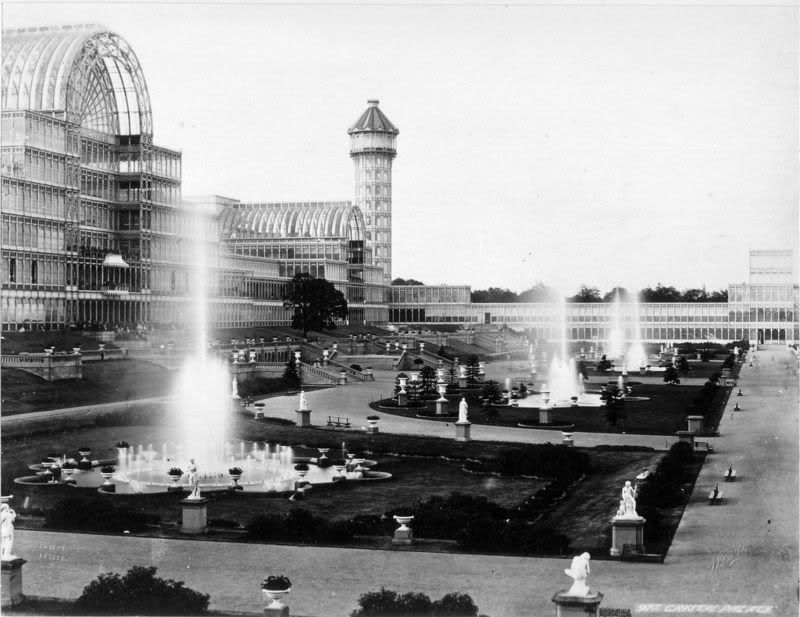
What is happening with the Crystal Palace redevelopment?


A curious press release appeared on Bromley Council’s website on Friday, announcing a £2.4million improvement programme for Crystal Palace Park. Nine projects would be examined and a feasibility study drawn up. The projects included conserving the dinosaurs, conserving the sphinxes and south terrace steps and the Paxton basin. The amount of money is not huge and will not vaguely cover the nine projects listed. But the bigger question is why is Bromley Council spending any money on the park at all when the Chinese ZhongRong group are still in negotiations over a £500million reimagining of Joseph Paxton’s Crystal Palace?

On a sunny, unusually warm day in February this year hundreds of people crammed in to a sweltering, sweaty, room to hear what might become of the park if the ZhongRong group get the go ahead to their ambitious scheme. As I wrote here, it wasn’t particularly informative. Bad-tempered from the beginning, the local community, evidently distrustful of planners and the council after decades of promises and inaction, broadly displayed suspicion towards the scheme, drowning out the few voices of support. Consultants Arup, who led the event, struggled to provide much information at all, as did representatives from Bromley Council and the Mayor of London’s office, who were also in attendance. No one from the ZhongRong was there, or at least made themselves known.

What was clear was a shortlist of six architectural practices had been drawn up with a winner due to be selected by the summer. And while summer has some time to go (hopefully), no winner has yet emerged and the whole grand scheme has been notable for its silence. The notion that an application might be submitted in Autumn this year - and building commencing in Winter 2015 - seems unlikely to say the least.

The delay appears to be within the negotiations between Bromley Council and ZhongRong. They were always going to be somewhat fraught, being, as they are, about selling off a large swathe of a public park to a private venture on a 125-year lease. Some observers have suggested - plausibly enough - that 'ZhongRong are making demands that cannot lawfully be met' but a council spokesman would not be drawn on this. Instead, he insisted that 'negotiations are on going'.

'We are going one stage at a time. The first step was the exclusivity contract. ZhongRong would then develop their plans and negotiations would continue about a land deal. These negotiations are on going.'

And, asked about Bromley Council spending money on restoring land which could be part of the redevelopment according to a map released a few months ago, he said:

'The map of exclusivity doesn't necessarily mean ZhongRong want, or indeed, are going to get, all that area. The idea around that is to get an area of land about which Bromley wouldn't enter into negotiations with other people. It was a way of giving ZhongRong some security.'

And he refused to say whether the timetable was slipping or not.

'We couldn't comment on the timetable. We want to be as open as possible with people about it and will give updates when we can.'

As for the money now being spent, we need to go back to when ZhongRong just made their presence noticed. Bromley Council had submitted an application for Heritage Lottery Funding for the park and it is likely they would have been successful had ZhongRong never appeared. In which case, the HLF would have given a £5million grant towards the park, on top of about £2.4million from the local authority and the Mayor of London's office. This £2.4million is that money.

And they know it is just a drop in the ocean of the funding the park really needs. The £60million masterplan which was halted a few years ago would need be about £100million in today's money, I am told. The council spokesman added: 

'£2.4million won't solve everything. We know that. Is it a step forward? Yes. Will it make a difference? Yes.' 

One wonders whether the ZhongRong plan will be the latest Crystal Palace to fail to materialise; a colourful, flamboyant intervention, backed by an overly-enthusiastic Mayor of London who is searching for vanity projects to create something of a legacy, and a council keen to rid themselves of a troublesome park. We will have to wait and see.

Wednesday, 30 July 2014

The day I was poisoned by my future wife

This following is a true story.

We were going out for dinner. My girlfriend – now wife – works in the charity sector and that evening, more than 12 years ago now, an elderly, doughty, eager volunteer was cooking for us at her home in west London. I had a bit of a sniffle and, fearful I might pass it on to our 90-year-old host, my girlfriend mixed a sachet of Beechams powder in a glass of water, despite my protests that I’d never had the mixture before.

I took a couple of swigs, and put the glass down. 'Disgusting stuff, I’m not drinking any more', I said to the consternation of my girlfriend and her family. We went out, had a couple of glasses of wine, and returned back to her family home, where what appeared to be a committee awaited our arrival.

‘You shouldn’t have Beechams with vodka,’ my girlfriend’s mother said with concern. ‘I didn’t’, I protested. ‘Well, that’s what it tasted like,’ - going on to say she had taken it off her husband who thought he might as well finish it off; waste not want not.

My girlfriend leapt to my defence; she had poured the drink, of course she didn’t use vodka. She used water from a Vittel bottle that was sitting in a bedroom. It was then the reality of what had happened became apparent.

For another family member was a then biology student and one of her tasks was to preserve insects using methanol or wood alcohol, which she had decanted from a larger bottle – marked appropriately – into the much-easier-to-carry Vittel bottle - marked as water - which was left on a side in the bedroom in which she was staying. It was this bottle which my girlfriend used to the mix the Beechams and three of us had managed to drink it.

We all felt fine but rang NHS Direct just in case. The person on the other end was reassuring and thought as long as we kept drinking water there would be no ill-effects, but she rang the poisons unit just in case. Within minutes she rang back and urged us to go to A&E immediately.

It was almost midnight, I think on a Friday night. I remember moaning the last thing I wanted was to have my stomach pumped. A digital display at the A&E at Charing Cross Hospital indicated a wait of about five hours. The woman on reception laughed at what had happened; ‘oh they’ll give you alcohol for that’, she chuckled and told us not to worry about the wait as we were urgent cases who needed to be dealt with. She was right. In minutes we were ushered into rooms and details were being taken down. Alcohol, specifically ethanol, was, indeed, the answer, it turned out. It was explained that essentially, once digested methanol becomes formaldehyde and consumed in sufficient quantities can blind or kill. Ethanol - the sort of alcohol we drink conventionally - basically latches on to the methanol and, comparatively harmlessly, flushes it though the system through the kidneys before it becomes toxic.

So we needed booze and spirits in particular. A bottle of Polish vodka was brought from the freezer at the family home; cupboards, doctors’ drawers, and anywhere else were raided for bottles of spirit; the local off licences had sadly closed.

We were moved to the paediatrics room of the A&E department where we were instructed to drink; from memory, we needed to drink a double every half an hour. We were there for six hours. Elsewhere in A&E, lots of teenagers dressed as school kids came in suffering from various injuries; there was a school disco themed party going on at a club somewhere. Later a man came in with blood caked to one side of his face. He had been mugged. My girlfriend’s mother was now an exceedingly entertaining drunk and invited him to come round for dinner sometime. My girlfriend’s father had to be woken every thirty minutes to have alcohol poured down his throat.

At about 6 or 7am, alcohol drips had finally been located. I rang my parents to tell them what was happening and we were finally taken off to various wards to be cured.

I remember my first proper day in hospital quite fondly. I was drunk. I remember charging around the ward, tugging my drip along, pushing my way into the corridor to make calls on my mobile, much to the annoyance of medical staff. My second day was predictably wretched and my mobile was stolen.

We were all kept on alcohol drips permanently for the entire weekend. The poisons unit – based somewhere else – was closed until Monday and consultants couldn’t be sure we were in the clear until the unit was able to provide confirmation. Ultimately, I was first home after discharging myself on Monday afternoon, keen to get back to work. It was a mistake, I was ill for several more days. 

Thankfully, however, we all recovered fully but I gather we ended up in a medical journal somewhere, no doubt an article explaining how an entire family of apparently intelligent people can be really stupid.


I recount this lengthy tale now as the A&E which may have saved my life and eyesight is set to be replaced. At a meeting of the Imperial College Healthcare NHS Trust, future plans for healthcare in the area were rubberstamped this morning, ignoring protesters outside, among whose numbers included local MP Andy Slaughter.

The A&E at Hammersmith hospital is to be closed and Charing Cross is going to face dramatic change. The plan will see the hospital demolished, 55 per cent of the land sold off to the private sector for development. In its place a local hospital is to be created with an ‘emergency service appropriate’ for such an establishment. No one knows what this means. The local Conservative Party insists the A&E is remaining. This is what Peter Graham, the chairman of Hammersmith Conservatives, told me today:


And in the House of Commons, Jeremy Hunt said recently:

'I have decided that the outcome should be that Ealing and Charing Cross hospitals should continue to offer an A and E service, even if it is a different shape or size from that currently offered.'

And, it is true, it will remain. Until it is demolished. After that, no one can promise anything as that hasn't been decided. Jeremy Hunt's 'different shape' in unknown.

But, what we do know is that the numbers of inpatient beds at Charing Cross will be reduced drastically, from 360 to just 24, and we know it will not be a full, operational A&E unit, as it is now, as it simply will not have the capacity. If another family, in years to come, pitch up after being similarly poisoned, would they be treated? Or, would they be shunted elsewhere, despite the dangers that failing to start treatment swiftly can pose? Currently, it's impossible to know.

It may be that this £400million reorganisation is the best option for people in West London. In their statement, the Trust say:

'Today our Trust board approved plans to transform our healthcare services over the next five years. The clinical strategy considered today is designed to improve clinical outcomes and patient experience, to help people stay as healthy as possible and to increase access to the most effective specialist care.

'While continuing to provide excellent urgent and emergency services, we have to transform the way that we care for the vastly increasing number of people with long-term conditions, such as diabetes or heart disease, and for our growing frail, elderly population.'

It has, nevertheless, provoked huge fury and upset. The campaign to save Charing Cross hospital is very vocal and it was the major issue which led to the Conservative Party losing control of the council at the last local elections, provoking much bitterness and accusations that the Labour Party lied during the campaign.

But, it is, perhaps, the insistence that an A&E will continue there, when it's patently obvious the current service will not continue and a less comprehensive service will appear in its place, that is causing the most frustration of all.

Tuesday, 29 July 2014

Independence 'an opportunity we shouldn't pass up'

The view from Inverness Castle, following the River Ness south
In one of the major streets of Inverness is the Yes campaign office. Prominent with its bright white ‘YES’ on a blue background, it’s hard to miss, and inside, every surface is covered in brochures, leaflets, bowls of badges, piles of car stickers and eager staff wanting to chat to visitors. Almost as significantly, it is positioned right by one of the busiest bus stops in the town. While I’m inside, I can hear people talking about the campaign as they wait for the bus to take them off to work.
‘It’s why we chose this spot,’ a man in the office tells me, ‘it’s fascinating hearing people interact and discuss it [the referendum]’. Seated on the bus stop bench, an elderly woman is chatting to a young tattooed man in a hi-vis jacket; they both seem convinced Yes voters. Inside, a volunteer is collecting badges and literature for a day’s campaigning; it feels like a professional operation yet both are volunteers. It’s a bit of contrast to the No office round the corner, up a street towards the castle, not the back of beyond but lacking comparative footfall. Peering inside earlier, I could see towers full of literature still encased in bubble wrap. On their window, big Yes stickers have been stuck over their slogans. There is something inadequate about the office; perhaps a sense of complacency.

A Yes campaign newspaper
‘They don’t have to persuade anybody,’ the chap in a faded blue shirt inside the Yes office tells me. ‘That’s what we’ve got to do. The No campaign are paying students, and for their accommodation, to distribute their material, we don’t.’ He says it’s well known and noticed around Inverness, but it’s not a claim I can verify at the moment. Inverness, though, is noticeably more pro-independence than the other places I have recently visited. More stickers tagged to bus-stops, posters strapped to lampposts, Saltires painted on guitars.
The guitar belongs to Willie Campbell, who is in town tonight. The musician, once with indie band Astrid – described by the writer Kevin MacNeil as ‘beloved, would’ve-could’ve-should’ve-made-it-massive-band… the greatest pop group the North of Scotland ever produced’ before imploding in ‘rancour’n’remorse’ – is playing at a couple of venues; I catch him at Lauders in Church Street. He performs with verve, singing his own songs, along with a smattering of covers, including a Neil Young number. He’s a very keen supporter of independence.
‘I think this is an enormous opportunity and we shouldn’t pass it up.’ I ask him why he thinks the demand for independence has come now.
‘It started with the creation of the Scottish parliament, and the SNP, slowly getting more and more power and doing well with it. The SNP have gone more left wing, and certainly more so than the government in Westminster.’
He thinks the result will be very close but hopes a late surge from those who haven’t voted before, particularly the young, will swing it towards a yes vote.
‘This is engaging people that are not normally engaged in politics’ he tells me as we chat outside the venue, before he has to dash off to another gig. ‘Hopefully thousands of people who wouldn’t normally vote will turn up.’
And he adds: ‘One thing that really annoys me is people assume that if you are voting Yes, you are voting for Alex Salmond. My hope is after a Yes vote, a strong Labour Party would emerge. That would get my vote.’
The last Labour government ‘were a big disappointment’ he says. It’s a sentiment I hear repeatedly.
A newspaper I picked up in the Inverness Yes office has a ‘Yes’ and ‘No’, what happens next column. The box at the top of the ‘No’ column reads ‘Tory government at Westminster we haven’t voted for’.

Another Tory government the first risk of a No vote, warns literature
‘The Tory party is toxic,’ Doug Haywood, a Radical Independence activist in Aberdeen tells me. ‘Very few people trust a Tory politician. If you tell people a Tory policy, without the brand, they might agree with it, as soon as you add the word Tory, they’re against it.’
Back in the Yes office, the man believes the desire for independence has always been there, but since the creation of the parliament at Holyrood, more and more Scottish people have seen it can be done while at the same time seeing politics in Westminster drift away from what they think is important.'There is still a lot of resentment towards the Thatcher government up here. People like Brown and Darling failed to achieve what people hoped as the Labour Party shifted further and further to the right. And Blair really lost the Labour Party for many up here.' 
And he is another convinced there will be a large surge for yes. ’If you’d asked me a few weeks ago I would have been unsure but now, I'm more confident. It's much closer. Particularly amongst the young, there's a lot of excitement and enthusiasm.'

Saturday, 26 July 2014

Scottish Independence; why now?

‘The Parliament sits in the land because it belongs to the Scottish land…. The building should originate from the sloping base of Arthur’s seat and arrive into the city almost out of the rock.’

This is what Enric Miralles, the architect of the Scottish parliament building in Edinburgh, who died before its completion, said regarding his controversial design. Before me is a terraced landscape. The terraces feature yarrow and other wild flowers (flùraichean fiadhaich), ‘Trapain’ rocks, newly planted pine trees and knapweed. They rise from clumsily manicured lawns, deliberately unkempt, to reflect the wilds of Arthur’s Seat, its base just a few hundred yards away. The parliament building is surrounded by this uncertain landscape, to make the architecture seem as if it were emerging from the indigenous rock. It tries hard to belong to this particular piece of Scottish land. Not everyone thinks the self-consciously rugged building succeeds.

If the Scottish people vote for or against independence on September 18, this building will - thankfully, considering the £414million cost - continue to be the home of Scottish democracy. A few school parties are queuing distractedly, waiting to look inside the parliament building, a pair of dogs are leaping in and out of an ornamental pond; there is the odd officer, but the phalanxes of police you would find in Westminster are not to be seen. It is oddly quiet; the quietest place I’ve yet found in Edinburgh.

For the capital city of Scotland is a city in preparation. Already swarming with tourists and eager fans of the Commonwealth Games, the Festival is just a week away. The City Art Centre is holding a lovely exhibition of the A-Z of Scottish Art, but that is its only attraction, the rest of the gallery a display of ladders, plastic and trolleys, as it readies a new series of exhibitions for the onslaught. Mention of the referendum for Scottish independence, almost 50 days away, is oddly absent, despite the potential for monumental constitutional change.

In the square by the National Galleries of Scotland, rather than stalls competing over the call for independence or unity, several thousand people have gathered instead to demand a Free Palestine, one banner calling for a boycott of the ‘Israeli Calendonian Hotel’ – a somewhat niche campaign, I’d have thought.

The Scottish Government has produced a 650-page document entitled ‘Scotland’s Future: Your Guide to an Independent Scotland’. With a forward by Alex Salmond, it is a very professional piece of work. In Edinburgh’s Central Library, it sits on a table with another document called ‘What Staying in the United Kingdom means for Scotland’. This pamphlet, published by the Westminster government, runs to 12 pages. While both may well make tendentious claims, one appears to be a professionally assembled campaign tome, a defiant call for unity, the other, coming from where a former PR man sits in Downing Street as Prime Minister, is poorer than a student-produced leaflet, flimsy, it appears very likely to find its way to the recycling bin, without anyone bothering to take it into the house.

Also in the library - I imagine - is Gordon Brown’s cogently argued My Scotland, Our Britain: A Future Worth Sharing.  Herein, the former Prime Minister asks, in respect of the demands for independence, a key question: ‘Why now? And why not before?’

It’s a valid question. Scotland doesn’t lack national pride. I know it’s a tourist magnet, but the Royal Mile is awash with shops such as ‘The Scottish Grocer’, ‘Simply Scottish’ and ‘Really Scottish’ which sells kilts ‘Made in Scotland’ in case anyone was worried. Elsewhere, bus seats are decorated in tartan, cafes advertise a ‘Full Scottish Breakfast’ and roads are full of the ‘Traditional Scottish Pub’.  It’s hard to think of an English equivalent; I don’t recall an ‘English Grocer’ though perhaps the traditional English pub has travelled more widely.  There is no lack of national pride; the independence movement cannot be borne out of pent-up nationalism, now free from imperial control.

Yet, according to 'Scotland’s Future', a yes vote ‘will be a resounding statement of national confidence’.

So why now? Is the independence call a result of a supremely canny politician in Alex Salmond, armed with a vigorous campaign team and capitalising on anti-English and specifically anti-Tory and anti-New Labour sentiment? Or are there genuine grievances, borne out of political ostracism, or Scotland’s huge deindustrialisation and deunionisation over the last 40 years, or even the Church of Scotland’s loss of influence? Is it a search for a new identity or a resurgence of an old one? Is it not enough to have a devolved parliament, health service, education and legal structure? Does Scotland, already a nation, now deserve and need, albeit with caveats - wishing to retain the pound and the Queen - statehood?

I don't have a vote in this referendum, but we may be on the cusp of momentous change, for every part of the Great Britain. Hopefully, after spending a few days travelling through several major cities in Scotland, I might find some answers.

Wednesday, 9 July 2014

The Trouble about Turnouts

A handful of case studies:


Robert Jenrick
Deftly puncturing the unrealistically high hopes of UKIP, Robert Jenrick was the most recent Conservative MP to be elected, at the Newark by-election on June 5th. He now has a majority of 7,403 but, despite this apparent endorsement, he only gained 45 per cent support from a turnout of just under 53 per cent, unusually high for a by-election; he was backed by a little over 24 per cent of those eligible to vote. Hardly a ringing endorsement.

At the last General Election, the constituency with the highest turnout was Renfrewshire East, where Jim Murphy was returned for the fourth occasion. More than 77 per cent of the electorate turned out and the shadow Secretary of State for international development got more than 50 per cent of votes cast. Overall though, he still hadn’t received the backing of more than 40 per cent of the total of those allowed to cast a vote.

And in Witney, Prime Minister David Cameron may have got 58.8 per cent of the support of those who voted, but still only had the endorsement of just over 43 per cent of the all the constituency's voters.

No local councillor has anything like the support of an MP. At the local elections in 2014, national turnout was about 36 per cent and could be horribly low in some extreme cases; a pitiful 13.86 of the electorate bothered to vote in the Liverpool Central Ward.

Turnout for elections for the government’s recent gimmick of Police and Crime Commissioners was pathetic. National 36 million people could express their opinion; in November 2012, just 15.1 per cent of people took time to do so.

All this leads us to the thorny issue of strikes. According to the Morning Star ‘millions’ of people could strike on July 10 when five unions, the members of the National Union of Teachers, Unison, GMB, the PCS and Unite are all playing to take to the streets and ‘challenge Con-Dem pay cuts’. It may not, ultimately, be millions who take to the streets, but there will be a sizable protest against the coalition government's pay restraint which means the vast majority of public sector workers are going to see their pay rises pegged to a meagre one per cent a year until 2018 at least.

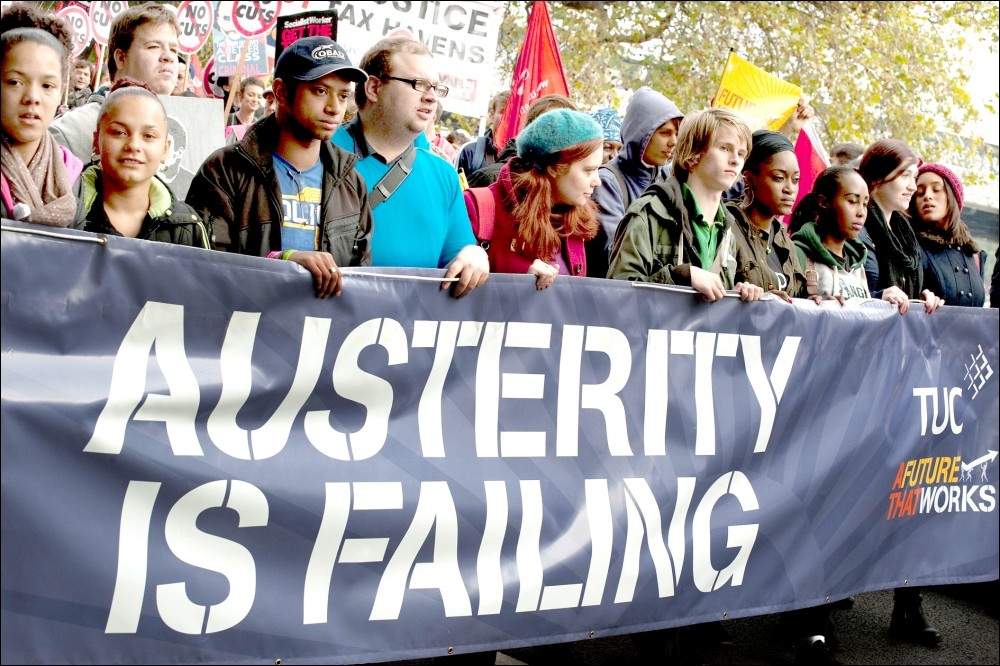
Anti-austerity campaigners on October 20, 2012. Photo: Paul Mattsson
Disruption will be widespread. Teachers, NHS staff, workers in job centres and benefits officers, staff in tax and passport offices, passport controls, immigration, museums and galleries, crown courts, country courts, magistrates and civilian staff in police stations; all will be taking to the streets after successful strike ballots by their unions. Yet in none of these ballots was there a turnout of more than 50 per cent. It is, therefore, very easy to see the simple political attraction of curbing such a demonstration by introducing a turnout threshold, ruling invalid any ballot that failed to reach the required level.

Today, at the final Prime Minister's Questions before MPs go off on their Summer Recess, David Cameron said this:

'I don't think these strikes are right... I think people should turn up for work. I think the time has come for looking at setting thresholds in strike ballots... The NUT strike ballot took place in 2012, based on a 27 per cent turnout.

'How can it possibly be right for our children's education to be disrupted by trade unions acting in that way? It is time to legislate and it will be in the Conservative manifesto.'

It is fairly clear what his intention is then and it is probably a measure which will get widespread support from those who think strikes are an unpleasant disruption which have no place in modern society. But glossing over this and the rather fundamental role protest has in a free society, introducing a turnout threshold of, say, 50 per cent - as suggested by Mayor of London Boris Johnson (himself elected with 51.53% of the vote on a 38.1 per cent turnout) - threatens to undermine further the authority of any elected figure and could well backfire.

Voting for a politician is so much easier than taking part in a strike ballot. Polling stations abound and it is not even necessary to carry your polling card when you do pitch up to mark your ballot paper. The organised can rely on postal ballots. Yet, despite, the lack of inconvenience, so many, disillusioned, disaffected, utterly fed up with all of the above, simply don't bother. As said above, the 53 per cent turnout in the Newark by-election was unusually high, buoyed by eager, naive, competition from UKIP. The turnout in Manchester Central in 2012 was just 18.2 per cent and they normally hover around in the thirties - this table shows the turnouts of every by-election since 1997.

Strike ballots, on the other hand, are only held through the postal system, a tactic, introduced under Margaret Thatcher, itself designed to reduce turnout and undermine credibility. It is not possible to turn up to your place of work, put it a cross in a box and put it in a ballot box. No one is suggesting making it easier for strike ballots to be held.

Already, the reputation of politicians could hardly be lower but, by forcing through such a change, they will leave themselves open to the very damaging charge that they deserve a more flexible, and frequently lower, level of democratic support than everyone else; one rule for Robert Jenrick, Boris Johnson, all those councillors and PCCs and another for teachers, nurses and basic state workers struggling on some of the lowest wages in the country.