Showing posts with label Tony Blair. Show all posts

Wednesday, 17 September 2014

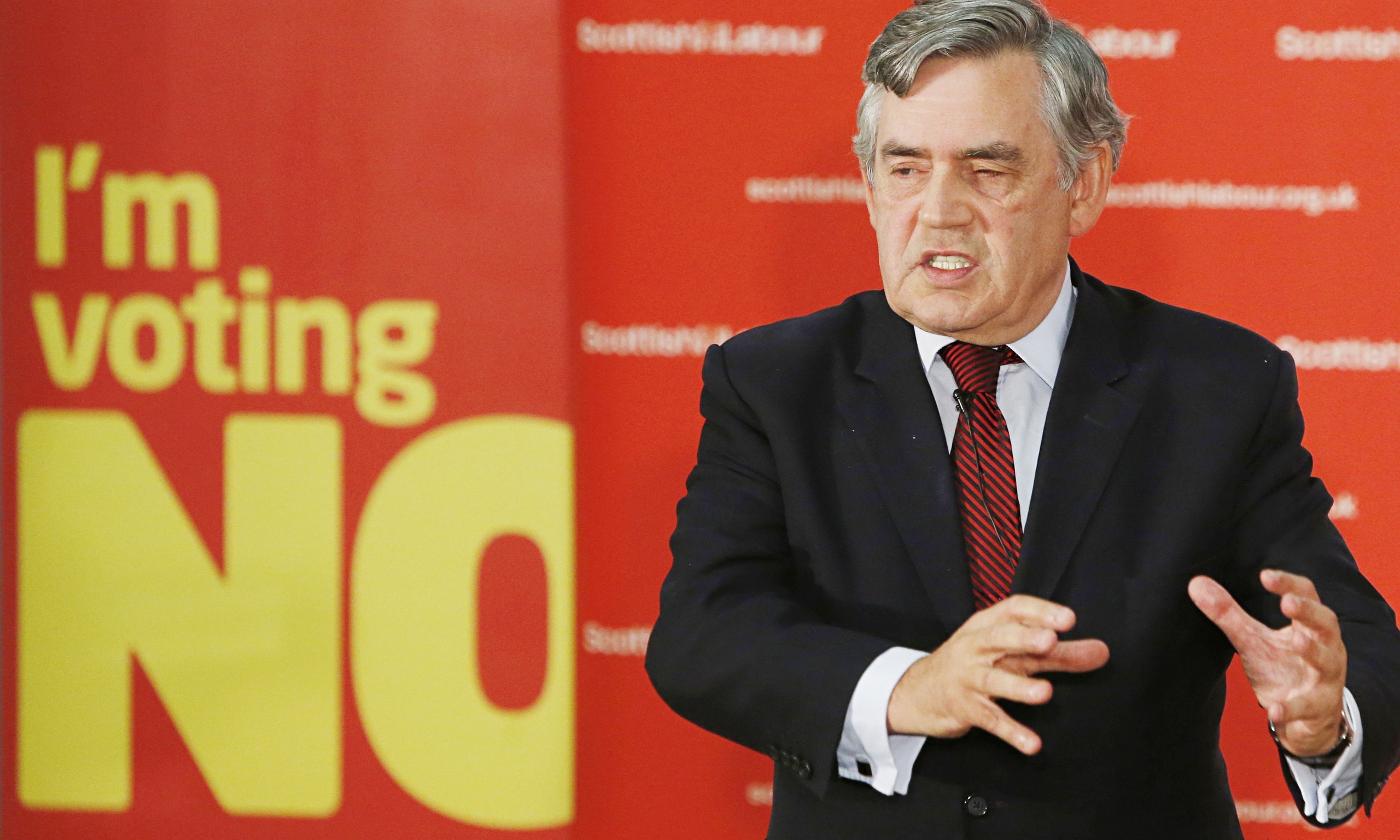
Brown delivers the speech of his life


Tony Blair is Scottish. He was born in Edinburgh, the grandson of an Orangeman and butcher, and went to school  at the prestigious Fettes College in the Scottish capital. This former prime minister hasn’t stayed silent on the independence debate referendum, saying just on Saturday that a Yes vote would ‘not be sensible, politically, economically or even emotionally’. It is not the sort of comment which is likely to endear him to any Scots and unlikely to sway any wavering voters. Which is why he hasn’t been allowed to be anywhere near the Better Together campaign, he is probably only second to Margaret Thatcher in the Most-Disliked-Politician-in-Scotland table.

All of this is in stark contrast to Gordon Brown. The conventional wisdom has written the former prime minister off portraying him as a dour, glowering figure, sulking in Kirkcaldy and rarely venturing into the House of Commons despite still being an MP. But the political biographies will have to be rewritten, especially, as seems increasingly likely, the No vote finally comes on top. It is probably too strong to say that a No win would be down to Gordon Brown’s impact, but it is undoubtedly true that the introduction of this true political heavyweight into the debate has shifted the balance.

Up and down the country, Brown has been speaking without notes, fluently and powerfully addressing rallies, galvanising the No campaign. Yes, it has basically been the same speech over and over again, with the same jokes about football failures, the same invocations of historical Scottish figures, the same warnings of the risks of voting for independence. But, regardless of the politics, it is a good, well-crafted speech. And the more Brown has given it, the better it has got, culminating with his appearance at Mayhill Community Central Hall, in Glasgow this morning (Wednesday, September 17). Prowling like a caged lion, his arms enthusiastically enacting the sentences as he spoke, the Kirkcaldy MP delivered one of the finest oratorical performances of our lifetime.  Oddly, though the contents of the speech are of course, important, the sheer style, and panache of the performance, means that one could disagree with every word and still come to the same conclusion.

Of course, Blair knew how to deliver a good speech. He could be fluent, funny, self-deprecating, confrontational and passionate; but ultimately, with Blair, one never knew if he, himself, actually believed what he was saying. With Brown today, though, there is no doubt that it came from the heart, the words almost erupting from within like an unstoppable force. Barack Obama, on his day possibly the English language’s finest orator, often gets compared to a preacher and Brown too, delivered his speech like an archetypal Scottish minister –he is the son of one, of course –  and it was after almighty crescendo that he bellowed the biblical line ‘what we have built together, let no nationalism put asunder’. (In the actual printed version of the speech, attached below, Brown apparently says 'Nationalist' at this point; 'Nationalism', which he said, works better).

It is something when grizzled hacks from the Daily Mail and The Sun can do no more than acknowledge the mastery of Gordon Brown’s oratorical skill. Brown has always been a powerful speaker, though his message was frequently dulled by power and his tactic of repeating the mantra of the day over and over again. In the context of a tightly fought referendum, this was the best speech of Brown's career.

There is no doubt Gordon Brown has shaken the No campaign from its complacency, appearing just as panic was setting in after an opinion poll gave Yes a narrow lead. He has injected it with energy and provided it with what it has desperately needed, a positive message in favour of the union, simultaneously celebrating Scottish identity and British identity – much of this can also be found in his book My Scotland, Our Britain. 

But, despite its undeniable power, will Brown’s contribution sway any votes? He left Downing Street after a tumultuous few years, the country reeling from an economic storm, his reputation severely damaged. But, still, possibly. In such a tight election, for the No campaign to win, it only needs a few votes to swing from one side to another and it could well help make the mind up of wavering voters. With this grand oratorical flourish, Gordon Brown could yet confound the political rule book and show that all political careers do not necessarily have to end in failure.

*The full text of the speech can be found here.

Tuesday, 9 September 2014

Gordon Brown; the Unionist's final throw of the dice?


When David Cameron was finally able to evict the ‘squatter holed up’ in Downing Street after the General Election in 2010, he must have thought he wouldn’t have worry about Gordon Brown again. The irony, therefore, that the Prime Minister is trusting his one-time opponent basically to lead the final stages of the battle to keep the union together must be painful indeed. Any personal animosity has, for now, been swept aside.

It is hard to conclude that the MP for Kirkcaldy’s intervention, pledging an array of devolved powers to Scotland, was anything other than an act of desperation. All three major Westminster parties have pledged their support for this package of constitutional reform, regardless of whether there has been any consultation with voters about what exactly they want. Moreover, while the reforms are apparently exclusively Scottish, it will rapidly prove to be an impossible position to maintain; Wales and Northern Ireland would certainly want something similar and regions, Cornwall, the North East, Yorkshire, will clamour for reform. Nick Clegg has already acknowledged this, saying further devolution in Scotland will:

'signal a much wider rewiring of the governance and constitutional arrangements in the country as a whole, particularly governance within England which remains an unusually over-centralised country'.

Hence, regardless of whether Scotland votes yes or not, Britain is on the cusp of potentially huge, and rushed, constitutional change.

Brown has been thrust into the limelight at this late stage as even his opponents are recognising that, despite his pretty disastrous time as prime minister, he remains the equivalent of Heineken; he can reach voters other pro-Union political figures just can’t reach. Messrs Cameron, Miliband and Clegg have cancelled their appearance Prime Ministers’ Questions to head to Scotland and campaign for a No vote, but their presence is, if anything, a boost to the Yes campaign. Alex Salmond said today: ‘The message of this extraordinary, last minute reaction is that the Westminster elite are in a state of absolute panic as the ground in Scotland shifts under their feet.’ The farcical scenes around the country of the Saltire being raised above town halls and even Downing Street, as if such an act would swing a floating voter, rather gives credence to the SNP leader’s view.

The toxicity of the Tories in Scotland cannot be underestimated; in my recent trip up there the venom reserved for Mrs Thatcher was still fresh and vivid. In many ways, the imposition of the 'Bedroom Tax', though applicable nationally, echoes the hated Poll Tax. Hence, One of the SNP’s strongest lines, repeated over and over again, is voting for independence is the only way Scotland can avoid ever having to endure a Conservative government again, conveniently forgetting that the Tories haven’t won an election since 1992 and, in parliamentary terms, remain virtually wiped out north of the border.

Ed Miliband has been inept, unable to harness the millions of Labour voters the party is normally able to rely upon; the Labour Party’s brand has been damaged by Alex Salmond constantly calling them the allies of the Tories. Such a comment would make any Labour voter in England bristle with irritation but it will still carry power. Labour's recent time in office also does them few favours too. While it may have established the Scottish parliament, paving the way for the situation we have today, the party, particularly under Tony Blair, shifted to the right, no longer recognisable to many.

And Clegg? As it is his party keeping the Conservatives in power, thus enabling unpopular measures such as the ‘Bedroom Tax’, he will struggle to find a sympathetic ear.

Gordon Brown will be seen every day between now and the referendum. Yesterday, he spoke without notes, with power, passion and fluency – Cameron’s advisers would have raved at such a performance. It was an echo of the early speeches Brown made before he was rendered thumpingly dull by the process of power.

Much of the contents echoed his book My Scotland, Our Britain, the best, most positive, pro-Union argument I have yet read, where he explains how it is possible to a both proud Scot and a proud Briton. And it recognises how the debate is one of economics and politics as well as an issue of the heart. And the former Labour prime minister may yet still win the day for the Union cause. Combined with the potential for constitutional change, we are faced with the prospect of a quirky historical twist that Gordon Brown could achieve something more long lasting and profound as a backbench Kirkcaldy MP than he ever did as Prime Minister.

UPDATE

It hasn't taken long for politicians from England's regions to start calling for extra powers to be devolved. Andrew George, MP, for St Ives, tells the Western Morning News:

'All parties now acknowledge the benefits and opportunities of allowing the nations and the regions of the UK to manage their public services and shape their futures whilst releasing themselves from the dead hand of micromanagement from Whitehall.

'If Scotland and Wales can be offered further powers then Cornwall must be next in line. After all, Cornwall is already recognised as a distinct region for economic development purposes, as a separate people and for its distinct language.

'After all, who is best-placed to decide how Cornwall's housing stock and development plans are best managed? Inspectors in Whitehall or democratically elected representatives in Cornwall?

'Who is best-placed to manage Cornwall's health and social care? Health managers in Whitehall and Leeds or the people, patients and clinicians of Cornwall?

'Who is best-placed to decide ho Cornwall's economic development aid is spent? Ministers and mandarins in Whitehall or the business leaders, workers and elected representatives of Cornwall?'

The full article can be found here.