Showing posts with label Enterprise. Show all posts

Thursday, 27 March 2014

Will a penny off a pint save the British pub?

Despite strenuous efforts, I have yet to find a publican who has lopped off 1p from the price of a pint of beer following George Osborne’s announcement in the budget last week.

This is surely strange; after all, coalition ministers have been shouting quite a lot about this. Grant Shapps, in the poster of his now infamous tweet, boasted that ‘Cutting the Bingo Tax & Beer duty’ was helping ‘hardworking people do more of the things they enjoy’. And Conservative MP Andrew Griffiths – who represents, some believe with painful irony, Burton, the home of British brewing – has been especially excited, proclaiming the cut proves ‘this is the most beer and pub-friendly government we have seen in a generation’.

Mr Griffiths wrote effervescently about what the chancellor had done in the Publicans’ Morning Advertiser:

‘Last year’s decision to cut a penny off the price of a pint of beer was the first such decision by a chancellor since 1959. Yet it was the decision to scrap Labour’s hated beer-duty escalator that really made the difference to the industry.

‘Ending the year on year ratcheting up of a beer duty, a system which saw it rocket 48% between 2008 and 2012, ended the misery of a system which was bleeding the beer industry dry.

‘The more optimistic of us hoped and campaigned for a freeze in this year’s Budget, but not many expected an historic successive second cut. This of course was followed by scrapping of the alcohol duty escalator, and freezes for Scottish whisky and real cider.

'All in all, this was a beer and pub budget that the whole industry should be thrilled with.’

And Mr Griffiths hasn't held back on Twitter either.


And here he is below, clearly exemplifying responsible drinking:


Now let's not be churlish. It is of course welcome that the government has felt able to make any cut in the price of a pint of beer, especially as drinkers are increasingly lucky to get change from a fiver when buying a pint in the capital these days.

But for anyone to suggest this is the great rescue of the pub trade is, frankly, not taking the issue seriously.

Recent figures from CAMRA suggested the number of pubs closing each week had risen to 28 per week and while many in the pub trade are pleased with the price cut, they have wasted no time in pointing out the government's inaction - despite repeated promises - in tackling pubco reform - offering tenants a chance for a fair rent and an end to the system which sees them hit by high rent costs and high beer costs. Posters such as the one below have quickly appeared:
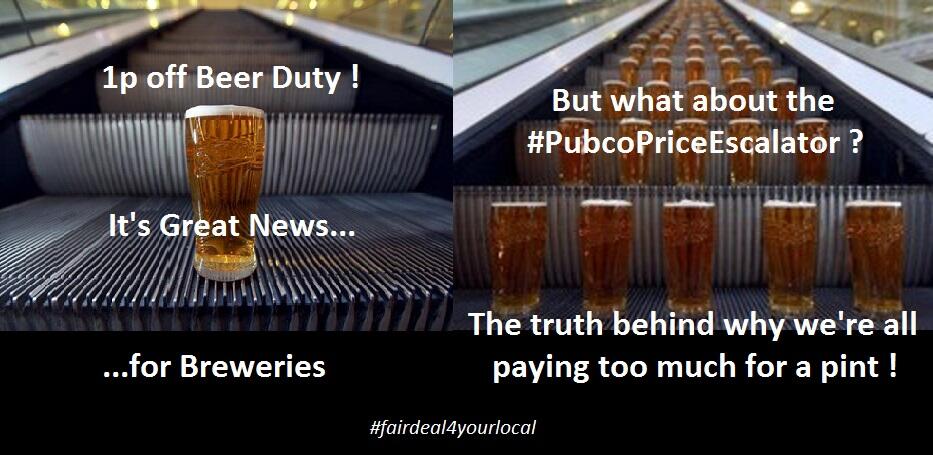


Simply nothing has happened. There has been no response to the government's consultation on the issue (for more on this delay see here) and it seems likely such reform has been blocked at a high cabinet level and nothing will happen this side of an election. It's worth noting Andrew Griffiths, a self-styled champion of pubs, is curiously opposed to any such reform.

And, in a timely fashion, the latest figure to get involved in the issue is the not insubstantial figure of Tim Martin, the founder of the Wetherspoon's chain. In his company magazine, he writes: 'The main additional reason for pub distress is the high level of debt assumed by some pub companies in the years running up to the credit crunch.' And he names financiers Guy Hands and Hugh Osmond of being the architects of this 'unsustainable', damaging model.

'In essence, Hands and Osmond bought large tenanted pub estates of the major brewers, using borrowed money, and then hiked up the rents and the beer prices paid by the tenants. As a result of the increased income which they generated, they were able, in effect, to remortgage pubs, extracting tens of millions of "profit" for themselves.'

Companies like Enterprise Inns and Punch Taverns were the successors to this and they continued using the same model. Tim Martin goes on:

'When the individual licensees/tenants started to suffer between the hammer of high rents and beer prices and the anvil of tax-subsidised supermarkets, unprecedented numbers of publicans went bankrupt - and the Enterprise and Punch shares plummeted on the stock market to a fraction of their former value.'

And while pub titans old and new, such as Hands, Osmond and Enterprise's former chief Ted Tuppen have showed little sympathy to the 'plight of the tenants', they have been vociferous in their complaints about high personal taxes, specifically Labour's plan to increase the top rate of income tax back up to 50 per cent should they regain power. He concludes, with restrained fury:

'There is a justifiable argument for a reasonable top rate of tax which encourages hard work - Britain did not benefit from the Rolling Stones hiding from the taxman in the south of France in the 1970s. However the disregard of the financial engineers for the plight of their tenants and their egocentric concentration on their own positions, dressed up as national concern, might even have caused Maggie Thatcher to side with Ed Balls.'

So while the government tinkers around the margins, fiddling ineffectively with beer prices, it continues to ignore the hugely damaging pubco model, something which all, but the most stubborn, now recognise needs tackling with urgency. Until the government belatedly takes action, their claims of being the publican's - and the beer drinker's  - friend will largely fall on sceptical and deaf ears.

Tim Martin's full article can be read here.

Tuesday, 26 November 2013

Pub closure figures; a brief return

‘Free-of-tie pubs are closing at a faster rate than tied pubs. That is evidence. It is real evidence. It comes out of a number of surveys taken over a whole period of years’

This is what Brigid Simmonds, chief executive of the British Beer and Pub Association, told the Business, Innovation and Skills committee in June earlier this year (see question 53). As I waded through the immense volume of information regarding pubcos and the campaign for reform, it was a claim which always struck me as slightly odd. I couldn’t work out how it quite added up. After all, the numbers of independent pubs reached more than 20,000 in 2012, up 1600 in ten years, as more than 10,000 pubs closed in the same period. How could the sector be growing while shrinking faster than pubcos?

Well, it turns out, the reason is quite clear; according to a new report published last week, it simply isn’t the case.

Pub Closures: the truth, published by the All Party Parliamentary Group last week, pretty compellingly shows how the leased/tenanted sector has seen many more pubs close than those of independent freehouses. It’s quite a significant detail as it counters what has been a core argument against pubco reform.

The figures upon which the BBPA rely are, it seems, CGA figures, which don’t actually track the closure of pubs at all but seek to ‘provide brand owners (and other suppliers to the on trade) with an up-to-date and accurate database of all currently trading on trade outlets’.

But according to those figures, the numbers of independent, free-of-tie pubs which closed between December 2005 and March 2014 is 2,131 pubs, while 5,117 'non-managed pubs' (mainly leased and tenanted) closed in the same period. 

The figures also omit the numbers of pubs which temporarily close following the failure of a licensee, but subsequently reopen under new management within a couple of weeks. This process is known as 'churn' and it simply isn't acknowledged in the CGA figures. So, for example, had The Alma reopened under new management, the failure of Kirsty Valentine's tenureship there simply wouldn't be acknowledged.

According to the report, in leaked figures from Punch Taverns, 'around a third of their pubs would churn in a year'. The report quotes a similar figure for Enterprise Inns.

And, oddly, the figures I quote at the top about the proportion of oubs which are free and independent or tied and managed are from the BBPA itself. So quite how does Brigid Simmonds justifies her statements to the BIS committee, I'm not really clear. 

The MP's report is unsurprisingly scathing in its conclusions:

'It is clear that the reality of trends in the pub sector, particularly where the main problem lies, has been misinterpreted by, or misrepresented to, a succession of government and parliamentary bodies, the Office of Fair Trading, select committees and Business, Innovations and Skills department have regularly quote, and relied upon, data which purports to represent the picture of pub closures.'

And the report ends with a plea to Vince Cable, who has been noticeable by his silence on this issue recently:

'Not only the BBPA myth based on misrepresentation of the CGA figures no longer a reason not to introduce the much needed statutory code with the all important market rent only option in it - but the clear and real evidence of pub ownership trends, pubco disposal figures and documented churn are all key reasons why BIS MUST (the report's emphasis) now do this.'

It is no surprise to see the BBPA are reacting rigorously against the report, eager to refute any suggestion they are spinning the figures or misleading the committee.


A piece in the Publican’s Morning Advertiser published this morning (November 26) said the BBPA was trying to correct ‘false and misleading’ statements about their interpretation of pub closure figures, adding that they would write to the BIS committee to ‘set out the facts’. Their rebuttal includes the lines: 'The accusation that the BBPA claims the free-of-tie sector has seen many more net closures is false' and 'Tied pubs are closing in larger numbers than free-of-tie pubs'. The full piece can be found here.

Meanwhile, I've noticed a new Twitter handle has appeared for The Alma. @TheAlma_N1 appeared over the last few days and has announced that the Stoke Newington pub will be reopening soon. Inevitably, the supporters of the previous landlady will have mixed feelings about this development. But, the new tenant is blameless for the situation in which Kirsty Valentine finds herself and an open pub is better than a closed pub.

Friday, 8 November 2013

The last moments of The Alma


Kirsty Valentine outside The Alma on eviction day

It’s 9.20am on a Friday morning and the Alma pub, recently crowned as North London Cider pub of the year by Camra, is busy. It isn’t open. The only drinks being consumed are tea and coffee. Everyone there, locals, friends and supporters, local MP Jeremy Corbyn, writer Pete Brown, are not there to toast landlady’s Kirsty Valentine’s success, but to be with her and offer support as bailiffs are expected at any moment to turf her out.


It’s the culmination of four years of fighting with owners, Enterprise Inns, the pub company (pubco) which own the pub. Kirsty has vigorously campaigned to reduce the rent, claiming it was impossible for her to make decent standard of living; conversely Enterprise claim they have tried to help find a solution.


But the time for negotiation ended on Thursday when Kirsty lost in court.


At 9.30, a representative from Enterprise is standing outside the locked doors of the pub with a man in a hi-vis jacket; he’s the man who will fix shutters to the doors and windows when the bailiff arrives.
Enterprise representative, plus 'shutters man' arrive


A locksmith appears. He looks somewhat surprised at the sight inside. ‘I was told this was a non-confrontational job, look at ‘em. There’s dozens in there. No one wants to lose their local.’ He speaks in a friendly manner, with an energetic, north-London ‘geezer’ accent.


When he does arrive, the bailiff is quiet, evidently keen not to be drawn into a confrontation. Still, two police officers pull up in a marked car, there to ensure there is no breach of the peace. Inside the pub, Kirsty is locked in conversations with lawyers trying desperately to come up with a last minute offer which might satisfy Enterprise’s demands. I’m told that Enterprise have said they will not accept any offer and just want her out (Enterprise dispute this).


Just after ten, the bailiff and Kirsty go to a back room of the pub to discuss matters. It’s agreed that they will leave the pub; there is no need for police, and bags of possessions, heaped on the floor start to be taken out.


With tears welling up, Kirsty goes behind the bar one final time and beckons her supporters to come and join her. They line up and hug; one final act of defiance before becoming a statistic, one of the 26 pubs which shut every week. The Alma is now closed.
Kirsty goes behind the bar one final time


________________________________________________


Enterprise insist they are very keen to reopen The Alma as soon as possible, countering fears that it could become a block of flats or a supermarket. In a statement, the company describe the Newington Green site as ‘a great pub with a fantastic community spirit and we want it to continue to thrive’. They also claim that the dispute actually is ‘a clear example where the tied pub model…. has provided extraordinary levels of support, flexibility and ultimately direct financial assistance to a tenant'.

They add: ‘Regrettably therefore, we have been left with no alternative but to revoke her tenancy and will seek to put in place a new operator as soon as possible.’


As for Kirsty, she has lost her home – she lived above the pub – her business and livelihood – ‘they’ve wiped me out in 12 hours’ she says. Friends have rallied round and offered her places to stay while she continues her next move.


‘I can’t even begin to consider anything much because I’m just so, I’m just in shock. It’s a mixture of shock and relief that it’s finally all over.'

As for whether she will return to the pub trade, she is very unsure.

'I need to go away and sit in the corner for a very long time and contemplate things.'

But considering the tumultuous events of the day, she sounds remarkably chipper and stoical; buoyed by the impressive support during her final moments at the pub.

'I was so thrilled, it's made it so much easier to deal with. For many many months, I have wondered what his moment would feel like that and it's nothing like my greatest fears.I don't feel ashamed and I don't feel embarrassed. I feel extremely proud and honoured that everyone stuck by my side. I'm extremely proud I'm going out with my head held high. My staff are very loyal and are extremely upset. It's a very sad day, but at the same token it's made it very much easier to know I'm very loved and respected.'

For more background on the argument between publicans and pubcos, and the campaign for pubco reform, visit here.

Note - for legal reasons any comments left under this piece will be treated with particular caution. Thanks