Showing posts with label Ed Miliband. Show all posts

Wednesday, 5 October 2016

Theresa May; the red and purple Tory PM

Has a prime minister ever had such an opportunity to seize and control the political narrative as Theresa May does currently?

Sure, Margaret Thatcher dominated the political weather of her era but she came pre-loaded with a free market ideology which she applied, with more pragmatism than is remembered, during her time in office. And, of course, Blair swept all aside in his climb to power but, despite the country crying out for a change after 18 years of Conservative rule, he was timid in ambition, still fearful of electoral defeat.

Theresa May, though, is an accidental prime minister and already a lucky one. She is unencumbered by the baggage gathered by David Cameron after a decade of leading his party, emboldened by a Labour Party which seems content for now to wallow in protest populism, meanwhile Ukip seems to be permanently locked in petty, internecine battles. May - who was something of a Teflon-coated Home Secretary - is left clutching a broad, blank, canvas upon which she can paint her own vision for the Conservative Party and the country.

And so, we have her first major keynote speech at a Conservative Party conference as prime minister. Broadly speaking, it was a very successful, clever, speech. Much of it could have been written and said by Ed Miliband, bulked up with a few additions from Nigel Farage, though most of his script had been left with Home Secretary Amber Rudd a day previously. Delivered without fuss from a lectern, Ms May didn't feel the need to display any flashy skills. She didn't take a suit jacket off to show she means business, or memorise the whole speech in an attempt to display her oratorical prowess. Down to earth, unfussy and practical, getting on with the job; that was the message.

While many still struggle to come to terms with the result of the Brexit referendum on June 23rd, Ms May described it as being a symptom of wider issues within society. The vote to leave was about a broader vote for change, 'about a sense - deep, profound and let's face it often justified - that many people have today that the world works well for a privileged few, but not for them'. She went on:

'Our society should work for everyone, but if you can't afford to get on to the property ladder, or your child is stuck in a bad school, it doesn't feel like it's working for you. Our economy should work for everyone, but if your pay has stagnated for several years in a row and fixed items of spending keep going up, it doesn't feel like it's working for you. Our democracy should work for everyone, but if you've been trying to say things need to change for years and your complaints fall on deaf ears, it doesn't feel like it's working for you. And the roots of the revolution run deep. because it wasn't the wealthy who made the biggest sacrifices after the financial crash. but ordinary, working class families.'

Compare and contrast with what Ed Miliband had to say in his conference speech in 2014.

'You see, for all the sound and fury in England, Scotland, Wales, across the United Kingdom, what people are actually saying to us is this country doesn't care about me. Our politics doesn't listen. our economy doesn't work and they're not wrong, they're right....

'Prosperity in one part of Britain, amongst a small elite. A circle that is closed to most, blind to the concerns of people. Sending the message to everyone but a few: you're on your own. See, think about it for a minute. In our economy, it's working people who are made to bear the burden of anxiety, precariousness and insecurity.'

All three paragraphs could easily have come from the same speech. But, while Ed Miliband suffered a humiliating defeat at the last general election, Theresa May is Prime Minister and received a standing ovation. She is busy taking Labour's clothes.

Corbyn himself recognises this. In his own conference speech, he acknowledged that Ms May knew there was a need for change:


The problem Labour and Corbyn faces, though, is that it currently isn't seen as a viable alternative for government. With that in mind, Corbyn is fortunate that Theresa May has ended speculation that she might call an early election for if she did, it seems fairly certain she would be rewarded with an enlarged parliamentary majority. 

Ms May currently faces bigger challenges from within her own party than the official opposition. Many Tory MPs object to the expansion of grammar schools.  There is a cohort of disgruntled Remainers. And the balance of the House of Lords is also still stacked against the Conservative Party. But all this could change. 

The Prime Minister acknowledges that the whole Brexit process will be a 'bumpy' road, the Conservative Party is still split over what Brexit actually means, and if the economy does indeed struggle as many experts fear, it will be this government that is blamed. Moreover, if her fine words remain just fine words and little effort is made to actually seize the centre ground, this will be noticed and Labour could still return there.

The Labour leader has been dismissed many times but he has weathered an almighty battering. It may be hard to imagine now, but, there is no doubt that Jeremy Corbyn has galvanised a movement behind him. Many may not recognise it as the Labour Party they have known for decades, but it is huge in number, over half a million in strength, and could still prove a formidable election fighting machine. The next election, however, remains Theresa May's to lose.

Wednesday, 29 October 2014

Politics should rise above playground abuse

Eric Pickles is not a slim man, you may have noticed, and he has long been subjected to the familiar jeers of the ‘who ate all the pies?’ sort - in this, he is a successor to John Prescott. Ed Balls is afflicted by a stammer – it is, for example, ‘impossible’ for him to start a sentence with an H. It is largely kept under control but it has emerged at a few moments, ruining high profile appearances in the House of Commons and prompting mockery.

Ed Miliband can appear socially awkward and seems unable to eat a bacon sandwich in public without pulling a face which looks as though he has swallowed a particularly energetic wasp, much to the amusement of many. Gordon Brown is Scottish and blind in one eye, justifying the charmless Jeremy Clarkson’s description of him as a ‘one-eyed Scottish idiot’.

Picking on such characteristics, over which people have little control, reflects the standard pattern of primary school bullying. In such circumstances it may provoke guffaws amongst a bully’s peers, laughter amongst a gaggle of skinny teenagers on a chilly, windswept sports pitch; but by the time most of us reach the sixth-form and the junior common room, it is those slinging such abuse who look like the idiot. But in politics, pitifully, this bullying remains a daily feature of the soap opera.

For all the high profile and worthy campaigns against bullying, it sadly seems increasingly to invade public life and appear as a form of entertainment. A couple of weeks ago The Apprentice returned to our television, expanded to include 20 candidates, all - probably deliberately - selected for their ability to behave with competing ghastliness. The seam running through the show seems to be bullying, the wannabes competing viciously between each other while Alan Sugar barks nastily from above. Perhaps the absence of this mean streak made The Great British Bake-Off such a success.

There is, of course, a rich history of clever, acid – and frequently rude – barbs being flung across the chamber of the House of Commons but it is too easy to look back with rose-tinted spectacles and paint politicians of the past as master orators, always ready with a cleverly constructed aside. Few will forget the hitherto mild-mannered, 'dead sheep', Geoffrey Howe bringing out his rapier and sticking it into his colleague and boss with such vigour.  For every perfectly judged quip, such as when Michael Foot said of Norman Tebbit, ‘It is not necessary that every time he rises he should give his famous imitation of a semi-house-trained polecat’, there was a Tony Banks. The late, former Sports Minister, once dismissed Margaret Thatcher as a ‘half-mad old bag lady’ and said, when Hague became Conservative leader, they had ‘elected a foetus as the party leader’, adding ‘I bet a lot of them wish they had not voted against abortion now’. 

We can look much further back into our political record. Lord Kenneth Baker, who held several cabinet posts under Margaret Thatcher, is a great enthusiast of political caricature, which has a long, venerable, and excoriating, history. He is a trustee of The Cartoon Museum and collects 18th century cartoons, recognising the importance of works by the likes of James Gillray and Thomas Rowlandson. These artists could be particularly vicious, never shy of focusing on a public figure's physical defects if it suited them. Gillray reserved special scorn for the Whig politician Charles James Fox, who often appeared, gruesomely, in his works:


Charles James Fox sharing a chamber pot with Lord North (a modern twist of this can be found here)
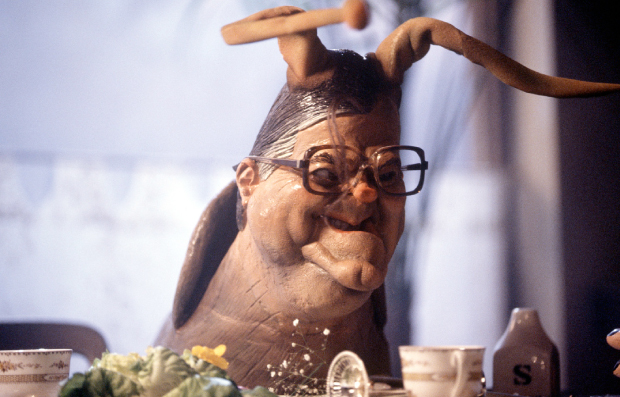
Baker himself, wasn't spared. Inspired, perhaps, by his oleaginous image, he was transmogrified into a slug by the Spitting Image team, though it was his decision to douse himself liberally with hair oil.


At what point does a clever - if deadly - political putdown become school-boy nastiness? Footballers are constantly reminded that they are role models and what they do on the football pitch is replicated up and down the country. Spit excessively, and children playing footie in the school yard will spit; swear and they will swear.

Politicians also bear this responsibility. The jibes above have little or nothing to do with the achievements - or otherwise - of our politicians, they focus on aspects the individual is powerless to alter. Mockery becomes cruelty when the victim is powerless to resist. When politicians descend to such cheap ridicule so casually, it is no wonder that public forums - such as social media - can become dominated with equally facile abuse. Politicians will not always succeed but they should try, if only for the sake of healthy debate in public life, to aspire to something better.

Wednesday, 2 October 2013

Listless Cameron looking for answers

It is a measure of what trouble the Conservative Party is in that its leader must reassure his most fervent supporters, gathered at the annual conference, that he wants to secure a majority government at the next election.

But that was one of David Cameron’s most heartfelt passages in his oddly flat conference speech today, vowing to fight ‘heart and soul’ at the next election, scotching any rumours that talks with Nick Clegg about continuing the coalition have amounted to anything significant.

At the last election, the Tories got a 36 per cent share of the vote and to win in 2015 it is very likely they will need their vote share to rise. It’s not impossible, of course; Cameron is their best asset – he remains more popular than his party – and incumbent party ratings tend to improve closer to an election. But, being split on the right by bumptious Nigel Farage and UKIP together with the Liberal Democrats’ decision not to support boundary changes, this remains a very tall order.

To win, Cameron has to try and control the centre ground and broaden the Conservatives’ appeal. Much of the last year the party has spent probably too much time shoring up its core support to try and stop the haemorrhage to UKIP; in this, it has probably succeeded but it has done little to improve its poll ratings, which remain stubbornly in the low thirties.

Given Ed Miliband’s supposed leap to the left, there should have been a fair swathe of centre ground into which David Cameron could have jumped this afternoon - yet it was ignored. In fact, not very much was said at all. Backed up by the vapid and schizophrenically-hyphenated slogan ‘For hardworking people’ (I got bored of counting the numbers of press releases from the Tory press office which included both ‘hardworking’ and ‘hard-working’), the prime minister ticked all the right Tory boxes, but did little else. Cameron can deliver a rousing speech but this wasn’t one of them. It felt forced; even the slivers of anger towards Labour, most noticeably on the NHS, sounded too scripted and rehearsed.

The key phrase of ‘land of opportunity’ is decent enough, so decent in fact it was used by Margaret Thatcher in her 1987 conference speech. And indeed by Harold Wilson back in 1965, who claimed that the 1964 election of a Labour government was a decision that ‘the old closed circle of opportunity based on family connections and school connections should go and should yield place to a land of opportunity for every boy and girl’.

Worse of all was the dearth of ideas. Cameron presented no new policies whatsoever. Some on the right have cheered this, satisfied that ’big’ government is taking a back seat, replaced by steady-as-she goes, a firm hand on the tiller. But around the country people can see that things need to be done: schools and homes to built; roads to mend; train tracks to be laid; services improved. By this measure, George Osborne’s speech was by far the more significant.

The nearest hint of a new policy was ‘everyone under 25 – earning or learning’. Halting benefits for the under 25s – particularly housing benefit – has been hinted at before and Downing Street sources, recognising the lack of much else to talk about, suddenly became eager to brief a few crumbs of detail. Housing benefit and job seekers’ allowance could both be affected and single parents could be included; this ‘land of opportunity’ Cameron spoke so much about will look an awful long way off for the children of the 166,002 single women on housing benefit, if it ever comes about. It all seemed very back-of-a-fag-packet stuff; it certainly won’t be a coalition policy and it will do little to broaden the party’s appeal.

Ed Miliband’s populist – and popular – targeting of the big six energy companies was inevitably rubbished; it may be economically illiterate but the prime minister didn’t explain why and he certainly didn’t present an alternative strategy to break the energy firms’ cartel; a problem all parties now acknowledge.

For well over a year now, Ed Miliband and Labour have threatened to win the next election without having to bother coming up with any policies. Now they have some and they remain unanswered. Obviously, next year’s conferences are to be the crucial clarion calls ahead of the 2015 election, but Cameron’s listless, uninspiring performance today gave little indication he has any idea how to respond.

Tuesday, 24 September 2013

'Red Ed' or not, Miliband is playing shrewd politics

So far, so predictable; energy companies reacted with apocalyptic warnings of blackouts faced with Ed Miliband's plan to freeze energy bills for two years if a Labour government is elected in 2015.

First, Angela Knight, chief executive of Energy UK (and former Tory MP and head of the British Bankers’ Association) said:

‘Freezing the bill, may be superficially attractive, but it will also freeze the money to build and renew power stations, freeze the jobs and livelihoods of the 600,000 plus people dependent on the energy industry and make the prospect of energy shortages a reality, pushing up the prices for everyone.’

Liberal Democrat energy secretary Ed Davey was even more worried: ‘When they tried to fix prices in California it results in an electricity crisis and widespread blackouts. We can’t risk the lights going out here too.’

Yes, the Californian experience; suddenly, every critic became an expert in the 2000/2001 horror story when blackouts were widespread. Today’s conclusion was that price caps were to blame, though no one mentioned the failure to build any new power stations as the population increased by 13 per cent, or the extensive criminal actions of Enron, as possible mitigating circumstances.

Ed Miliband knows energy prices are a problem. So does David Cameron. Since 2007, the average prices of gas and electricity has increased by 41 per cent and 20 per cent in real terms respectively. An average annual bill is now over £1,400.

Coping with such bills is a problem affecting more and more people, especially as wages rises stubbornly stay behind inflation. The National Debtline received 15,592 calls between January and June this year from people struggling with their bills, an increase of 111 per cent in five years.

All the while, customers see energy companies' profits soar to record levels. According to figures assembled by Labour in August this year, the total profits of the big six - British Gas, Eon, nPower, SSE, Scottish Power and EDF, responsible for supplying 98 per cent of the country - was £3.74billion in 2012, up from £2.16bn in 2009. Energy company fears about the implications of such a measure may well be genuine, but they will fall on uncaring ears.

When David Cameron announced his plan to force energy companies to offer the lowest available tariff to customers, almost a year ago now, the prime minister’s official spokesman told reporters: ‘The point is, in practice this market is not operating for everyone.’ New laws were needed as energy companies had failed to reform and clean up their ‘bewildering array’ of tariffs as Cameron had asked. Cameron thus declared himself for the consumer and against the big six energy companies.

Politicians of both parties know that customers, whether rightly or wrongly, feel they are being fleeced by what is effectively a cartel. They both agree that ‘something must be done’.

Cameron is in a tricky position; coming out as a champion for the energy industry is not an option. No doubt, questions about the legality of Ed Miliband’s scheme will be raised, though the advice I've seen so far says that it is. And, of course, Tories will make great play on ’the return of Red Ed’.

Already, some hysterical commentators are fatuously heralding the return of ‘class war’, ‘the politics of envy’ and ‘divide and rule’. Yet – though there is a palpable shift to the left – Ed Miliband is gambling people won't mind a little bit of state interventionism if it means holding down bills.

It remains unclear how the plan will work. Miliband wants to ‘reset the market’, whatever that means, and to break up the big six, though quite how is a mystery. It almost sounds as though Labour is planning a form of temporary renationalisation of the sector before reprivatizing it in hopefully more competition-friendly bite size chunks. Is this vaguely realistic? I have my doubts.

But regardless of whether it happens or not, Miliband, in easily his most commanding, fluent, powerful speech as Labour leader, has come up with an idea which may well prove popular. And with a marginal general election two years away, politically that may be the most important thing.