Showing posts with label Camden New Journal. Show all posts

Monday, 5 October 2015

Bye then Illtyd

I don't really know what to say about Illtyd, who died last week at the age of 84, as I know anything I write will fail to do him justice. As with all good teachers, Illtyd would say, with his soft, lilting, lyrical Merthyr tones - which could click seamlessly into hilarious, poetic, fluent and startling invective - you can always aim higher.

He was a man of immense and huge kindness; generous with his mind and money. He was an idiosyncratic  writer, his words threaded with wit and often irascible venom, and he was blessed with an infectious humour which made his wealth of stories - frequently about Labour politicians doing something in their youth that they shouldn't - sparkle.

Several times a week, he would limp his way into the Camden New Journal offices where I used to work, clutching books marked with the yellow paper - paper I have never seen anyone else use - upon which he wrote his columns and book and theatre reviews. Again, as with all good teachers I have known, his handwriting was appalling; knowing this, he would sit down and patiently dictate his words to one of the several young hacks there. It could be tricky, particularly if it was after lunch; his voice could get fainter and fainter and you'd be grasping to catch it, like the song of the lark as it soars higher and higher.

He was a nurturer. He wanted to help us all, to nudge us to success. He was always interested in our lives, concerned about our families. It was lovely that he made the time to come to my wedding more than ten years ago. His words of advice were affectionate and well-considered; though he wasn't shy of telling anyone that he or she was being an idiot if the moment required.

Illtyd, with a newly trimmed beard, at our wedding, with a long haired me
Often, after delivering his lines to whatever young Turk he encountered in the office, Illtyd and I would slink off to a nearby pub where we'd discuss the politics of the day; he had very little time for Tony Blair's New Labour and left the party over the invasion of Iraq. He also had a deep mine of stories from the Labour Party; older figures such as Barbara Castle, Marcia Falkender and Ken Livingstone would mingle with Alastair Campbell and Peter Mandelson.

I remember once he was opening a Camden New Journal jobs fair and, bizarrely, there was a stall representing the security services. Illtyd opened the fair in typically respectful fashion before turning with unveiled fury on the unfortunate officers at this stall, demanding they show him his MI5 security file. I don't think they returned to the fair in subsequent years.

Illtyd at the Gay Hussar, by Martin Rowson
Illtyd loved the conspiratorial nature of his tales. Similarly, he loved the gossipy atmosphere of the Gay Hussar, where he could take his huge range of friends, from politics, journalism and acting, for lunch. During a meal he could wave and greet old friends as well as scowl, with a menacing glint in his eye, at old foes, while regaling those present at his table with his stories. And, yes, I have never known a better swearer. Maybe there is something about the Welsh timbre which can enable the foulest language to sing like poetry. It was a naughty delight to hear Illtyd suddenly crackle with explicit glee, condemning some dull New Labour apparatchik in the most unrepeatable manner.

These lunches could take a while. I believe my then editor did wonder where I'd gone on those Friday afternoons. I remember one occasion when we were dining on the first floor of the Greek Street restaurant; at 5pm, I was still getting the brandy from behind the bar to top up our glasses. 

The great love of his life was Christopher Downes, the theatre dresser and Camden New Journal theatre reviewer. Together they ran what ran what Peter Mandelson called the 'trattoria'. Talking after his death in 2003, Mr Mandelson told me:

'I remember spending Saturday afternoons in the pub with them and their friends, and we would go back to Lea House (Illtyd and Chris's house), which I used to call 'the trattoria', and Chris would make and assortment of tasty and hearty dishes.' 

Homosexuality was illegal for some of the time they were together. In an interview for BBC Wales in 2008, his nephew, actor Richard Harrington, asked how the relationship had been possible, especially considering Illtyd held public office:

'We did it openly. There were lots of men and women like us. We didn't advertise, putting a sign up - we just got on with our lives.'

With Chris, they mixed with an altogether more glamorous crowd than mere politicians; thus, their encounters with Hollywood stars would be liberally sprinkled in their tales. Illtyd and Chris were together for over 50 years and Illtyd felt his loss deeply.

The day after Illtyd's death came news of the death of Denis Healey, a huge Labour figure. Illtyd was denied a chance to be an MP and a member of the House of Lords by machinist politicians who feared his variety and intellect, and Healey, likewise, could be said to have missed out on the top job for similar reasons. But both were part of a generation of post-war Labour politicians whose wider personal experiences, knowledge of a genuine ideological divide, informed their politics. Compared to the politicians of today, whose career trajectories are frequently dull and confined within the walls of Whitehall, this generation had 'hinterland' and knew personally of the real struggles people have to contend with in their daily lives

During one afternoon at the Gay Hussar with Illtyd, I recorded our conversation, many of his stories and his reflections on New Labour; it really is about time I dug up the recording and transcribed it.

Friday, 6 December 2013

When Mandela came to Camden Town


Plaque unveilings to the great and the good are frequent enough occasions. If planners are lucky, a photographer from the local press might turn up to take a few quick shots of the curtain being pulled to gentle applause from a small gathering of friends and fans of a once famous comedian, writer or artist.

Rarely do they attract international statesmen, crowds of hundreds, singers and a paparazzi pack that wouldn’t be out of place at the Cannes Film Festival.

But early on a bright, warm July morning in 2003, Lyme Street, Camden Town, was the stage for this special English Heritage occasion. Nelson Mandela, in London ahead of this 85th birthday, rearranged his schedule so he could be there, to remove a curtain to reveal the plaque dedicated to anti-apartheid campaigners Joe Slovo and Ruth First, who lived in the terraced house between 1966 and 1978.

At the time I was working for the Camden New Journal*. It was a far bigger picture job than I was normally used to but when the editor, Eric Gordon, asked for a volunteer I jumped at the chance. Despite its being a press night the evening before, I was up before six and was in Camden Town just after 7am. I’d borrowed a step ladder from a colleague and found my way to Lyme Street.

Hardened paparazzi photographers were already there, but there was sufficient space for me to erect the stepladder and squeeze it along the front row by the railings, just a few yards from a little rectangular red drape, behind which was the plaque.

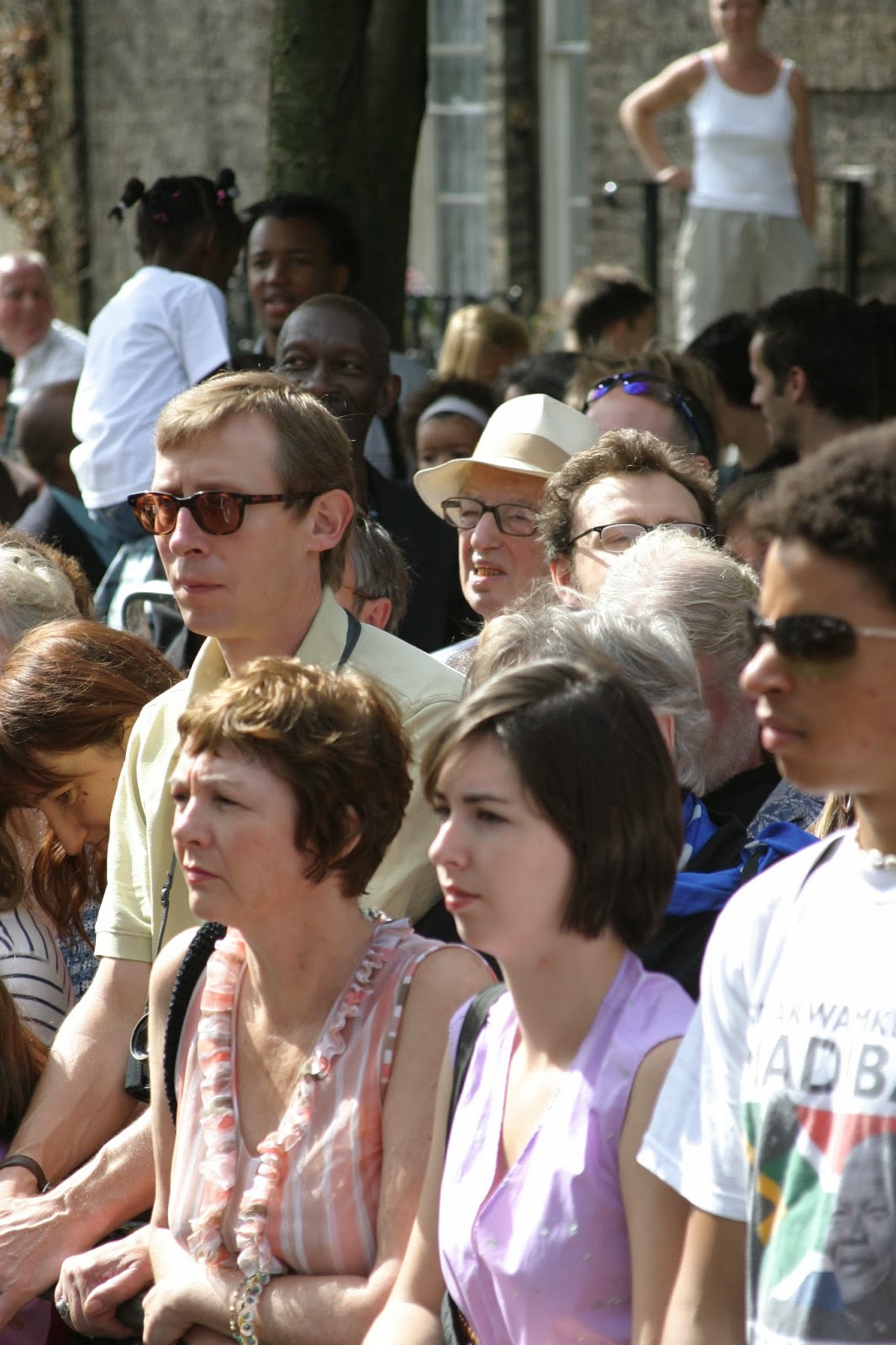
Several colleagues from the paper turned up, not to do any work but to experience something unique. Eric sauntered along, in a fedora, and chirpy despite the early hour; it wasn’t a time we often saw him. The accountant and the head of advertising had also made the short journey down the road. And while the unveiling hadn’t been widely publicised, it was clear the message of what was happening that Friday morning was echoing around the area; at first there were tens of people, soon there were hundreds.

Marxist historian Eric Hobsbawm appears to have been among the crowds

Sash windows in houses on the other side of the road were open fully and in some people sat precariously on sills, legs dangling beneath them. Parents carried their children on their shoulders; people climbed on top of walls and up poles to try and get a glimpse of what was happening. Behind railings near the plaque dignitaries were arriving. Frank Dobson MP was joined by Loyd Grossman – his role was, remarkably, compere of the occasion. Doreen Lawrence was there. Somewhere around was Alastair Campbell, as I later discovered when we bumped into each as the crowd dispersed.

The young Camden mayor Nasim Ali arrived, resplendent in robes and adorned with the traditional gold chain. He was effervescent. He bounded over and asked me to get a good photograph of himself with Nelson Mandela; later, as he hugged the former president, I tried to get the shot but found too many heads in the way. I always regretted not supplying the perfect shot for him though looking at the pictures now there are several shots he would enjoy.

Mayor Nash Ali greeting Mandela, under the watchful eye of Zelda la Grange

Many in the crowd were getting a bit agitated; they could see little of what was about to happen with so many photographers on ladders. A cry went up 'get down, get out the way'. The photographers were unwilling to move, but such became the pressure eventually we all got to the ground.

Soon, police wearing hi-vis jackets appeared at the corner by Camden Road, a series of cars turned the corner and there, was Nelson Mandela, walking with a stick, accompanied by his reliable - and fearsomely protective aide Zelda la Grange. He was first greeted by Gillian Slovo, the writer and daughter of Joe Slovo and Ruth First.


Mandela's speech wasn't long, but it was witty, affectionate towards his old comrades in arms and full of cheek. Ruth First, he recalled, was a 'sharp lady' who didn't suffer fools gladly. He still had the 'scars' on his back to prove it.

When Mandela pulled the cord, to loud whoops and applause (had this noise ever happened at an English Heritage plaque unveiling before?), and, on stairs leading up to the front door of a neighbouring house, a South African choir, singing with gusto, all with broad smiles.

There was security of course. Hefty numbers of police marked the street, English Heritage officials stood by the railings and Mandela's own easily identifiable guards - hair hard cropped, sunglasses, all white - watched attentively. But it wasn't overbearing.  People danced and waved, jumped with joy, yelled out Mandela's name with glee. The former president himself smiled, waved and joined in with the merriment. He left to music, laughter and joy. He was probably on the scene for no longer than 20 minutes, but it was a moment no-one there would forget the occasion. I felt privileged just to see the man and take his photograph.

*The Camden New Journal's report of the day can be found here.


A final aside

While the majority of the photographers were in the pen with me, some, like The Guardian's David Sillitoe, looked for different angles. Below is the picture which ran in his paper:


Towards the left hand side, I'm one of the few members of the press pack who can be identified, with my long blonde hair, I'm captured just looking to my right.

For some reason, we got hold of an international edition of The Guardian that week and the same photograph ran. Except, there appears to have been a bit of a cropping error. While I can still be seen looking in the wrong direction, Nelson Mandela has been removed from the image almost entirely; just his right hand survived the chop.  Oops!