Showing posts with label #GE2015. Show all posts

Tuesday, 5 May 2015

The campaign trail to nowhere

This election campaign may have only officially begun at the end of March, but as we approach the final hours, it seems to have lasted many more months and years. And, ultimately, what has been the point? For all the polls have shifted, it might as well have just started at the start of last week. For all the flashy billboards, boisterous though far from spontaneous rallies of the faithful, the personal attacks, the sniping in the press and the plethora of pledges, the polls have barely moved an inch.

For a brief moment last week, the Conservatives appeared, in a couple of polls, to be establishing something of a lead; was clear blue water finally emerging? Well, no. The polls have levelled once more, maybe the Tories holding a slender, but far from firm, lead. A hung parliament is, it seems, an inevitability.

So how have the campaigns gone for each of the main political parties:


Conservatives

The leading member of the coalition had a very leaden, clunking, gloomy start. The messages were dour, warnings of ‘chaos’ tedious beyond belief and the operation slack. The personal attacks on Ed Miliband, such as the backstabbing one from Michael Fallon backfired, and David Cameron failing to acknowledge Ed Miliband as a 'decent man' was jarring and unbecoming of the man. 
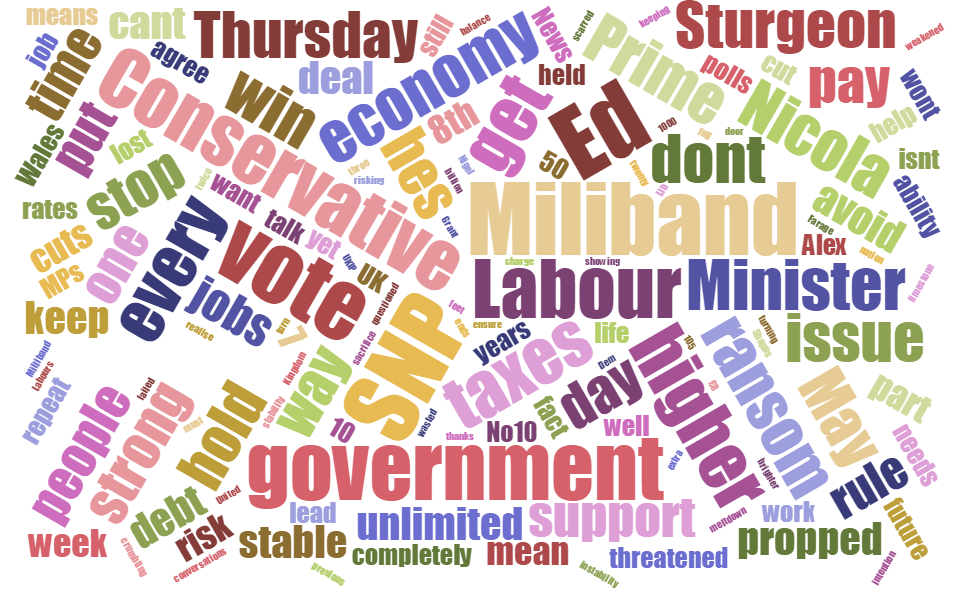

Just from the wordcloud above, using statements made in Conservative Party press releases since Friday, the words 'Nicola', 'Sturgeon', 'SNP' are have been used almost as often as 'Miliband'; 'ransom' is also pretty prominent. For an apparently 'Unionist' party the venom stirred up against Scottish voters has been extraordinary. Stirring up English nationalism may well prove, in the long run, to have been an extremely unwise thing to do.

Then there were pledges, a windfall of them: Inheritance Tax threshold increased to £1million for a couple; 40 per cent Income Tax threshold raised to £50,000; personal allowance up to £12,500; commuter rail fares frozen; £8billion above inflation for the NHS; 30 hours free childcare for 3 and 4 year-olds, What a gold mine; who could possibly suffer from such pledges? The only problem there was little information how any of these would be paid for; they almost appeared like post-election coalition talks. And they came on top of the repeated failure by senior Tory figures to explain '£12billion in welfare cuts' apparently planned for after the election.

In the last week, however, the party has recovered lost momentum, mainly due to David Cameron's own campaigning skills. His 'I'm pumped up' and 'bloody lively' routine sounds absurd but there is something in Dan Hodges' piece from early April which talks about the Prime Minister rolling up his sleeves and hitting the road after a lacklustre campaign start. It's also possible that the constant repetition of the same slogans is finally hitting home.

If Cameron wins a majority, it will be a huge personal success and not a ringing endorsement of Lynton Crosby's election campaign; frankly the Tories should really ask for their money back.


Labour

For some reason Ed Miliband has been routinely underestimated throughout his leadership of the Labour Party. His doggedness has been entirely overlooked. So when it came to the election campaign itself expectations were not high. As a consequence, the fact that Labour launched a coherent, spirited, hungry campaign rather took onlookers by surprise.

Miliband also did well in the debates. In the spin room at the first non-debate, reporters from pro-Tory papers acknowledged to each other that the Labour leader had easily beaten Cameron, who looked utterly terrified when confronted by Jeremy Paxman.

The #edstone
But, in the penultimate week, as the polls appeared to be giving the Tories a slender leader, jitters could be seen. Perhaps this is why Ed Miliband decided that rather than a pledge card, which can be slipped easily into a wallet, he would opt to have his promises engraved on an 8-foot limestone monument; surely the invocation of gravestones or Old Testament tablets inscribed with the Ten Commandments were inevitable? It is as though a member of his team watched The Thick of It thinking it was a template from which to copy rather than a satire. Perhaps, again, evidence of an imported public relations guru not really worth his weight in gold, or even limestone.


Liberal Democrats

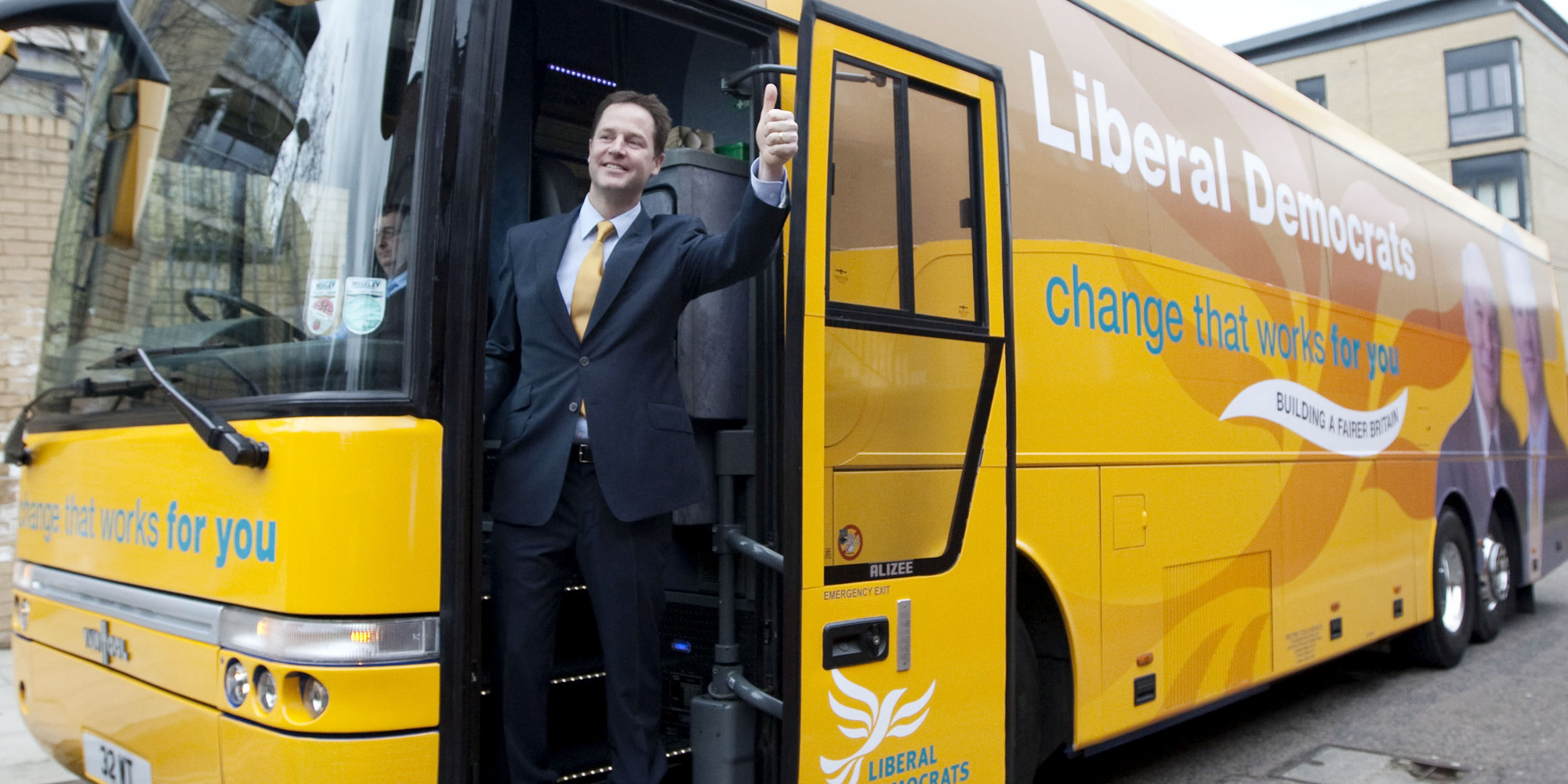
Pitching themselves as a moderating force for both the Conservatives and Labour, this election has been one of consolidation for the Lib Dems. Whatever Nick Clegg says, they will lose seats on Thursday night, probably a lot of them. They may lose so many that he cannot stay as party leader. In many ways this would be a shame as the Lib Dem leader is unquestionably a decent man who was thrust in an invidious position back in 2010. The numbers could have allowed a Labour/Lib Dem coalition but it would have been far from stable and far less so than the Tory/Lib Dem coalition has proved to be.


Danny Alexander's leaking of apparent Tory post-election child benefit plans had the air of someone who knew who was going to lose and didn't care any more. Safe to say that after he loses his Inverness seat - which he almost certainly will - even if Alexander ends up in the Lords, he won't be the first person to whom the Tories turn to join another coalition in the future.


Ukip

Nigel Farage's party has maintained its level in the polls surprisingly well considering what a wretched campaign they have had. It may not be until after the election that the full details of why Ukip's campaign never gained any momentum is known; Farage's health issues with his back are clearly a factor. But, the cancelled events, the comments - whether reasonable or not - about Farage's own lack of appearances in Thanet South where he is standing, have all not helped.

The party also seems to have decided there is a concerted media plot against it. Farage launched a misguided attack on an independently selected audience during a BBC debate complaining it was too left wing, forgetting that, with Cameron's absence, right-wing members of the audience had little to clap for. It isn't actually the media's fault that member after member says or does something stupid or offensive. The latest is the suspension of Robert Blay, a Ukip parliamentary candidate who was caught on camera saying he would 'personally put a bullet between' the eyes of his much-tipped Tory opponent if he were ever to become Britain's first Asian prime minister.

Through the share of the vote they look likely to take, Ukip could still cause the Tories problems but it seems less likely that this will prove a breakthrough election for them; Carswell looks set to win but none other can be as sure.


Greens

Remember the Green surge? Membership shot up, overtaking Ukip and even the Lib Dems but today's poll of polls leave them on five per cent. Caroline Lucas may return for the Brighton Pavilion seat but other gains look very unlikely.

Sadly for Natalie Bennett, the party's surge never really kept going after her 'mental brain fade' on LBC radio back in February, even thought she stood her ground well when she took to the stage on the BBC Challengers' Election debate. We should not forget the fact that this programme featured three effective female politicians - Bennett, Nicola Sturgeon and Leanne Wood. This is possibly the only time women have ever outnumbered men in such a format, and it lent the discussino a novel, even an exciting, edge. It was in this format that Bennett was probably at her best.

Before long, however, fundamental problems faced the party. Because the Greens were now pitching themselves as members of a serious political and less a campaign group, their manifesto faced more scrutiny than ever before. Bennett was repeatedly challenged as to whether she wanted to ban the grand national or outlaw rabbit hutches, or back up the party's economic policy with solid evidence. Perhaps inevitably, while there was no repeat of the 'mind-fade', she continued to struggle in interviews.


Conclusion

The next five years are likely to be troublesome: Britain's membership of the European Union could well be the subject of a referendum; the strength of the Union will be put under enormous strain; the refugee crisis in the Middle East is not going away and its effects will spread further; Russia under Putin is likely to maintain is bellicose stance; global security is shaky; the environment is under threat; and the economy is still vulnerable to shocks. And, yet it seems, if we believe the opinion polls, we may well, after the general election, be left with an unstable, fractious, government with a major party reliant on the support of one, two, even three smaller parties.

It's clear neither the Conservatives nor Labour has presented a vision for the country which has captured the imagination of the public, their campaigning has been narrow, artificial and blinkered. There has been too little discussion about several vital issues during this campaign. Foreign affairs and the environment have barely featured.

From the uncertain melee of this messy, unsatisfactory, campaign, one can hope for a stable government to emerge but if not, we might have to do it all again soon.

Sunday, 12 April 2015

Wolf in Sheep's clothing - or the other way around?

The country has suffered the greatest recession in living memory, every party admits more painful austerity is on the way after May's election and this state of affairs will have to continue throughout the next parliament if there is a vague chance of wiping out the deficit, let alone the national debt. And yet, judging by their actions of the last few days, the various parties think they're living in clover.

The Conservative Party is acting like a chap who thinks he's the latest Euromillions winner, flashing the cash with abandon, promising his mates all the gifts they could want; only to discover later he got the numbers wrong.

The giveaways have come in a rush: regulated rail fares will be pegged with RPI throughout the lifetime of the next parliament; the NHS will receive the £8billion a year by 2020 which independent experts reckon it needs to keep up with our ageing population; and the next Tory government - somewhat failing to understand the principle of volunteering - would offer 15million workers the opportunity of three days' leave every year to volunteer.

All this is being offered at the same time as the party rules out raising National Insurance and VAT and offers another tax cut to the extremely wealthy through its Inheritance Tax plans.

This is not to suggest these are unpopular ideas (indeed, two of them could benefit me personally hugely - than you George!) but nothing has been offered, by way of explanation, as to how the country would pay for such perks.

And they all come on top of the Conservatives failing to say where £1billion of welfare cuts will come from after the vote. Some might think this would be a rather crucial nugget of detail before deciding which way to swing when voters finally enter the polling booth on May 7,

This campaign of giveaways emerged suddenly after a few days of negative attacks, and negative press especially in the case of Michael Fallon's ferocious attempt at knifing Ed Miliband's character. Perhaps this timing was always the tactic but it does seem abrupt; some commentators have not shied away from calling it panicky. And, there is little doubt, it comes in stark contrast to the fiscal discipline to which George Osborne has consistently claimed his party adhered.

For instance, when Labour suggested a 'tough cap' on rail fares in August 2014, Transport Secretary Patrick McLoughlin denounced it as 'yet another unfunded spending promise' that 'would cost £1.8bn over the lifetime of the next parliament and be paid for by more borrowing and higher taxes'.

When Andrew Marr challenged Chancellor of the Exchequer to explain where the extra NHS funds would come from, all George Osborne would say was that it was 'part of our balanced plan'. So far, all the weight is on one side of the economic see-saw.

Also, as some clever person pointed out on Twitter, if the Conservatives were planning this move, why not actually commit to such spending in the most recent Budget?

Labour has not been much better. Savings have been promised but not nearly amounting to the levels needed to have a credible attempt at tackling the deficit.

In a brazen attempt to steal the Conservative Party's clothes, Ed Miliband will, at the launch of Labour's manifesto tomorrow, commit a Labour government to a new 'Budget Responsibility Lock'.

This, the party explains, will ensure that 'every policy... will be paid for without requiring any additional borrowing' and all parties 'in the future will have their spending and tax commitments independently audited by the Office for Budget Responsibility before a General Election'.

Launching the manifesto, Ed Miliband will declare:

'The very start of our manifesto is different to previous elections. It does not do what most manifestos do. It isn't a shopping list of spending policies. It does something different: its very first page sets out a vow to protect our nation's finances; a clear commitment that every policy in this Manifesto is paid for without a single penny of extra borrowing.'

And he is set to go on, rounding on the Tories for their apparently generous spending commitments.

'In recent days you have seen the Conservatives throwing spending promises around with no idea of where the money is coming from, promises which are unfunded, unfair and unbelievable.

'That approach is bad for the nation's books. And nothing is more dangerous to our NHS than saying you will protect it without being able to say where the money is coming from. You can't help the NHS with an IOU.'

Considering the state of the economy when Labour last left office, it is an audacious bid even to attempt to claim the economic moral high ground. For five years, the Conservatives and Liberal Democrats have called - whether reasonably or not - for Ed Balls and Ed Miliband to apologise for Labour's economic record. That being so it is fairly remarkable that the Labour Party has been given the opportunity to swoop on to this political battle ground and attempt a rebrand. Will it persuade ordinary voters that Labour is suddenly fiscally responsible? Its promise of no extra borrowing is surely a position no government could really maintain if faced with tricky economic circumstances.

Moreover, the insistence on rectitude and the refusal of any 'extra borrowing' neatly overlooks the significant distinction between deficit and debt; and this after we have been carefully introduced, in recent years, to some of the economic and linguistic distinctions nestling within these terms. it is all very perplexing.

The Conservative manifesto is being published on Tuesday; they might need to start offering some answers to all the questions.

All concerned should be aware that Paul Johnson, the Director of the Institute for Fiscal Studies, told The World This Weekend that all parties were 'making up numbers'.

'I've found this entire debate from all the parties really deeply depressing. You've had the main parties ruling out whole hosts of relatively straightforward ways of increasing tax, talking about raising tax from some other group, be they the rich or the non-doms or the tax avoiders, but this is all real money and has real effects on the economy, and no sense from anybody about a serious way forward for the tax system.'