Showing posts with label pubco. Show all posts

Wednesday, 4 June 2014

A timid launch for timid pub reforms


If the press launch is anything to go by, then tied publicans should be wary of the government’s pub reforms plans.

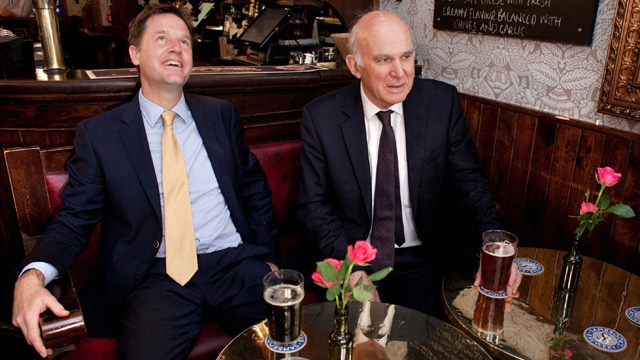
For the first time since the botched coup against Nick Clegg, the Deputy Prime Minster and Liberal Democrat leader met in public with Vince Cable, the business secretary, in a Piccadilly pub to unveil the long-awaited proposals to give tenants a bigger say in negotiations with pubcos - the large, often heavily indebted, property-companies which own about 25,000 pubs across the country.

Such is the level of trust between the two men that the press were kept outside the Queen’s Head, left in the rain, unable to hear a word. All that was released were a few sentences, with Vince Cable saying: ’Far too many landlords feel their income is squeezed by big pub companies, so today we are taking action to make sure they get a fairer deal.’

Even the venue chosen for the launch left a lot to be desired. The Queen’s Head is a very distinguished pub in the heart of the West End, but it is independently owned and, therefore, will not be affected by these proposals.

As for the measures themselves, they are not as sweeping and radical as the campaigners would have hoped. The reforms will allow tenants, tied to companies like Punch Taverns and Enterprise Inns, to request a rent review if they have not had one for five years, and to see the information companies use to increase rents. (For background on the issue, see here)

Tenants would have access to an independent adjudicator who could impose sanctions if a new mandatory code is breached. Tenants would also be able to ask for an assessment to see whether they were better or worse off than free-of-tie tenants.

But there is no market rent option, no relaxation of the tie. Tenants will still face ground rent and be forced to buy supplies through their owners.

The reforms leave the pubcos pretty much as they were. Punch and Enterprise remain ’zombie’ companies, as Greg Mulholland claimed in the House of Commons in 2013. And vocal campaign groups, who many might think would be on the side of tenant publicans, bemoan any intervention by the government.

For example, Brigid Simmonds, the chief executive of the British Beer and Pub Association, said:

'While we welcome greater certainty and clarity after such a long period of debate, we are disappointed that the government is seeking to introduce potentially costly legislation, with the disproportionate costs of a statutory adjudicator, rather than supporting the existing, and evolving, system of self-regulation.'

It would be a tough ask to find any tied publican who would defend the current system of self-regulation.

There will be opportunities as the legislation passes through parliament to amend these fundamentally timid plans and Greg Mulholland, who has been one of the most prominent champions for reform in the House of Commons, has indicated he intends to do what he can. Responding to messages of congratulations, from Lib Dem president Tim Farron, pleased that any proposals were being discussed, Mr Mulholland replied:


We can expect to see the free-of-tie option tabled. It will get the backing of Labour, the Lib Dems and many Tories, so could still force its way into legislation.

But the most significant obstacle facing even these reforms is the fracturing coalition.

While Clegg and David Cameron try and portray an image of back-slapping unity, in truth, this Queen’s Speech sees a series of measures suggested by one side followed by another set from the other. It was noticeable that no Conservative figure has associated him or herself with the pubco measures. George Osborne is certainly nowhere to be seen and the pubs minister Brandon Lewis - who appears to have only a semi-detached relationship with his brief - is invisible. And, of course, there was no Andrew Griffiths MP, who represents Burton, the spiritual home of British brewing, and has spent years campaigning against any such reforms; surely he is not closer to the non-beer making pubcos than the pubs which actually sell the stuff?

While reforms have wide support amongst Tory backbenchers, there is no support from the Conservative benches in government; indeed, the delay to any proposals having been unveiled before now has not been the amount of responses to the consultation, as previously and preposterously claimed, but because of the extensive lobbying campaign by pubcos.

Lib Dem figures accept these measures are very much a ’first step’ - and Labour have already pledged to go further if re-elected - but they face a battle to get even these passed through parliament.

Thursday, 27 March 2014

Will a penny off a pint save the British pub?

Despite strenuous efforts, I have yet to find a publican who has lopped off 1p from the price of a pint of beer following George Osborne’s announcement in the budget last week.

This is surely strange; after all, coalition ministers have been shouting quite a lot about this. Grant Shapps, in the poster of his now infamous tweet, boasted that ‘Cutting the Bingo Tax & Beer duty’ was helping ‘hardworking people do more of the things they enjoy’. And Conservative MP Andrew Griffiths – who represents, some believe with painful irony, Burton, the home of British brewing – has been especially excited, proclaiming the cut proves ‘this is the most beer and pub-friendly government we have seen in a generation’.

Mr Griffiths wrote effervescently about what the chancellor had done in the Publicans’ Morning Advertiser:

‘Last year’s decision to cut a penny off the price of a pint of beer was the first such decision by a chancellor since 1959. Yet it was the decision to scrap Labour’s hated beer-duty escalator that really made the difference to the industry.

‘Ending the year on year ratcheting up of a beer duty, a system which saw it rocket 48% between 2008 and 2012, ended the misery of a system which was bleeding the beer industry dry.

‘The more optimistic of us hoped and campaigned for a freeze in this year’s Budget, but not many expected an historic successive second cut. This of course was followed by scrapping of the alcohol duty escalator, and freezes for Scottish whisky and real cider.

'All in all, this was a beer and pub budget that the whole industry should be thrilled with.’

And Mr Griffiths hasn't held back on Twitter either.


And here he is below, clearly exemplifying responsible drinking:


Now let's not be churlish. It is of course welcome that the government has felt able to make any cut in the price of a pint of beer, especially as drinkers are increasingly lucky to get change from a fiver when buying a pint in the capital these days.

But for anyone to suggest this is the great rescue of the pub trade is, frankly, not taking the issue seriously.

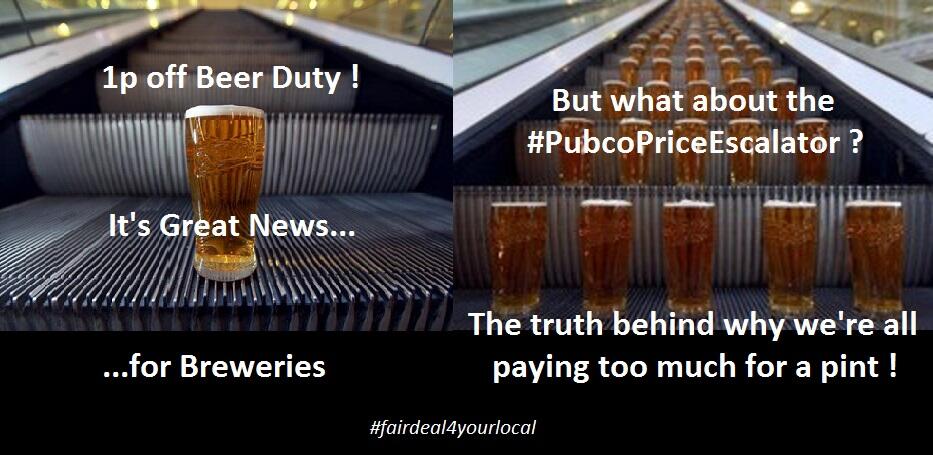
Recent figures from CAMRA suggested the number of pubs closing each week had risen to 28 per week and while many in the pub trade are pleased with the price cut, they have wasted no time in pointing out the government's inaction - despite repeated promises - in tackling pubco reform - offering tenants a chance for a fair rent and an end to the system which sees them hit by high rent costs and high beer costs. Posters such as the one below have quickly appeared:


Simply nothing has happened. There has been no response to the government's consultation on the issue (for more on this delay see here) and it seems likely such reform has been blocked at a high cabinet level and nothing will happen this side of an election. It's worth noting Andrew Griffiths, a self-styled champion of pubs, is curiously opposed to any such reform.

And, in a timely fashion, the latest figure to get involved in the issue is the not insubstantial figure of Tim Martin, the founder of the Wetherspoon's chain. In his company magazine, he writes: 'The main additional reason for pub distress is the high level of debt assumed by some pub companies in the years running up to the credit crunch.' And he names financiers Guy Hands and Hugh Osmond of being the architects of this 'unsustainable', damaging model.

'In essence, Hands and Osmond bought large tenanted pub estates of the major brewers, using borrowed money, and then hiked up the rents and the beer prices paid by the tenants. As a result of the increased income which they generated, they were able, in effect, to remortgage pubs, extracting tens of millions of "profit" for themselves.'

Companies like Enterprise Inns and Punch Taverns were the successors to this and they continued using the same model. Tim Martin goes on:

'When the individual licensees/tenants started to suffer between the hammer of high rents and beer prices and the anvil of tax-subsidised supermarkets, unprecedented numbers of publicans went bankrupt - and the Enterprise and Punch shares plummeted on the stock market to a fraction of their former value.'

And while pub titans old and new, such as Hands, Osmond and Enterprise's former chief Ted Tuppen have showed little sympathy to the 'plight of the tenants', they have been vociferous in their complaints about high personal taxes, specifically Labour's plan to increase the top rate of income tax back up to 50 per cent should they regain power. He concludes, with restrained fury:

'There is a justifiable argument for a reasonable top rate of tax which encourages hard work - Britain did not benefit from the Rolling Stones hiding from the taxman in the south of France in the 1970s. However the disregard of the financial engineers for the plight of their tenants and their egocentric concentration on their own positions, dressed up as national concern, might even have caused Maggie Thatcher to side with Ed Balls.'

So while the government tinkers around the margins, fiddling ineffectively with beer prices, it continues to ignore the hugely damaging pubco model, something which all, but the most stubborn, now recognise needs tackling with urgency. Until the government belatedly takes action, their claims of being the publican's - and the beer drinker's  - friend will largely fall on sceptical and deaf ears.

Tim Martin's full article can be read here.

Friday, 8 November 2013

The last moments of The Alma


Kirsty Valentine outside The Alma on eviction day

It’s 9.20am on a Friday morning and the Alma pub, recently crowned as North London Cider pub of the year by Camra, is busy. It isn’t open. The only drinks being consumed are tea and coffee. Everyone there, locals, friends and supporters, local MP Jeremy Corbyn, writer Pete Brown, are not there to toast landlady’s Kirsty Valentine’s success, but to be with her and offer support as bailiffs are expected at any moment to turf her out.


It’s the culmination of four years of fighting with owners, Enterprise Inns, the pub company (pubco) which own the pub. Kirsty has vigorously campaigned to reduce the rent, claiming it was impossible for her to make decent standard of living; conversely Enterprise claim they have tried to help find a solution.


But the time for negotiation ended on Thursday when Kirsty lost in court.


At 9.30, a representative from Enterprise is standing outside the locked doors of the pub with a man in a hi-vis jacket; he’s the man who will fix shutters to the doors and windows when the bailiff arrives.
Enterprise representative, plus 'shutters man' arrive


A locksmith appears. He looks somewhat surprised at the sight inside. ‘I was told this was a non-confrontational job, look at ‘em. There’s dozens in there. No one wants to lose their local.’ He speaks in a friendly manner, with an energetic, north-London ‘geezer’ accent.


When he does arrive, the bailiff is quiet, evidently keen not to be drawn into a confrontation. Still, two police officers pull up in a marked car, there to ensure there is no breach of the peace. Inside the pub, Kirsty is locked in conversations with lawyers trying desperately to come up with a last minute offer which might satisfy Enterprise’s demands. I’m told that Enterprise have said they will not accept any offer and just want her out (Enterprise dispute this).


Just after ten, the bailiff and Kirsty go to a back room of the pub to discuss matters. It’s agreed that they will leave the pub; there is no need for police, and bags of possessions, heaped on the floor start to be taken out.


With tears welling up, Kirsty goes behind the bar one final time and beckons her supporters to come and join her. They line up and hug; one final act of defiance before becoming a statistic, one of the 26 pubs which shut every week. The Alma is now closed.
Kirsty goes behind the bar one final time


________________________________________________


Enterprise insist they are very keen to reopen The Alma as soon as possible, countering fears that it could become a block of flats or a supermarket. In a statement, the company describe the Newington Green site as ‘a great pub with a fantastic community spirit and we want it to continue to thrive’. They also claim that the dispute actually is ‘a clear example where the tied pub model…. has provided extraordinary levels of support, flexibility and ultimately direct financial assistance to a tenant'.

They add: ‘Regrettably therefore, we have been left with no alternative but to revoke her tenancy and will seek to put in place a new operator as soon as possible.’


As for Kirsty, she has lost her home – she lived above the pub – her business and livelihood – ‘they’ve wiped me out in 12 hours’ she says. Friends have rallied round and offered her places to stay while she continues her next move.


‘I can’t even begin to consider anything much because I’m just so, I’m just in shock. It’s a mixture of shock and relief that it’s finally all over.'

As for whether she will return to the pub trade, she is very unsure.

'I need to go away and sit in the corner for a very long time and contemplate things.'

But considering the tumultuous events of the day, she sounds remarkably chipper and stoical; buoyed by the impressive support during her final moments at the pub.

'I was so thrilled, it's made it so much easier to deal with. For many many months, I have wondered what his moment would feel like that and it's nothing like my greatest fears.I don't feel ashamed and I don't feel embarrassed. I feel extremely proud and honoured that everyone stuck by my side. I'm extremely proud I'm going out with my head held high. My staff are very loyal and are extremely upset. It's a very sad day, but at the same token it's made it very much easier to know I'm very loved and respected.'

For more background on the argument between publicans and pubcos, and the campaign for pubco reform, visit here.

Note - for legal reasons any comments left under this piece will be treated with particular caution. Thanks