Showing posts with label Scotland vote. Show all posts

Wednesday, 17 September 2014

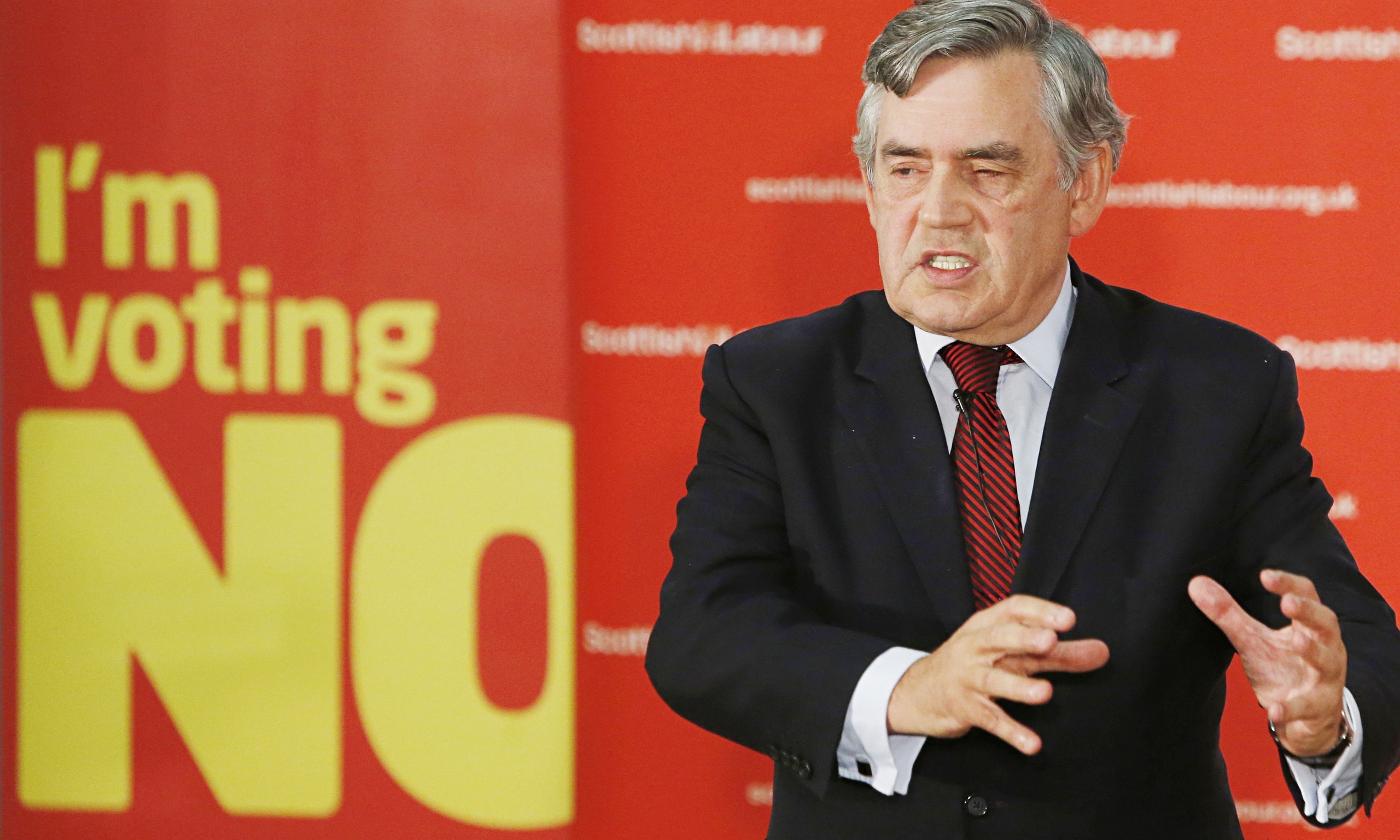
Brown delivers the speech of his life


Tony Blair is Scottish. He was born in Edinburgh, the grandson of an Orangeman and butcher, and went to school  at the prestigious Fettes College in the Scottish capital. This former prime minister hasn’t stayed silent on the independence debate referendum, saying just on Saturday that a Yes vote would ‘not be sensible, politically, economically or even emotionally’. It is not the sort of comment which is likely to endear him to any Scots and unlikely to sway any wavering voters. Which is why he hasn’t been allowed to be anywhere near the Better Together campaign, he is probably only second to Margaret Thatcher in the Most-Disliked-Politician-in-Scotland table.

All of this is in stark contrast to Gordon Brown. The conventional wisdom has written the former prime minister off portraying him as a dour, glowering figure, sulking in Kirkcaldy and rarely venturing into the House of Commons despite still being an MP. But the political biographies will have to be rewritten, especially, as seems increasingly likely, the No vote finally comes on top. It is probably too strong to say that a No win would be down to Gordon Brown’s impact, but it is undoubtedly true that the introduction of this true political heavyweight into the debate has shifted the balance.

Up and down the country, Brown has been speaking without notes, fluently and powerfully addressing rallies, galvanising the No campaign. Yes, it has basically been the same speech over and over again, with the same jokes about football failures, the same invocations of historical Scottish figures, the same warnings of the risks of voting for independence. But, regardless of the politics, it is a good, well-crafted speech. And the more Brown has given it, the better it has got, culminating with his appearance at Mayhill Community Central Hall, in Glasgow this morning (Wednesday, September 17). Prowling like a caged lion, his arms enthusiastically enacting the sentences as he spoke, the Kirkcaldy MP delivered one of the finest oratorical performances of our lifetime.  Oddly, though the contents of the speech are of course, important, the sheer style, and panache of the performance, means that one could disagree with every word and still come to the same conclusion.

Of course, Blair knew how to deliver a good speech. He could be fluent, funny, self-deprecating, confrontational and passionate; but ultimately, with Blair, one never knew if he, himself, actually believed what he was saying. With Brown today, though, there is no doubt that it came from the heart, the words almost erupting from within like an unstoppable force. Barack Obama, on his day possibly the English language’s finest orator, often gets compared to a preacher and Brown too, delivered his speech like an archetypal Scottish minister –he is the son of one, of course –  and it was after almighty crescendo that he bellowed the biblical line ‘what we have built together, let no nationalism put asunder’. (In the actual printed version of the speech, attached below, Brown apparently says 'Nationalist' at this point; 'Nationalism', which he said, works better).

It is something when grizzled hacks from the Daily Mail and The Sun can do no more than acknowledge the mastery of Gordon Brown’s oratorical skill. Brown has always been a powerful speaker, though his message was frequently dulled by power and his tactic of repeating the mantra of the day over and over again. In the context of a tightly fought referendum, this was the best speech of Brown's career.

There is no doubt Gordon Brown has shaken the No campaign from its complacency, appearing just as panic was setting in after an opinion poll gave Yes a narrow lead. He has injected it with energy and provided it with what it has desperately needed, a positive message in favour of the union, simultaneously celebrating Scottish identity and British identity – much of this can also be found in his book My Scotland, Our Britain. 

But, despite its undeniable power, will Brown’s contribution sway any votes? He left Downing Street after a tumultuous few years, the country reeling from an economic storm, his reputation severely damaged. But, still, possibly. In such a tight election, for the No campaign to win, it only needs a few votes to swing from one side to another and it could well help make the mind up of wavering voters. With this grand oratorical flourish, Gordon Brown could yet confound the political rule book and show that all political careers do not necessarily have to end in failure.

*The full text of the speech can be found here.

Tuesday, 9 September 2014

Gordon Brown; the Unionist's final throw of the dice?


When David Cameron was finally able to evict the ‘squatter holed up’ in Downing Street after the General Election in 2010, he must have thought he wouldn’t have worry about Gordon Brown again. The irony, therefore, that the Prime Minister is trusting his one-time opponent basically to lead the final stages of the battle to keep the union together must be painful indeed. Any personal animosity has, for now, been swept aside.

It is hard to conclude that the MP for Kirkcaldy’s intervention, pledging an array of devolved powers to Scotland, was anything other than an act of desperation. All three major Westminster parties have pledged their support for this package of constitutional reform, regardless of whether there has been any consultation with voters about what exactly they want. Moreover, while the reforms are apparently exclusively Scottish, it will rapidly prove to be an impossible position to maintain; Wales and Northern Ireland would certainly want something similar and regions, Cornwall, the North East, Yorkshire, will clamour for reform. Nick Clegg has already acknowledged this, saying further devolution in Scotland will:

'signal a much wider rewiring of the governance and constitutional arrangements in the country as a whole, particularly governance within England which remains an unusually over-centralised country'.

Hence, regardless of whether Scotland votes yes or not, Britain is on the cusp of potentially huge, and rushed, constitutional change.

Brown has been thrust into the limelight at this late stage as even his opponents are recognising that, despite his pretty disastrous time as prime minister, he remains the equivalent of Heineken; he can reach voters other pro-Union political figures just can’t reach. Messrs Cameron, Miliband and Clegg have cancelled their appearance Prime Ministers’ Questions to head to Scotland and campaign for a No vote, but their presence is, if anything, a boost to the Yes campaign. Alex Salmond said today: ‘The message of this extraordinary, last minute reaction is that the Westminster elite are in a state of absolute panic as the ground in Scotland shifts under their feet.’ The farcical scenes around the country of the Saltire being raised above town halls and even Downing Street, as if such an act would swing a floating voter, rather gives credence to the SNP leader’s view.

The toxicity of the Tories in Scotland cannot be underestimated; in my recent trip up there the venom reserved for Mrs Thatcher was still fresh and vivid. In many ways, the imposition of the 'Bedroom Tax', though applicable nationally, echoes the hated Poll Tax. Hence, One of the SNP’s strongest lines, repeated over and over again, is voting for independence is the only way Scotland can avoid ever having to endure a Conservative government again, conveniently forgetting that the Tories haven’t won an election since 1992 and, in parliamentary terms, remain virtually wiped out north of the border.

Ed Miliband has been inept, unable to harness the millions of Labour voters the party is normally able to rely upon; the Labour Party’s brand has been damaged by Alex Salmond constantly calling them the allies of the Tories. Such a comment would make any Labour voter in England bristle with irritation but it will still carry power. Labour's recent time in office also does them few favours too. While it may have established the Scottish parliament, paving the way for the situation we have today, the party, particularly under Tony Blair, shifted to the right, no longer recognisable to many.

And Clegg? As it is his party keeping the Conservatives in power, thus enabling unpopular measures such as the ‘Bedroom Tax’, he will struggle to find a sympathetic ear.

Gordon Brown will be seen every day between now and the referendum. Yesterday, he spoke without notes, with power, passion and fluency – Cameron’s advisers would have raved at such a performance. It was an echo of the early speeches Brown made before he was rendered thumpingly dull by the process of power.

Much of the contents echoed his book My Scotland, Our Britain, the best, most positive, pro-Union argument I have yet read, where he explains how it is possible to a both proud Scot and a proud Briton. And it recognises how the debate is one of economics and politics as well as an issue of the heart. And the former Labour prime minister may yet still win the day for the Union cause. Combined with the potential for constitutional change, we are faced with the prospect of a quirky historical twist that Gordon Brown could achieve something more long lasting and profound as a backbench Kirkcaldy MP than he ever did as Prime Minister.

UPDATE

It hasn't taken long for politicians from England's regions to start calling for extra powers to be devolved. Andrew George, MP, for St Ives, tells the Western Morning News:

'All parties now acknowledge the benefits and opportunities of allowing the nations and the regions of the UK to manage their public services and shape their futures whilst releasing themselves from the dead hand of micromanagement from Whitehall.

'If Scotland and Wales can be offered further powers then Cornwall must be next in line. After all, Cornwall is already recognised as a distinct region for economic development purposes, as a separate people and for its distinct language.

'After all, who is best-placed to decide how Cornwall's housing stock and development plans are best managed? Inspectors in Whitehall or democratically elected representatives in Cornwall?

'Who is best-placed to manage Cornwall's health and social care? Health managers in Whitehall and Leeds or the people, patients and clinicians of Cornwall?

'Who is best-placed to decide ho Cornwall's economic development aid is spent? Ministers and mandarins in Whitehall or the business leaders, workers and elected representatives of Cornwall?'

The full article can be found here.

Tuesday, 29 July 2014

Independence 'an opportunity we shouldn't pass up'

The view from Inverness Castle, following the River Ness south
In one of the major streets of Inverness is the Yes campaign office. Prominent with its bright white ‘YES’ on a blue background, it’s hard to miss, and inside, every surface is covered in brochures, leaflets, bowls of badges, piles of car stickers and eager staff wanting to chat to visitors. Almost as significantly, it is positioned right by one of the busiest bus stops in the town. While I’m inside, I can hear people talking about the campaign as they wait for the bus to take them off to work.
‘It’s why we chose this spot,’ a man in the office tells me, ‘it’s fascinating hearing people interact and discuss it [the referendum]’. Seated on the bus stop bench, an elderly woman is chatting to a young tattooed man in a hi-vis jacket; they both seem convinced Yes voters. Inside, a volunteer is collecting badges and literature for a day’s campaigning; it feels like a professional operation yet both are volunteers. It’s a bit of contrast to the No office round the corner, up a street towards the castle, not the back of beyond but lacking comparative footfall. Peering inside earlier, I could see towers full of literature still encased in bubble wrap. On their window, big Yes stickers have been stuck over their slogans. There is something inadequate about the office; perhaps a sense of complacency.

A Yes campaign newspaper
‘They don’t have to persuade anybody,’ the chap in a faded blue shirt inside the Yes office tells me. ‘That’s what we’ve got to do. The No campaign are paying students, and for their accommodation, to distribute their material, we don’t.’ He says it’s well known and noticed around Inverness, but it’s not a claim I can verify at the moment. Inverness, though, is noticeably more pro-independence than the other places I have recently visited. More stickers tagged to bus-stops, posters strapped to lampposts, Saltires painted on guitars.
The guitar belongs to Willie Campbell, who is in town tonight. The musician, once with indie band Astrid – described by the writer Kevin MacNeil as ‘beloved, would’ve-could’ve-should’ve-made-it-massive-band… the greatest pop group the North of Scotland ever produced’ before imploding in ‘rancour’n’remorse’ – is playing at a couple of venues; I catch him at Lauders in Church Street. He performs with verve, singing his own songs, along with a smattering of covers, including a Neil Young number. He’s a very keen supporter of independence.
‘I think this is an enormous opportunity and we shouldn’t pass it up.’ I ask him why he thinks the demand for independence has come now.
‘It started with the creation of the Scottish parliament, and the SNP, slowly getting more and more power and doing well with it. The SNP have gone more left wing, and certainly more so than the government in Westminster.’
He thinks the result will be very close but hopes a late surge from those who haven’t voted before, particularly the young, will swing it towards a yes vote.
‘This is engaging people that are not normally engaged in politics’ he tells me as we chat outside the venue, before he has to dash off to another gig. ‘Hopefully thousands of people who wouldn’t normally vote will turn up.’
And he adds: ‘One thing that really annoys me is people assume that if you are voting Yes, you are voting for Alex Salmond. My hope is after a Yes vote, a strong Labour Party would emerge. That would get my vote.’
The last Labour government ‘were a big disappointment’ he says. It’s a sentiment I hear repeatedly.
A newspaper I picked up in the Inverness Yes office has a ‘Yes’ and ‘No’, what happens next column. The box at the top of the ‘No’ column reads ‘Tory government at Westminster we haven’t voted for’.

Another Tory government the first risk of a No vote, warns literature
‘The Tory party is toxic,’ Doug Haywood, a Radical Independence activist in Aberdeen tells me. ‘Very few people trust a Tory politician. If you tell people a Tory policy, without the brand, they might agree with it, as soon as you add the word Tory, they’re against it.’
Back in the Yes office, the man believes the desire for independence has always been there, but since the creation of the parliament at Holyrood, more and more Scottish people have seen it can be done while at the same time seeing politics in Westminster drift away from what they think is important.'There is still a lot of resentment towards the Thatcher government up here. People like Brown and Darling failed to achieve what people hoped as the Labour Party shifted further and further to the right. And Blair really lost the Labour Party for many up here.' 
And he is another convinced there will be a large surge for yes. ’If you’d asked me a few weeks ago I would have been unsure but now, I'm more confident. It's much closer. Particularly amongst the young, there's a lot of excitement and enthusiasm.'

Saturday, 26 July 2014

Scottish Independence; why now?

‘The Parliament sits in the land because it belongs to the Scottish land…. The building should originate from the sloping base of Arthur’s seat and arrive into the city almost out of the rock.’

This is what Enric Miralles, the architect of the Scottish parliament building in Edinburgh, who died before its completion, said regarding his controversial design. Before me is a terraced landscape. The terraces feature yarrow and other wild flowers (flùraichean fiadhaich), ‘Trapain’ rocks, newly planted pine trees and knapweed. They rise from clumsily manicured lawns, deliberately unkempt, to reflect the wilds of Arthur’s Seat, its base just a few hundred yards away. The parliament building is surrounded by this uncertain landscape, to make the architecture seem as if it were emerging from the indigenous rock. It tries hard to belong to this particular piece of Scottish land. Not everyone thinks the self-consciously rugged building succeeds.

If the Scottish people vote for or against independence on September 18, this building will - thankfully, considering the £414million cost - continue to be the home of Scottish democracy. A few school parties are queuing distractedly, waiting to look inside the parliament building, a pair of dogs are leaping in and out of an ornamental pond; there is the odd officer, but the phalanxes of police you would find in Westminster are not to be seen. It is oddly quiet; the quietest place I’ve yet found in Edinburgh.

For the capital city of Scotland is a city in preparation. Already swarming with tourists and eager fans of the Commonwealth Games, the Festival is just a week away. The City Art Centre is holding a lovely exhibition of the A-Z of Scottish Art, but that is its only attraction, the rest of the gallery a display of ladders, plastic and trolleys, as it readies a new series of exhibitions for the onslaught. Mention of the referendum for Scottish independence, almost 50 days away, is oddly absent, despite the potential for monumental constitutional change.

In the square by the National Galleries of Scotland, rather than stalls competing over the call for independence or unity, several thousand people have gathered instead to demand a Free Palestine, one banner calling for a boycott of the ‘Israeli Calendonian Hotel’ – a somewhat niche campaign, I’d have thought.

The Scottish Government has produced a 650-page document entitled ‘Scotland’s Future: Your Guide to an Independent Scotland’. With a forward by Alex Salmond, it is a very professional piece of work. In Edinburgh’s Central Library, it sits on a table with another document called ‘What Staying in the United Kingdom means for Scotland’. This pamphlet, published by the Westminster government, runs to 12 pages. While both may well make tendentious claims, one appears to be a professionally assembled campaign tome, a defiant call for unity, the other, coming from where a former PR man sits in Downing Street as Prime Minister, is poorer than a student-produced leaflet, flimsy, it appears very likely to find its way to the recycling bin, without anyone bothering to take it into the house.

Also in the library - I imagine - is Gordon Brown’s cogently argued My Scotland, Our Britain: A Future Worth Sharing.  Herein, the former Prime Minister asks, in respect of the demands for independence, a key question: ‘Why now? And why not before?’

It’s a valid question. Scotland doesn’t lack national pride. I know it’s a tourist magnet, but the Royal Mile is awash with shops such as ‘The Scottish Grocer’, ‘Simply Scottish’ and ‘Really Scottish’ which sells kilts ‘Made in Scotland’ in case anyone was worried. Elsewhere, bus seats are decorated in tartan, cafes advertise a ‘Full Scottish Breakfast’ and roads are full of the ‘Traditional Scottish Pub’.  It’s hard to think of an English equivalent; I don’t recall an ‘English Grocer’ though perhaps the traditional English pub has travelled more widely.  There is no lack of national pride; the independence movement cannot be borne out of pent-up nationalism, now free from imperial control.

Yet, according to 'Scotland’s Future', a yes vote ‘will be a resounding statement of national confidence’.

So why now? Is the independence call a result of a supremely canny politician in Alex Salmond, armed with a vigorous campaign team and capitalising on anti-English and specifically anti-Tory and anti-New Labour sentiment? Or are there genuine grievances, borne out of political ostracism, or Scotland’s huge deindustrialisation and deunionisation over the last 40 years, or even the Church of Scotland’s loss of influence? Is it a search for a new identity or a resurgence of an old one? Is it not enough to have a devolved parliament, health service, education and legal structure? Does Scotland, already a nation, now deserve and need, albeit with caveats - wishing to retain the pound and the Queen - statehood?

I don't have a vote in this referendum, but we may be on the cusp of momentous change, for every part of the Great Britain. Hopefully, after spending a few days travelling through several major cities in Scotland, I might find some answers.

Thursday, 19 June 2014

Scotland risks deep splits with bitter independence debate

Towards the end of April, acclaimed composer James MacMillan – I can heartily recommend his hauntingly beautiful Miserere, a successor to Allegri’s masterpiece – wrote, in a somewhat withering essay in The Scotsman that he, along with other prominent Scottish artists, were keen to keep their views on Scottish independence private.

The main target of his piece (found here) were those Scottish artists who have aligned themselves with the Yes campaign, and failed, in his view, to consider, or understand, the full implications of such a decision – or to be willing to countenance the views of others.

In the crucial passage of his essay, he warns:

‘Youthful idealism or patriotism can sometimes give succour to dark, lurking forces in our collective psyche… artists can be good in society, but we can see that some of them end up supporting evil, blind to the roots and inevitable ends of their thinking’.

He mentions, in particular, the National Collective, the pro-independence alliance of artists.

‘A visit to their website shows them to be young, shouty and completely unquestioning about their cause. Some worry that their black-and-white perspective on things may damage the quality of their work. Some of their poetry seems risible and thin, and certainly light on nuance and subtlety. Are they simply producing propaganda masquerading as art?’

Singled out for criticism was the writer Alan Bissett and his ‘monologue Vote Britain’ in which he, MacMillan claims, stereotypes ‘the English “Establishment” and Conservative voters’ – a typical passage reads:

‘Vote for Robert Burns being called by Paxman ‘sentimental doggerel.
Vote for The Iron Lady. Such a strong leader, gave this country backbone
(you didn’t really want the unions, industries or council homes, just made the place look tatty’).

The full poem can be found here

MacMillan detects ‘crass rabble-rousing’ in the piece and says Bissett’s earlier work is ‘much better’. And he warns that artists such as Bissett ‘are putting off the whole debate and having a negative effect on everyone else too’. Indeed, he compares artists’ commitment to the Yes campaign with the Scottish 20th century poet Hugh MacDiarmid’s flirtation with Fascism.

It was hardly surprising that MacMillan’s caustic text prompted quite a reaction. Bissett replied:

‘If MacMillan believes art and politics shouldn’t mix, that’s up to him, although I would find it odd if Scottish artists had nothing to say about the seismic changes their country is undergoing. For me, the world would be poorer place without the likes of Orwell, Steinbeck, Atwood, Zepheniah, Angelou, Morrison, Loach, Picasso and countless others politicising their art to challenge the official narratives of the powerful. In this case, the powerful is an increasingly cold, elitist and unequal British state, which the majority of artists believe Scotland, if given the chance, can improve upon.’

How he can be sure what the ‘majority of artists in Scotland’ believe, I am not entirely sure.

It is not hard to castigate MacMillan in going so far as to suggest that supporting the SNP was backing ‘evil’ or approximating Fascism. And surely he did not mean to imply that art should never be political. But, his warning about the dangers public figures face when putting their heads above the parapet in this debate has to be taken seriously. It was explicitly highlighted last week when Harry Potter author, JK Rowling, announced she was backing the No campaign, in the process giving the cause £1million. The writer was subjected to a vile torrent of abuse, Ms Rowling being called a ‘Union cow bag’, a ‘traitor’ and a ‘whore’. One wrote on Twitter, with almost impressive colour, ‘fuck jk Rowling and that wee gadge harry potter’.

And just last week, though less noticed outside of Scotland, Alex Salmond’s own senior political adviser, Campbell Gunn, was drawn into this ugly side of campaigning after Clare Lally, a mother of two-year-old twin girls, one of whom has cerebral palsy, found herself under attack for speaking at a Better Together campaign.

Ms Lally, who became a ‘Carers Champion’ in the  Scottish Labour back in 2012, appeared the conference saying she was ‘just an ordinary mum from Clydebank campaigning for Scotland to stay in the UK’ and she explained how grateful she was to health care workers for the attention her daughter received.

Mr Gunn, however, wrote an email to the Daily Telegraph’s Scottish political editor Simon Johnson saying: ‘You are no doubt aware that the “mother-of-two” who described herself as “just a normal person” …. is actually a member of Labour’s Shadow Cabinet and daughter-in-law of former Labour Lord Provost of Glasgow Pat Lally’: so, by implication, not a normal person at all and certainly not one allowed to have the normal right to an opinion.. Similar accusations appeared on a Nationalist website and, predictably, Ms Lally received typical abuse on Twitter.

Perhaps she should have been more open about her Labour links, but she is not elected and – in speaking about her experience with her own children, surely her views are perfectly valid? Furthermore, she is not, in fact, related to Pat Lally at all. Mr Gunn, who admits to making a mistake, still denies trying to discredit Ms Lally by suggesting she wasn’t such an ordinary mum after all. It is hard, however, to come up with any other explanation for his rushing into such a crass mistake.

Throughout the campaign, the level of debate has never been great – altogether too ‘shouty’, simplistic, negative and patronising on both sides – but with this level of abuse, any sensible discussion is becoming severely restricted. And are we beginning to see that in the development of such polarised opinions, potentially more damaging splits, with long-term implications, are being nurtured in Scottish society and between the English and Scots? That a No campaigner can be depicted as a traitor for simply holding a different opinion is a shocking intrusion in what should be a civilised debate, especially on such a crucial issue. We are in danger of creating deep fissures between peoples who have lived together, in amity and rivalry, for centuries.