Showing posts with label Boris Johnson. Show all posts

Monday, 27 May 2019

London faces losing a vital link to its history

The history of a great city can be charted in its architecture and London is conspicuously fortunate to be awash with revered sites, to which thousands of tourists flock every year and which we can cherish as signs of the grand sweep and the incidental details of our history.

It isn’t just monuments like St Paul’s Cathedral, Westminster Abbey or the Tower of London – occupied and dominated across centuries by monarchs, power and wealth – which are crucial to understanding London’s long history; so too are smaller buildings and spaces, those of a domestic scale which reveal how people lived and the layers of society and which map the evolution of our social, economic and cultural lives. Market squares, cottages built for manual workers, weavers, servants and the growing population; alleyways, pubs, churches, chapels, hidden archways, riverside staircases, canals, docks:  all offer the corner of a veil which can be lifted, revealing how the common man and woman existed. More often than not, we can see aspects of our own lives in theirs and reflect how we might have struggled facing the every-day challenges in the environment of a huge, growing, turbulent capital city.

And it is these, perhaps less immediately appreciable, sometimes more anonymous, features which are confronted with the greatest threats to their existence.  As London grows into an ever bigger global city, inviting investors with big ambitions and bigger wallets from across the world, we sometimes fail to notice what we are losing before it is too late. A cursory glimpse of the City of London and one might still be able to delineate the pattern of alleyways that illuminates something  of an ancient past, but its buildings increasingly do not; skyscrapers grow higher and in ever more bold, unsympathetic, shapes.

In Spitalfields, despite a battle lasting years, the British Land development of Norton Folgate is going ahead – a result of then mayor of London, Boris Johnson, overturning a local planning decision – demolishing ‘more than 80% of the fabric’ of the site, despite being in a Conservation Area. Moreover, Mr Johnson’s decision appears to have alerted other developers that such a status offers little protection to the modest, but beautiful.

And now, planners are seeking to demolish an 18th century weavers’ cottage, No. 3 Club Row.

No. 3 Club Row
In his magisterial ‘Spitalfields’, published in 2017, Dan Cruickshank describes the legible history of the, ‘handful of streets that constitute’ the area, the, ‘religious strife, civil conflict, waves of immigration, the rise and fall of industry, great prosperity and grinding poverty.’   

In particular, Cruickshank highlights the survival of a pair of houses, ‘3 and 5 Club Row, dating from 1764-5’, describing them as ‘remarkable’. He adds: 

‘They are three storeys high above a basement, each presenting to the street one wide window per floor… they are little altered examples of the humble houses in which Georgian journeymen silk weavers lived and worked… The very few early buildings that survive on these small estates in north Spitalfields – notably the pairs of houses in Club Row and in [nearby] Redchurch Street – are the fragmentary remains of a lost Georgian Spitalfields.’

He says that these buildings were once in their thousands around Spitalfields, Bethnal Green and Shoreditch. And he adds:

‘Their architecture was humble and unglamorous – so in consequence unappreciated, undervalued and unprotected. Yet they were also fascinating social documents …. Now there are barely two dozen such buildings left in Spitalfields.’

One would have thought that the purpose of a Conservation Area designation would be to protect these rare insights into our past and into such a crucial London trade, but faced with powerful investors resistance can be difficult.

The backers of the redevelopment of 3 Club Row claim, in their heritage statement, that the building is ‘innocuous’ (whatever that means) and the ‘growing vacancy and derelict appearance of the building has made the corner site detrimental to the quality and character of the area’. Indeed, it argues that the building detracts from the Conservation Area itself and the setting of a nearby listed building, thus apparently pandering to the specious notion that ‘conservation’ should be concerned only with the great and showily glorious. It is further claimed that, the current building is ‘not suited to the uses of existing and forecast requirements of users/the community’ and the replacement, 5-storey building, will see the ‘active regeneration of this site’.

The local community, however, appears not to agree. Already the application has received 140 comments and a vigorous campaign against the development has been launched. And their campaigning has been noticed locally, at least, as the local council, Tower Hamlets, has issued a temporary Building Preservation Notice for six months as Historic England decides whether or not to list the building.

As Historic England loudly proclaims ‘We protect, champion and save places that define who we are’; one hopes that local feelings will be heard.

What can be done to save what little is left of Chaucer’s London, huddled in the streets near Southwark Cathedral, Borough High Street and London Bridge, is less clear. Once the only crossing point into the City, the roads around Borough High Street became something of a wild border town; rowdy hostelries, brothels, inns and theatres emerged, offering entertainments and attractions forbidden on the other side of the Thames.
Spur Inn Yard today

Just one of London’s great gallery inns survives In Borough High Street, The George, now managed by the National Trust (Pete Brown’s excellent ‘Shakespeare’s Pub:  A BarstoolHistory of London’ offers a biography of the pub and a fascinating history of the surrounding area), but the memory of others lingers on in the names of alleyways. There’s Kings Head Yard, which weaves round into White Hart Yard, Spur Inn Yard and Talbot Yard, once home to the Tabard Inn, where Chaucer’s Pilgrims gathered on their way to Canterbury

In a recent article for ‘Country Life’, architect Ptolemy Dean appealed for the protection of the area as developers erase its character. He wrote:

‘Preserved by a mixture of decline and neglect, the distinctive character of this area has not been extinguished by the Great Southwark Fire of 1676, the imposition of Victorian railways and roads or later bomb damage… As a consequence Borough High Street has been a designated Conservation Area since 1968’.

But it seems that we can, today, wreak damage that none of our predecessors has managed.  King’s College London recently, ‘destroyed the intimate character of the former Spur Inn Yard’, despite its protective designation, with a development that included a supermarket and a hotel, with ‘the total loss of the old covered arch entrance to Spur Inn’.

Mr. Dean notes that the destruction does not stop here:

‘Now, KCL has further applied for permission to create a four-block “student village”. The tallest “village” building will rise 12 storeys. These will overshadow The George and destroy the neighbouring Talbot Yard where two 19th-century hop warehouses, much mutilated, but potentially recoverable, will be demolished in the process.’

And Mr Dean fears worse is to come. He notes that the, ‘enclosed intimacy of Kings Head Yard is one of the best surviving alleyways that also still contains an inn’. But, ambitious plans are being laid.

Great Portland Estates is planning ‘New City Court’, a 373,900 sq ft redevelopment that wants to ‘provide generous and accessible new public spaces and routes’ and a 139m purpose-built office block, ‘equivalent height to Guy’s Tower adjacent to our site’.  It will be the latest high rise building now dwarfing the low level heritage, The Shard being the most conspicuous example.

While an environmental impact assessment was put to planning last year, a full planning application has yet to be submitted though it is, reportedly, hoped that building will start in 2022.

To this development, Kings Head Yard is ‘little more than a service route for the site and other buildings along it…. Our proposal for the site includes reinstating the yard arrangement and to improve accessibility and journeys through the site’.

But for Mr Dean – and surely, for so many of us – the ‘street pattern of Southwark is intrinsic to its particular character and it’s sad to see it ignorantly, greedily and ineptly destroyed’.  Dean concludes, ruefully:

‘With such forces raised against it, however, only a miracle can save it now.’

The richness of our collective history owes so much to places and spaces such as 3 Club Row, The George and Kings Head Yard. It is crucial that Conservation Areas are enforced and organisations like Historic England must reflect and act upon their responsibilities and it remains up to society to remember and treasure these artefacts while we still can.  Whilst it might be much easier to recognise and enjoy ever-more ambitious – and often coarse – skyscrapers and showy developments, do we really want to efface, clean up, make more ‘useful’ – and otherwise destroy – all the history of our multifarious, picturesque, highly distinctive and complicated capital city?  There are powerful stories embodied in its modest buildings, streets and inconvenient corners.  We should relish them.

Tuesday, 17 May 2016

Sadiq Khan the 'radical'

What was never clear about Zac Goldsmith’s campaign is when the dodgy fellows with whom Sadiq Khan was supposedly allied would emerge and wield their influence over the new mayor. Sadiq Khan has been in position for just over a week so it’s probably too early to judge whether he is the security risk to the capital that Goldsmith, Michael Fallon and David Cameron suggested. In his first few days, however, he has displayed little apparent sympathy with Islamic extremism. Instead, the new mayor has displayed sound judgement and shown canny political instincts.

Consider his first few days:

His swearing in ceremony took place in the modest splendour of Southwark Cathedral, rather than City Hall, several stones' throw further east along the river.

The following day, Mayor Khan attended the Yom HaShoah memorial event, remembering victims of the Holocaust. There, he chatted with the Chief Rabbi Ephraim Mirvis, commiserating that he’d been unable to vote due to the shambles at polling stations in Barnet. The photographs portray an amicable meeting despite, just a few days earlier, Rabbi Mirvis warning that the Labour party had a ‘severe’ issue with anti-Semitism. 

Writing in the Jewish Chronicle, Marcus Dysch wrote:

‘A Muslim politician, the son of Pakistani immigrants, standing shoulder to shoulder with Shoah survivors? It looked good, and it felt good too. And that is not something Jews have been able to say about many Labour politicians in the past year. Two days into the job, he has now cemented his position as the community’s go-to figure.’

The Labour Party's troubles do not seem to be Sadiq Khan's.

And today (17/05/16) the Gay Pride flag is flying outside City Hall to mark International Day Against Homophobia and Transphobia (IDAHOT): 


It has been well documented how Sadiq Khan upset some in his own community for backing same-sex marriage in 2013, to the point of even receiving death threats. This didn't stop him from reassuring Pink News back in January, however, that he would attend future Gay pride marches, after Boris Johnson's failure to attend since 2010.

Now, it's perfectly likely that Zac Goldsmith would have been appeared at these events had he been elected mayor; they're just the sort of trips a new London mayor makes. But, they go a long way very quickly towards dispelling any fears waverers may have had over who was taking over City Hall. And, with the added benefit of hindsight, it marks the Conservative mayoral campaign as being even more tactically and painfully misjudged. 

The even more tragic aspect of the whole affair is, while the Conservative Party will ultimately continue on its way, Zac Goldsmith's reputation is likely to have been tarnished for years to come.

Wednesday, 16 March 2016

Nanny George taxes our sugar

The sugar levy, the bouncing dead cat announcement by George Osborne in his latest budget, has had a curious gestation period. Despite being consistently called for by the health lobby for several years the government has been lukewarm at best towards the proposal. Here’s a quick rundown of the last couple of years:

In March 2014, the Prime Minister’s official spokesman made it clear David Cameron was opposed any plan to control the contents of food and drink.

‘What we are doing is working with the industry. You have already seen commitments from retailers and food manufacturers to reduce levels of salt, to remove calorie content and improve labelling, as well as public health campaigns by local authorities and the NHS.’

In May of the same year, despite the National Obesity Forum claiming a 'revolutionary' levy of 25 per cent slapped on fizzy drinks, chocolate and biscuits was needed to help the NHS - backed by Conservative life sciences minister George Freeman - Healthy Secretary Jeremy Hunt made it known no such charge would be applied as it would push up the cost of the weekly shop.

A Public Health England report, details of which leaked in October last year, said:

‘there is a role for a fiscal approach in reducing sugary drink consumption’.

But several papers reported that David Cameron had again blocked such a tax apparently after being ‘got at’ by interested parties in the food and drinks industry.

According to The Sun on October 22, 2015:

‘Sources say the PM sees it as a "blunt weapon” that would hit struggling families.
'But it emerged that last year Mr Cameron hosted lobbyists from Mars, Coca-Cola, Nestle and the major supermarkets.
‘Tam Fry, from the National Obesity Forum, called it a "stitch-up". She claimed “You have to think he has been got at by an industry that does not want him to ‘tax its products’”.'

Then, in January this year The Times suddenly reported the tax was ‘back on the table’ only for it to be shelved again in February as food and drinks firms were apparently going to be given ‘one last chance to slash calories and portion sizes voluntarily’.

So, it rather begs the question why it has fallen to George Osborne - the Chancellor of the Exchequer and not the Health Secretary - to announce this latest u-turn in national health policy.

While the most obvious purposes of the plans may indeed be to tackle public health concerns and, more immediately, to distract from the grim growth forecasts revealed in today's Budget, could there be any other thoughts on Mr Osborne's mind?

I suppose it can't have had anything to do with wanting to reassert his potential leadership credentials after Boris Johnson stole a march unveiling his own 10p charge on all added-sugar soft drinks sold at City Hall's cafe in January this year. In a pointed speech, which didn't pay too much heed to any of the usual 'nanny state' klaxons, Mr Johnson said:

'I hope this initiative will allow us to raise awareness of the problem and encourage people to think about their diets'.

It is noticeable that duty on the adult vices of alcohol, despite the health problems it causes, remained frozen in Osborne's budget, but when it comes to the health of the country's children, Nanny George steps in. In caring terms, much to the delight of the health lobby and especially Jamie Oliver, George Osborne said:

'I am not prepared to look back at my time here in this Parliament, doing this job and say to my children's generation: I'm sorry. We knew there was a problem with sugary drinks. We knew it caused disease. But we ducked the difficult decisions and we did nothing.'

Your turn Boris.

Tuesday, 15 March 2016

If only there was some green space in London


'What if there was one place right in the middle of it all where we could all just slow down for moment, look up and see our London like we haven't seen it before'

The above is the question posed at the end of the new promotional video for the Thames Garden Bridge. And, indeed, watching the video, which, produced with Oliver Stone-style freneticism, portrays London as an unremittingly fast-paced urban brick and concrete jungle, one could certainly do with some spacious views of the Thames and a bit of leafy peace and quiet.

But, as some have noted, the video entirely ignores one of London's great assets, its beautiful and plentiful green spaces. The joys of Hyde Park, Regent's Park, St James's Park, Battersea Park, Crystal Palace Park, Hampstead Heath, Kelsey Park, Alexandra Recreation Ground, and every other green space in the capital are completely ignored. Likewise, all the walks and gardens along the Thames and the many picturesque bridges which command spacious views of the river.

Even Middle Temple Gardens and the surrounding Inns of Court, close to where the bridge is supposed to 'land' on the north bank and replete with some of the most remarkable buildings and green spaces in the capital, are overlooked. Is this because one of the express aims of the Bridge is to bring 'regeneration' to the North Bank and it wouldn't do to mention what jewels we already have - and what might be damaged - there?

Instead, the film suggests that only the Garden Bridge will provide relief from the chaos; and only the Garden Bridge will afford views of the river, glimpses of which are offered, as a final promise

Tuesday, 6 October 2015

While Labour shouts, the real battle is in the Tory Party

Somewhat unfortunately I found myself in an argument with an ‘ultra-leftie’ Corbyn fan the other night, one who clearly hadn’t got the memo about a kinder politics from his Dear Leader. He thought it was reasonable to illustrate a graphic explaining ‘How Tory Welfare Reforms Work’ with an image of a Swastika, claiming it was merely ‘a diagram’. When I suggested this was a fairly offensive comparison to make, I was taken to task. The implication was that if anyone implied that this 'diagram' might be unfairly tainting the Conservative Party with Nazism, then it was the viewer's - in this case, my - fault. Clearly, he had not managed to grasp the power of semiotics. 

For merely questioning his taste I was accused of being a Tory. And this is where the Labour Party now find themselves; unreasonable people railing against the world, convinced their own view is the one true view, accusing those who might question them of apostasy. The vast majority on the left, the thoughtful, kind, principled but pragmatic, have been rendered dumb by the earthquake that has occurred beneath their feet. Until Corbyn and his shadow cabinet emerge with a package of coherent policies, the official Labour Party is something of an irrelevance, failing to provide a decent opposition.

Meanwhile, in the real world, George Osborne has been busy donning a cloak of moderate sensibilities and set about stealing some of Labour’s best policies and there is barely a whimper of protest – or indeed claims of ownership – from Jeremy Corbyn and his shadow cabinet. Lord Adonis, whose talent for ideas and getting things done was such that he was close to Tony Blair, Gordon Brown and Ed Miliband, has been left flailing in the wind and, given the opportunity to resurrect his idea of an infrastructure commission, leads it with George Osborne’s blessing. For a party serious about forming the next government, losing the talents of Lord Adonis is little short of criminal.

Other ideas Osborne has pinched or developed include the devolution of business rates, grand-parental leave, the abolition of non-dom status and the national ‘living wage’. And remember the city academies idea – chaotically attacked by the last shadow Labour cabinet – was the brainchild of a certain chap called Andrew Adonis when he was a part of a Labour government.

George Osborne’s pitch is part of the real battle currently going on in British politics; who will succeed David Cameron. The PM has reiterated this week his intention to last the full five years of his second term, but, as I have written before, this simply isn’t practical or honest. If Cameron isn’t to stand for election again – and there is time for him to find a way to renege on this pledge – he has to leave office giving his successor sufficient time to outline his or her vision for the country before the 2020 general election.


The Shadow Chancellor, who, inevitably as he is the one ordering ‘austerity’ across the country, has a reputation of being the hard man of the government, the hatchet man. To counter this, he has, without any shame, turned into a magpie and is happily stealing good ideas from wherever he can find them, trying to present himself as the possesor of the common ground, a man not attached to a particular political dogma and above the day-to-day political fray. For now, until when or if there is an economic downturn, he remains the Tory Party’s lucky chancellor and a supreme tactician.

Theresa May, on the other hand, has, with one speech, jeopardised her chances of succeeding in her campaign to become next leader. Ignoring the government’s own statistics (see this excellent James Kirkup piece here), she painted a fearful picture of a Britain being held back and divided by immigration, warning about how we must protect our borders from the hordes outside and, by doing this, remain strong, a ‘beacon of hope’. It’s not a million miles away from the vision created in the film of Children of Men. 

The motives for her speech are curious. This vision might appeal to some grass roots Tories, timid and fretful of the outside world, comfortable in their shires, but it's a weak pitch for leadership. The government has failed to hit its own targets at reducing immigration. Logically, the only way to get net migration to the tens of thousands is to bar European Union migrants and the only way of achieving this is to pull out of the EU to end the freedom of movement. (Her refusal to even acknowledge the migration crisis affecting Europe is a discussion for another day).

Unsurprisingly, this has prompted a ferocious backlash from business groups who find themselves on the same side as refugee groups. Simon Walker, the Director General of the Institute of Directors, said:

‘We are astonished by the irresponsible rhetoric and pandering to anti-immigration sentiment from the Home Secretary. It is yet another example of the Home Secretary turning away the world’s best and brightest, putting internal party politics ahead of the country and helping our competitor economies instead of our own.

‘The myth of the job stealing immigrant is nonsense. Immigrants do not steal jobs, they help fill vital skill shortages and, in doing so, create demand and more jobs. If they did steal jobs we wouldn’t have the record levels of employment we currently do.’

With such a response from what is supposed to be part of their core constituency, May’s speech and stance is very hard for any other minister to defend though some will foolishly try. A rattled Prime Minister later gave it a go on the BBC.

I have never much rated Theresa May’s chances to succeed Cameron; a long-serving Home Secretary yes, but she gives the impression of being too hard and too unsympathetic. She first warned of the Tories being seen by too many as the 'nasty' party and yet, here she is the one reviving the image. Combined with simply being factually wrong on the impact of immigration and annoying large swathes of business, I think her chances of becoming leader have slumped further.

The other much-touted contender, Boris Johnson, didn’t hurt his chances at the Conservative Party conference. He is the conference darling, his speech was packed with jokes and he presented a vividly more humane Tory alternative. But he is way behind Osborne at the moment, to such an extent the Chancellor can happily say he would be ‘very surprised’ if Boris didn’t make it to the top team under Cameron. He didn’t add ‘if he’s a good little boy’ but was probably thinking it.


Friday, 30 January 2015

Crystal Palace; nothing happening very slowly


By the time something is done with the north terrace of Crystal Palace Park - the site of Joseph Paxton's masterpiece and now little more than waste ground - I would not at all be surprised if the construction of HS2 to Manchester had long been completed and we were all used to travelling on Crossrail 2. Such is the complexity of the site, coupled with the various interested parties, it is very tricky to make any progress. And so it comes as no great surprise to learn that the exclusivity deal signed between Bromley Council and the Chinese ZhongRong group - who want to spend £500million rebuilding a version of the palace - has come to an end with little evidence of progress being made.

A quick recap of the original timetable:

Early 2014 - Shortlist of architects selected. This was achieved and the six firms - the usual suspects for such a high profile project - can be found here

Autumn 2014 - Architect selected and a planning application submitted

Winter 2015 - Building work begins

The last two have got utterly nowhere. The hoped-for schedule was always wildly optimistic and so it has proved. The notion that a planning application of such magnitude would be passed so swiftly, especially considering widespread opposition from local groups, was absurd. I should add that the scheme does, or perhaps did, have support from some residents and local businesses, impressed by the scale and potential of the project. They have, however, become increasingly hard to track down.

The main sticking point seems to be that the Chinese firm want to take over large swathes of the public park and Bromley Council have not received sufficient assurances over access to the land or, indeed, what on earth they would put in a new palace once it was built.

Bromley Council are very keen to stress that just because the exclusivity deal is over, does not mean talks with ZhongRong have ended. They continue. In a statement, dated Monday February 2, council leader Stephen Carr says the following:

'These have been and remain complex proposals. The potential to completely restore and improve the park as well as regeneration for the surrounding area is something we cannot ignore. Equally, the Council is not going to agree to something without being confident about the proposals as we are custodians of this fantastic park.'

He adds:

'Whilst we are no longer bound by an exclusivity agreement, the confidential discussions have not concluded and these continue with ZhongRong. Local people and other interested parties should know that when there is something to say, we will keep them informed as we have sought to do all the way along this process and I thank them for their continued patience.'

From Bromley's perspective, it is easy to see their point. Someone is offering a huge amount of money to regenerate a pitifully neglected spot and while it is a huge pity Heritage Lottery Fund money has been lost, AGAIN, it is a pittance in comparison to the quantity being talked about by this Chinese firm. But one must question whether a project on this scale was ever vaguely realistic.

The Greens were first out of the traps this morning (Friday January 30) calling for the scheme to be scrapped. Tom Chance, the party's candidate for Lewisham West and Penge, said:

'The idea of building a huge hotel and conference centre on our park was wrong, the consultation process was hopeless, and the consequences have included community groups blocked from improving our park, the loss of millions of pounds of lottery funding, and a huge amount of anger and resentment among local people.

'Bromley and the GLA need to stop messing around with fantasy projects and send the ZhongRong group packing.'

And he has his own ideas as to what should happen now:

'If they set-up a Community Land Trust to govern the park's future this could find viable ways to implement the adopted masterplan incrementally without losing large areas of the park to private ownership and commercial buildings. 

'The council could also work with local environmental groups to turn the scrub and woodland on the hill top into a popular local nature reserve within the next six months, instead of denigrating it as a waste of space and trying to concrete it over.'

Personally, I'm sure Bromley will persist for a while longer but I expect ZhongRong to eventually slink away and the council will be forced to return to the masterplan. The gleaming building, below, which dazzled the easily-bedazzled Boris Johnson so looks increasingly unlikely ever to emerge. I doubt even Joanna Lumley's smile would be enough to rescue this.


Monday, 4 August 2014

What is happening with the Crystal Palace redevelopment?


A curious press release appeared on Bromley Council’s website on Friday, announcing a £2.4million improvement programme for Crystal Palace Park. Nine projects would be examined and a feasibility study drawn up. The projects included conserving the dinosaurs, conserving the sphinxes and south terrace steps and the Paxton basin. The amount of money is not huge and will not vaguely cover the nine projects listed. But the bigger question is why is Bromley Council spending any money on the park at all when the Chinese ZhongRong group are still in negotiations over a £500million reimagining of Joseph Paxton’s Crystal Palace?

On a sunny, unusually warm day in February this year hundreds of people crammed in to a sweltering, sweaty, room to hear what might become of the park if the ZhongRong group get the go ahead to their ambitious scheme. As I wrote here, it wasn’t particularly informative. Bad-tempered from the beginning, the local community, evidently distrustful of planners and the council after decades of promises and inaction, broadly displayed suspicion towards the scheme, drowning out the few voices of support. Consultants Arup, who led the event, struggled to provide much information at all, as did representatives from Bromley Council and the Mayor of London’s office, who were also in attendance. No one from the ZhongRong was there, or at least made themselves known.

What was clear was a shortlist of six architectural practices had been drawn up with a winner due to be selected by the summer. And while summer has some time to go (hopefully), no winner has yet emerged and the whole grand scheme has been notable for its silence. The notion that an application might be submitted in Autumn this year - and building commencing in Winter 2015 - seems unlikely to say the least.

The delay appears to be within the negotiations between Bromley Council and ZhongRong. They were always going to be somewhat fraught, being, as they are, about selling off a large swathe of a public park to a private venture on a 125-year lease. Some observers have suggested - plausibly enough - that 'ZhongRong are making demands that cannot lawfully be met' but a council spokesman would not be drawn on this. Instead, he insisted that 'negotiations are on going'.

'We are going one stage at a time. The first step was the exclusivity contract. ZhongRong would then develop their plans and negotiations would continue about a land deal. These negotiations are on going.'

And, asked about Bromley Council spending money on restoring land which could be part of the redevelopment according to a map released a few months ago, he said:

'The map of exclusivity doesn't necessarily mean ZhongRong want, or indeed, are going to get, all that area. The idea around that is to get an area of land about which Bromley wouldn't enter into negotiations with other people. It was a way of giving ZhongRong some security.'

And he refused to say whether the timetable was slipping or not.

'We couldn't comment on the timetable. We want to be as open as possible with people about it and will give updates when we can.'

As for the money now being spent, we need to go back to when ZhongRong just made their presence noticed. Bromley Council had submitted an application for Heritage Lottery Funding for the park and it is likely they would have been successful had ZhongRong never appeared. In which case, the HLF would have given a £5million grant towards the park, on top of about £2.4million from the local authority and the Mayor of London's office. This £2.4million is that money.

And they know it is just a drop in the ocean of the funding the park really needs. The £60million masterplan which was halted a few years ago would need be about £100million in today's money, I am told. The council spokesman added: 

'£2.4million won't solve everything. We know that. Is it a step forward? Yes. Will it make a difference? Yes.' 

One wonders whether the ZhongRong plan will be the latest Crystal Palace to fail to materialise; a colourful, flamboyant intervention, backed by an overly-enthusiastic Mayor of London who is searching for vanity projects to create something of a legacy, and a council keen to rid themselves of a troublesome park. We will have to wait and see.

Wednesday, 9 July 2014

The Trouble about Turnouts

A handful of case studies:


Robert Jenrick
Deftly puncturing the unrealistically high hopes of UKIP, Robert Jenrick was the most recent Conservative MP to be elected, at the Newark by-election on June 5th. He now has a majority of 7,403 but, despite this apparent endorsement, he only gained 45 per cent support from a turnout of just under 53 per cent, unusually high for a by-election; he was backed by a little over 24 per cent of those eligible to vote. Hardly a ringing endorsement.

At the last General Election, the constituency with the highest turnout was Renfrewshire East, where Jim Murphy was returned for the fourth occasion. More than 77 per cent of the electorate turned out and the shadow Secretary of State for international development got more than 50 per cent of votes cast. Overall though, he still hadn’t received the backing of more than 40 per cent of the total of those allowed to cast a vote.

And in Witney, Prime Minister David Cameron may have got 58.8 per cent of the support of those who voted, but still only had the endorsement of just over 43 per cent of the all the constituency's voters.

No local councillor has anything like the support of an MP. At the local elections in 2014, national turnout was about 36 per cent and could be horribly low in some extreme cases; a pitiful 13.86 of the electorate bothered to vote in the Liverpool Central Ward.

Turnout for elections for the government’s recent gimmick of Police and Crime Commissioners was pathetic. National 36 million people could express their opinion; in November 2012, just 15.1 per cent of people took time to do so.

All this leads us to the thorny issue of strikes. According to the Morning Star ‘millions’ of people could strike on July 10 when five unions, the members of the National Union of Teachers, Unison, GMB, the PCS and Unite are all playing to take to the streets and ‘challenge Con-Dem pay cuts’. It may not, ultimately, be millions who take to the streets, but there will be a sizable protest against the coalition government's pay restraint which means the vast majority of public sector workers are going to see their pay rises pegged to a meagre one per cent a year until 2018 at least.

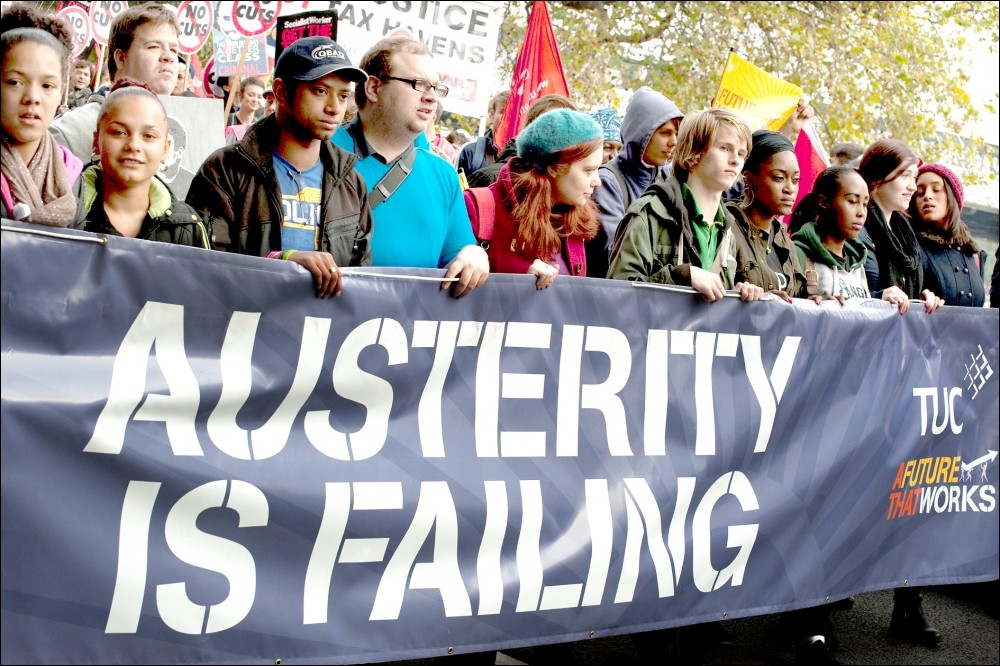
Anti-austerity campaigners on October 20, 2012. Photo: Paul Mattsson
Disruption will be widespread. Teachers, NHS staff, workers in job centres and benefits officers, staff in tax and passport offices, passport controls, immigration, museums and galleries, crown courts, country courts, magistrates and civilian staff in police stations; all will be taking to the streets after successful strike ballots by their unions. Yet in none of these ballots was there a turnout of more than 50 per cent. It is, therefore, very easy to see the simple political attraction of curbing such a demonstration by introducing a turnout threshold, ruling invalid any ballot that failed to reach the required level.

Today, at the final Prime Minister's Questions before MPs go off on their Summer Recess, David Cameron said this:

'I don't think these strikes are right... I think people should turn up for work. I think the time has come for looking at setting thresholds in strike ballots... The NUT strike ballot took place in 2012, based on a 27 per cent turnout.

'How can it possibly be right for our children's education to be disrupted by trade unions acting in that way? It is time to legislate and it will be in the Conservative manifesto.'

It is fairly clear what his intention is then and it is probably a measure which will get widespread support from those who think strikes are an unpleasant disruption which have no place in modern society. But glossing over this and the rather fundamental role protest has in a free society, introducing a turnout threshold of, say, 50 per cent - as suggested by Mayor of London Boris Johnson (himself elected with 51.53% of the vote on a 38.1 per cent turnout) - threatens to undermine further the authority of any elected figure and could well backfire.

Voting for a politician is so much easier than taking part in a strike ballot. Polling stations abound and it is not even necessary to carry your polling card when you do pitch up to mark your ballot paper. The organised can rely on postal ballots. Yet, despite, the lack of inconvenience, so many, disillusioned, disaffected, utterly fed up with all of the above, simply don't bother. As said above, the 53 per cent turnout in the Newark by-election was unusually high, buoyed by eager, naive, competition from UKIP. The turnout in Manchester Central in 2012 was just 18.2 per cent and they normally hover around in the thirties - this table shows the turnouts of every by-election since 1997.

Strike ballots, on the other hand, are only held through the postal system, a tactic, introduced under Margaret Thatcher, itself designed to reduce turnout and undermine credibility. It is not possible to turn up to your place of work, put it a cross in a box and put it in a ballot box. No one is suggesting making it easier for strike ballots to be held.

Already, the reputation of politicians could hardly be lower but, by forcing through such a change, they will leave themselves open to the very damaging charge that they deserve a more flexible, and frequently lower, level of democratic support than everyone else; one rule for Robert Jenrick, Boris Johnson, all those councillors and PCCs and another for teachers, nurses and basic state workers struggling on some of the lowest wages in the country.

Wednesday, 16 April 2014

Five problems London's next mayor will inherit

In just over two years, London is highly likely to have a new mayor. The Boris Johnson show - arch clown, Latin performer, the mayor of the Olympics - could well have drawn to an end. The blond one insists he is not standing again and if that were to be the case, though many doubt his promises, it would result in the most open, unpredictable London mayoral election since the position was established.

Boris has not been a bad mayor. His great talent is championing the capital, most vividly demonstrated before and during the London Olympics. It is hard to imagine any other British politician so effectively, and eccentrically, exhorting the crowds to enjoy themselves. He has also, for the most part, remained assuredly independent, not dogmatically pursuing a Conservative agenda, a tacit acknowledgement that his support derives far more from his personality than from his party's politics.

But, he has been a surprisingly unambitious mayor. Much of Boris’ creations have been built upon the legacy left by Ken Livingstone and his own legacy relies too heavily on curious vanity projects and follies; fun while they last but ultimately ephemeral and unsatisfactory. Boris' Vision 2020 is a remarkable document in its vapidity, and the next mayor, he or she, Tory or Labour (sorry, the Lib Dems won't win) will inherit several high profile, potentially politically awkward issues. Here are just five of them:

The Cable Car

Boris was very proud when the cable car – or the Emirates Air Line as it is officially called – opened in June 2012, ahead of the Olympics. It was, he said enthusiastically in this interview, ‘a fantastic deal for the taxpayer’ with much of the £60million cost covered by sponsorship and the European Union:

‘We’ve got a wonderful new way of getting over the river… at virtually no cost to the taxpayer….. The real advantage of it is that it is an important addition to our transport network, it’s as good as a bus route with 30 buses on it… it’s a viable addition to people's commuter route’.

And certainly, during the Olympics it was a notable success with more than 20,000 trips made per day but since then it has been nothing short of an embarrassment for the mayor. Far from being the equivalent of a bus route with 30 full buses, it emerged in December that just four passengers were using the service regularly enough to qualify for discounted prices. 

It wasn't a good deal for the taxpayer either as it later emerged Transport for London paid £15.5million towards construction with a further £6million for operational costs.

The abject failure of the cable car to attract passengers is hitting Transport for London's finances - not hugely, but enough not to be ignored. Mayorwatch reported revenue from tickets last year was 35 per cent lower than forecast. While Emirates has a ten year sponsorship deal for the cable car, it clearly isn't a 'viable addition' to commuter routes and the next mayor is likely to try and sell it, hoping someone in the private sector can run it successfully as a tourist attraction.

The Boris Bus

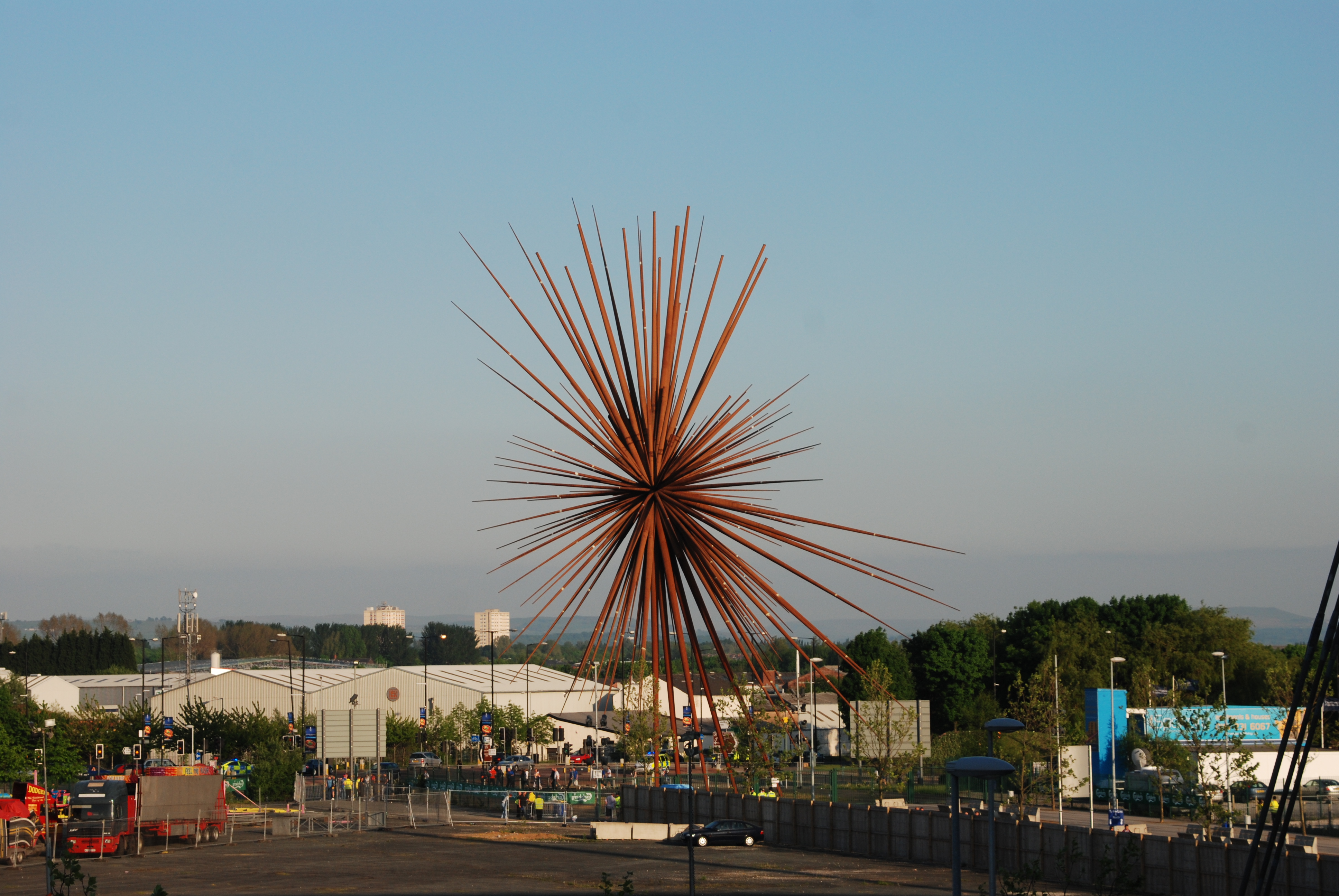
The New Bus for London (NB4L), or the Boris Bus, is perhaps the current mayor’s greatest demonstration of his vanity. Designed by Thomas Heatherwick, he of Olympic cauldron fame (and also the considerably less successful B of the Bang), the NB4L is an enormously expensive bus especially notable for its many design flaws.


B of the Bang, in its brief prime


As something of a nostalgic public transport enthusiast, in some ways I applauded the initial aim of creating a successor for the Routemaster, to add character, quirk and identity to London’s streets, but this entire project has been a tale of excessive folly.
From the start, the selection of Heatherwick as designer was odd considering he is not a bus engineer. It can be argued that the resulting vehicle has one staircase too many (two) - the desire to maintain a hop off/hop on capacity being mainly to blame for this. The back staircase works perfectly well during the day but at night, when the rear doors are closed, the central staircase is vital as passengers board and alight.
Last summer, the overheating on the bus, particularly on the top deck, promoted hundreds of complaints. The bus relies on air conditioning as the windows don’t open, but the system is clearly inadequate and several blogs and papers reported temperatures soaring above 37 degrees last summer. It was later claimed that the problem had been ’fixed’ but temperatures have still been measured over a stifling 32 degrees.
Then there is the little matter of cost. At £354,500 per bus - on top of the £11.4m development costs - they are substantially more costly than a conventional double decker bus which has a price tag of about £190,000 each. And then there is the additional cost of conductors, with an estimated annual amount of £60,000 each.
Ah yes, the conductor. They are not actually conductors but ’Passenger Assistants’ and their primary role is not ticket collection but, according to a job description, ’to travel the length of the route and ensure that passengers board and alight the bus safely’. They are, in fact, merely responsible for ’encouraging passengers’ to pay for their journey.
The next mayor will have 600 of these vehicles. Clearly, the buses cannot simply be scrapped, that would just add even more cost. But, we can expect the conductors to vanish - though the fare dodging problems that afflicted Ken Livingstone’s bendy buses are likely to return - and the notion of a hop on/hop off bus in London will be consigned to history. And gradually, over years, the NB4L too will be phased out from our streets.
 A crashed Boris Bus near Hyde Park corner, causing problems, much like the new bus

The Boris Bike

In many respects this has been one of Boris' great successes; more people are cycling than ever before, a network of these familiar hire bikes is well established across large parts of the city - the south east of London remains a glaring exception - and, unlike the cable car, the system genuinely does add another 'viable' commuter choice. It was not Boris' idea, of course, but he was responsible for its implementation. Their Barclays blue livery is a familiar sight across central London and the scheme has expanded, going further west, and continuing to prove a hit.

Nevertheless, it is still beset with problems. Barclays is ending its sponsorship in 2015, three years earlier than expected and the scheme is proving costly. A report last year found that TfL faced an annual bill of £11.1million – or £1,388 per bike. The price of the service also rose by 100 per cent; 24 hour access is now £2, and annual membership increased from £45 to £90. The price hike was way above inflation and combined with a chilly winter, the number of rentals fell by a third over the year to March 2013.

Perhaps the most fundamental problem of the system are its most typical users, white, middle class professional men between the ages of 25 and 44; these are not the usual recipients of a heavily subsidised means of transport. The next mayor will have to do something to broaden the network’s appeal.

The lack of a new east London bridge

A few weeks ago, I found myself going through the Blackwall Tunnel for the first time, going north on a 108 bus. With the narrow Victorian passage twisting its way under the Thames, offering no sign of surface light from either end, it feels like the preamble to a disaster film.


The bus route is one of the most unreliable in London due to the constant congestion in the tunnel; any accident, particularly on the older, north bound line, almost certainly incurs massive delays. Yet, the Blackwall Tunnel is one of the most important transport arteries in London and one of the very few river crossings east of Tower Bridge.

One of Boris’ first actions as mayor was to cancel the Thames Gateway Bridge, the go-ahead for which had been given by the previous mayor. Had everything gone as scheduled the bridge would now be open.

The plan had faced considerable opposition but there is now widespread acknowledgement that a major new river crossing is needed in east London to relieve traffic congestion and to encourage investment into the area, especially as the Olympic Village and Greenwich Peninsula are currently such massive redevelopment sites.

Potential mayoral candidate for Labour, Andrew Adonis, wants three new east London river crossings but just one would take a new mayor, I'm reliably informed, about five years to deliver. It will be near the top of the next incumbent’s ’To Do’ list.

Housing

This is not a problem of Boris' making - it goes much further back than his administration - but one upon which he has failed to have a significant impact. His successor will have a troubling trio of housing challenges: supply; affordability; and construction.

London desperately needs more homes - yes, the city is awash with property building but not of the sort we need, genuinely affordable homes in the right locations and family homes.

According to the Office for National Statistics, in its release published the other day, in the year to February this year, house prices in London soared by almost 18%. If you're lucky enough to own a home in London, it is very likely it earned you more money in the last year than you did from your salary.

Boris Johnson has a target of building 42,000 homes a year but last year only about 20,000 were built. In September last year London Councils estimated 809,000 extra homes would be needed by 2021, with currently only 250,000 scheduled to be built.


Boris has not been a disaster for London; instead a celebrant and champion of the city. But his mind wanders; too often, he gives the impression of being semi-detached and like an excitable kid he is prone to throwing himself into a new project before completing the one he had already started. Assuming Boris doesn't stand it's hard to know who the Conservatives will pick to stand in his place; names such as Sebastian Coe have been suggested. There also seems to be uncertainty from the Liberal Democrats.

A whole host of possible candidates have emerged for Labour. As previously mentioned, there is Andrew Adonis, but also transport journalist, Christian Wolmar, Tessa Jowell, David Lammy, Sadiq Khan, Diane Abbott and Doreen Lawrence.

But will any of the eventual candidates have the ideas to solve these - and many other - issues facing the capital?

Friday, 18 October 2013

What if Lord Adonis ran for mayor?

A map from the Abercrombie plan for London

Thus far, the only person to have publicly declared his desire to be Labour’s next London mayoral candidate is the eminent transport writer Christian Wolmar.

Disappointingly, in the first poll assessing the chances of the candidates, Wolmar was not included. While he is a long way from being the favourite, his work on trains is constantly interesting and informed and such is the importance of transport in the London Mayor’s brief he deserves to be taken more seriously.

The poll, published in the Evening Standard, found comedian Eddie Izzard favourite amongst the public, followed by Tessa Jowell, Diane Abbott, David Lammy, Andrew Adonis and Sadiq Khan. Izzard is unlikely to stand, Jowell is a strong candidate, especially after her performance during the Olympics while Abbott has a high profile and has a reputation for outspokenness, which hasn’t proved a political obstacle thus far, in the short existence of the London mayoralty.

While not commanding such a prominent media presence amongst this group, Lord Adonis is perhaps the most interesting potential candidate. Closely linked with Tony Blair, Adonis was the architect of academy schools and HighSpeed 2 (HS2): all these factors might be regarded as politically damaging. But they also reveal a man keen on promoting large, transformative projects, thoughtful and unwilling to play safe.

A few weeks ago, Adonis gave a few hints as to what his ambitions might be, as Mayor, in the annual lecture to the Vauxhall Labour Party. He began:

‘London needs a plan – a plan to become both a bigger world city and also a better working city for Londoners.’

And he continued, highlighting the problems which undeniably face the city. London has five of the 20 local authorities with the highest levels of income deprivation in England, youth unemployment is at 24 per cent, it boasts amongst the lowest apprenticeship take-up rates in the country, a 20-year difference in life expectancy between Oxford Circus and some distant stops on the Docklands Light Railway, as well as housing costs and transport problems.

‘Looming behind all this is a population explosion – caused by London’s success, but making all these problems steadily worse and more urgent.’

Adonis was scathing about Boris’ vapid 2020 Vision:

‘It is a blowing of London’s trumpet and a collection of suggestions to support London’s growth, but with little coherence, or assessment of priorities, timescales or deliverability.

‘We have a Vision without a plan. We have a succession of documents called plans which aren’t plans, some of which promise real plans at some point in the future. Then, depending on which mayoral non-plan you read, there are anything from 19 to 43 areas for priority development across the capital, but only 10 have an actual development plan. And there is a Plan Implementation Plan which promises further work on the key components of what should be included in the plan it is supposed to be implementing.’

‘Well, that’s all clear then,’ he added witheringly.

He compared it with the ‘inspirational’ Abercrombie plan, the first volume published in 1943, the second in 1944. (For more information on this ambitious, but largely unimplemented, project see this excellent piece.)

Sir Patrick Abercrombie
With the air of a philatelist who has stumbled across a particularly spectacular collection of stamps, he continues:

‘In 400 pages, plus dozens of maps, charts and photos, it surveys the historic development of London. Its analysis and recommendations are incisive and panoramic…. the tone throughout is of expertise and passion, tempered by urgency and practicality, summed up by Abercrombie’s opening words “All things are read if our minds be so”.’

He went on:

'London needs a plan for a population of 10 million. Boris hasn't got one. In practical policy, Boris has essentially been implementing parts of Ken Livingstone's unfinished programme - the parts, like Crossrail, that don't offend Tory boroughs - without developing a credible successor plan for a population of 10 million.'

So were he to stand for mayor, what post-Boris plan would Lord Adonis develop? He identified five priorities.

Three new East Thames road crossings: the Thames Gateway bridge; the Silvertown Tunnel; the new lower Thames Crossing.

Facilitating the development of London Gateway Port, which opens next year, helping it become a 'world class logistics centre. He noted that already Marks and Spencer are building a 900,000 square foot distribution centre at the site; and 'impediments stopping others from following suit - including infrastructure, skills and housing' need to be overcome to enable other firms to follow suit.

As well as 'significantly expanding Basildon', Adonis has a vision for another 'successful new town'. Already with good transport links - just 17 minutes from St Pancras via HS1 -  'Ebbsfleet is an obvious candidate.'

'It was, in effect, supposed to be a private-sector new-town but it hasn't happened because the private sector hasn't been able to put in the required infrastructure up front and take on the associated risks.'

Then, Adonis lists the Lower Lea Valley, Stratford, the Royal Docks, London Riverside, Woolwich, the Greenwich peninsula and Canada Water as 'priority areas for substantial housing and community development'.

And finally, he wants to emulate the Victorians and endow London boroughs with 'great parks and cultural attractions'. He mentions a 'serious proposal' of a £2billion Paramount theme park at Ebbsfleet, to rival Paris' Disneyland, and, (perhaps more my cup of tea), 'a kind of new national park covering the wetlands and associated habitats in the Estuary'.

It may well prove to be the case that Lord Adonis lacks the public profile and acknowledgement to carry him to the London mayoralty; too much technocrat, not enough showman. His closeness to the Blairite project may prove to be a hindrance within his own party (it shouldn't but it could). But he displays a knowledge of the capital, of its ways and means, its history and cultures, successes and challenges, to be an invaluable ally and source of inspiration to whomever Labour select as their candidate

In just one speech, Lord Adonis presents a plan for London of much more focus and significance - and much more human and celebratory - than anything Boris has proposed in his six years of office. All that is missing is a clown on a bike.


Note - Further pieces on potential mayoral candidates will appear as and when their vision for the job becomes clearer.

Thursday, 3 October 2013

Can Paxton's Crystal Palace be rebuilt?


Over the years, plans to restore the site of the Crystal Palace have come and gone, stymied by local agendas, politics, planning and a lack of funds. I have seen sympathetic butterfly houses suggested, trees mapping out the template of the original palace, a car park, houses, a shopping complex and a huge private scheme which envisaged hotels, shops, a conference centre and the inclusion of an Olympic sized swimming pool  alongside restoration of the enormous fountains. All have been conceived, some with greater detail than others, but they have fallen by the wayside.

Several local pressure groups have their own, competing ideas and have been known to take consultants on site, show them around and then, one by one, take the expert aside to whisper that the others had little idea what they were talking about. It is no surprise nothing significant has happened.

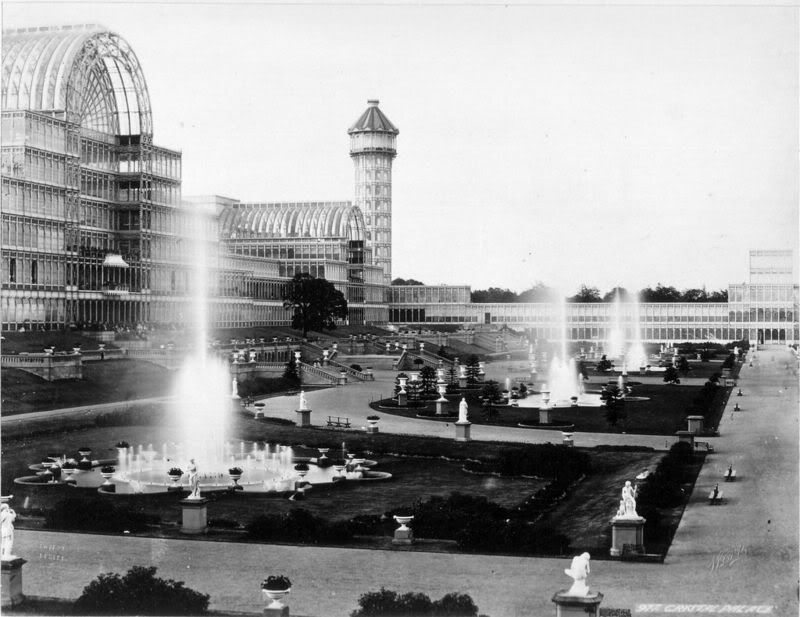
But yesterday Mayor of London Boris Johnson was joined by Mr Ni Zhaoxing, the chairman of the ZhongRong Group. Mr Zhaoxing – worth $1.25 billion and 76th on the China Rich List according to Forbes – has a dream of restoring Joseph Paxton’s Crystal Palace to its former glory (a video of their scheme is below). It wouldn't be the same as Paxton’s original, which sadly burned down in 1936, but will update the ‘innovative, translucent and delicate structure of the original along with its size and scale’, about 50 metres high and 500 metres long.


The palace would be a ‘culture-led exhibition and employment space’, the Italian terraces restored, a central tree lined boulevard running through much of the park created, the concert bowl renovated and the dinosaurs given new lighting (they were only recently restored in 2002). Sadly, no mention of the magnificent fountains which came with the original building but you never know.

They anticipate it would feature a hotel and conference facilities, studios, galleries and other commercial space. Not altogether too dissimilar from the scheme I mentioned above. Currently it remains all a bit vague. Detailed plans are, we are assured, ‘to be developed’. But if they want to stick with their timetable, they had better get cracking. A figure of £500million has been mooted for the project and they hope an application could be submitted as early as Autumn 2014, with building starting in winter 2015. And all of that includes the minefield of consultation, with the myriad of interests bickering for attention.


Paxton's original Crystal Palace


Leader of Bromley Council Stephen Carr describes it as a ‘visionary proposal’ but admits it is at an ‘early stage’. ‘It has to be worthy of serious consideration,’ he believes. They claim up to 2,000 jobs could be created.

On its website Bromley Council says the park needs ‘significant financial investment to its infrastructure to ensure that it can be enjoyed by generations to come,’ and this plan boasts that it would not need housing to be built. But it does mean handing over a large swathe of the park to a private, Chinese investment company. We know that: ‘The investor has submitted a request for an exclusivity agreement from Bromley Council.'

And already there are concerns about the project. In a letter to Bromley Council in August, the Crystal Palace Community Stakeholder Group (CSG), after they got wind of the scheme following a private reception at the Houses of Parliament, said the ‘proposal threatens the growth of community engagement and enthusiasm for a new sustainable future for the park’. They fear the park would be ‘under threat from commercial developers’. And they are particularly worried the scheme may jeopardise the Masterplan for the park, which has spent years working its way through the planning system, as well as scuppering chances for a Heritage Lottery Fund bid.

And in the London Assembly, the Green Party are already against it. Assembly member Darren Johnson said:

‘While I’m sure many people would love to see the Crystal Palace raised from the ashes, this precious parkland isn’t the right place for it. When the palace was moved there in the 1850s the newly laid out park was near countryside, but today it’s an urban park with a lot of space already taken up by the national sports centre, car parks, road and the caravan site.

‘The Mayor and the council need to concentrate on enhancing the park and backing the community groups who are doing their best to restore heritage features without losing green space.’

And as with the CSG, he raised the prospect losing the chance for an HLF bid.

One does not want to be too negative as it may be an interesting scheme and it is certainly ambitious. There are serious people on board, such as the co-founder of the Eden Project, Sir Tim Smit, who will sit on an advisory panel, chaired by Boris Johnson, which will have the challenging task of steering a path through the minefields ahead. But, at the moment, it feels it was too early to announce, such are the scant details. Details need to be urgently fleshed out and meetings with local community group need to be held within weeks. 

Update

It only seemed sensible to go up to Crystal Palace, from our little Penge cottage, to see what locals made of the idea. A prominent local businessman, who has been involved in previous restoration plans, was very keen.

'I think it's fantastic. Brilliant. It's definitely going to happen. The government are behind it, Boris is behind it; it's inevitable. They'll be a few people round here who won't like. They'll say it's like a Westfield, but it won't be. It will be great. I've been involved in plans before and I've had poison pen letters. But the vast majority of people will be right behind it. Great for the area'

A woman at the Westow pub, however, was a bit more circumspect.

'Oh no, it won't be a replica, it will be an ugly, horrible thing and they'll fill it with Caffe Nero's. We'll lose green space, and they better restore the park properly.'

Not scientific, or comprehensive, survey; just a bit of local anecdote.

Meanwhile, the egregious Stephen Bayley, writing for the Telegraph, says a new Crystal Palace will 'shame Britain'. In an absurd, pompous article, he thinks a new palace will be a 'convention centre for the lanyard-festooned suits with the inevitable yawn-inducing hotel' and calls it 'architectural debauchery'. yes, there are plenty of hurdles and issues ahead, but this is written before he has seen any plans, architectural drawings, even before an architect has been appointed. In fact, his biggest concern appears to be that such a building might appear in south east London. He writes:

'The legacy of 1851 was Albertopolis, the extraordinary collection of colleges and museums that make South Kensington one of the intellectual centres of the worlds. That's not going to happen in Penge.'

This is true. Penge is never going to compete with South Kensington, with its palace, museums and conspicuous wealth. But if he ever bothered to come to Penge he would find plenty of links with old Prince Albert, who, despite his regal bearing, wasn't such an insufferable snob; such as a beautiful estate of workers' cottages, which, if not based on his designs, were certainly inspired by them.