Showing posts with label Andrew Adonis. Show all posts

Sunday, 16 March 2014

Will Britain ever be finished?

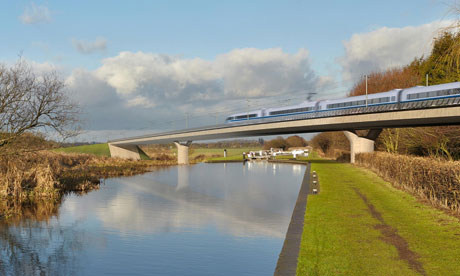
The sort of HS2 image backers don't want you to see these days
Assuming all goes to plan – and, yes, that is a very big assumption – the next twenty years in Britain is going to be marked by enormous infrastructure investment.

High Speed 2, Crossrail 2, trans-Pennine train links, new nuclear power plants and renewable projects, at least one new runway, massive house building projects including the creation of garden cities – such as the one re-announced today by George Osborne at Ebbsfleet – and bridges across the Thames are all in the pipeline and that’s before schemes not yet conceived emerge.

But, as a senior rail official told me last week, ‘it’s not a question of either or’ with these projectss; it can be argued all are needed.

Few, for example, would disagree that as North Sea oil stock dwindles, as Russia plays expansionist games in Crimea and Ukraine, Britain's fuel security is undermined further. Alternative means of power need to be found with nuclear power being an obvious source, while others will point at renewables and fracking as alternatives.

Similarly, once HS2 - subject of a major report tomorrow - is running, Euston station is set to be overrun with thousands of extra passengers a day leaving the Northern and Victoria lines unable to cope, hence the growing calls for Crossrail 2. In December last year, possible Labour Mayoral candidate Andrew Adonis warned that today’s ‘sardine conditions on central London’s Tube will be nothing compared with the congestion of the 2020s; the capital will grind to a halt’. Improving the capital’s infrastructure will be a major aspect of any campaign he runs.

After ditching the argument that HS2 was all about superfast bullet trains whizzing through an unrecognisable England, those behind the plan – inspired by the appointment of Sir David Higgins as boss – have, instead, sought to emphasize how the service will be reduce congestion south of Birmingham and be a catalyst to trans-Pennine rail links in the north.

Sir David Higgins
Materially there is nothing in HS2 which will cut journey times between Liverpool and Leeds, Manchester and Hull. But planners are adamant that the connection itself, the stage two link from Manchester and Liverpool to Birmingham and the South, will inspire northern cities to press for their own infrastructure. While many local northern authorities support HS2, there is frustration within the HS2 team that in the past these bodies have acted with too much isolation, failing to capitalise sufficiently on their geographical proximity. This, it is believed, is partly to blame for infrastructure spending per head being so much higher in the south-east than in the north.

And it is a major incentive as to why the HS2 chairman is so keen to press with the northern section of the line as fast as he is able. There is no chance, as some would like, of the line being constructed from north to south – phase two of HS2 is at least three years behind phase one in parliamentary terms alone – but the second phase could still be brought forward.

Planners also want to cut the current price tag of £50billion but the Higgins report published tomorrow will not offer any headline cut simply for easy headlines. The contingency will remain as large as it is at the moment. They know that the only way for any savings to be delivered is for the scheme to get political support from all sides in government - regardless of who is in power as the process will cover several administrations - and from local authorities across the country.

With such commitment, they hope for momentum, which will stimulate northern investment. For much of the last decade Network Rail funds have been largely diverted south to projects such as Crossrail 1. During the construction phase of HS2, fresh Network Rail funds could be invested on these northern projects, though they could still face competition from the likes of Crossrail 2, if it gets the go-ahead.

Tomorrow, Higgins will try to focus and reinforce the HS2 vision and urge politicians, and especially a twitchy Labour Party - currently the most likely to withdraw their support - to stay the course. 

HS2 planners seem to have finally honed their vision but they know success, and savings, will only come from political certainty. With so many huge infrastructure projects at the starting gates - billions of pounds waiting to be committed, spent, invested, wasted, lost or delivered - their backers will be watching closely, trying to gauge the cost of political will.

Friday, 18 October 2013

What if Lord Adonis ran for mayor?

A map from the Abercrombie plan for London

Thus far, the only person to have publicly declared his desire to be Labour’s next London mayoral candidate is the eminent transport writer Christian Wolmar.

Disappointingly, in the first poll assessing the chances of the candidates, Wolmar was not included. While he is a long way from being the favourite, his work on trains is constantly interesting and informed and such is the importance of transport in the London Mayor’s brief he deserves to be taken more seriously.

The poll, published in the Evening Standard, found comedian Eddie Izzard favourite amongst the public, followed by Tessa Jowell, Diane Abbott, David Lammy, Andrew Adonis and Sadiq Khan. Izzard is unlikely to stand, Jowell is a strong candidate, especially after her performance during the Olympics while Abbott has a high profile and has a reputation for outspokenness, which hasn’t proved a political obstacle thus far, in the short existence of the London mayoralty.

While not commanding such a prominent media presence amongst this group, Lord Adonis is perhaps the most interesting potential candidate. Closely linked with Tony Blair, Adonis was the architect of academy schools and HighSpeed 2 (HS2): all these factors might be regarded as politically damaging. But they also reveal a man keen on promoting large, transformative projects, thoughtful and unwilling to play safe.

A few weeks ago, Adonis gave a few hints as to what his ambitions might be, as Mayor, in the annual lecture to the Vauxhall Labour Party. He began:

‘London needs a plan – a plan to become both a bigger world city and also a better working city for Londoners.’

And he continued, highlighting the problems which undeniably face the city. London has five of the 20 local authorities with the highest levels of income deprivation in England, youth unemployment is at 24 per cent, it boasts amongst the lowest apprenticeship take-up rates in the country, a 20-year difference in life expectancy between Oxford Circus and some distant stops on the Docklands Light Railway, as well as housing costs and transport problems.

‘Looming behind all this is a population explosion – caused by London’s success, but making all these problems steadily worse and more urgent.’

Adonis was scathing about Boris’ vapid 2020 Vision:

‘It is a blowing of London’s trumpet and a collection of suggestions to support London’s growth, but with little coherence, or assessment of priorities, timescales or deliverability.

‘We have a Vision without a plan. We have a succession of documents called plans which aren’t plans, some of which promise real plans at some point in the future. Then, depending on which mayoral non-plan you read, there are anything from 19 to 43 areas for priority development across the capital, but only 10 have an actual development plan. And there is a Plan Implementation Plan which promises further work on the key components of what should be included in the plan it is supposed to be implementing.’

‘Well, that’s all clear then,’ he added witheringly.

He compared it with the ‘inspirational’ Abercrombie plan, the first volume published in 1943, the second in 1944. (For more information on this ambitious, but largely unimplemented, project see this excellent piece.)

Sir Patrick Abercrombie
With the air of a philatelist who has stumbled across a particularly spectacular collection of stamps, he continues:

‘In 400 pages, plus dozens of maps, charts and photos, it surveys the historic development of London. Its analysis and recommendations are incisive and panoramic…. the tone throughout is of expertise and passion, tempered by urgency and practicality, summed up by Abercrombie’s opening words “All things are read if our minds be so”.’

He went on:

'London needs a plan for a population of 10 million. Boris hasn't got one. In practical policy, Boris has essentially been implementing parts of Ken Livingstone's unfinished programme - the parts, like Crossrail, that don't offend Tory boroughs - without developing a credible successor plan for a population of 10 million.'

So were he to stand for mayor, what post-Boris plan would Lord Adonis develop? He identified five priorities.

Three new East Thames road crossings: the Thames Gateway bridge; the Silvertown Tunnel; the new lower Thames Crossing.

Facilitating the development of London Gateway Port, which opens next year, helping it become a 'world class logistics centre. He noted that already Marks and Spencer are building a 900,000 square foot distribution centre at the site; and 'impediments stopping others from following suit - including infrastructure, skills and housing' need to be overcome to enable other firms to follow suit.

As well as 'significantly expanding Basildon', Adonis has a vision for another 'successful new town'. Already with good transport links - just 17 minutes from St Pancras via HS1 -  'Ebbsfleet is an obvious candidate.'

'It was, in effect, supposed to be a private-sector new-town but it hasn't happened because the private sector hasn't been able to put in the required infrastructure up front and take on the associated risks.'

Then, Adonis lists the Lower Lea Valley, Stratford, the Royal Docks, London Riverside, Woolwich, the Greenwich peninsula and Canada Water as 'priority areas for substantial housing and community development'.

And finally, he wants to emulate the Victorians and endow London boroughs with 'great parks and cultural attractions'. He mentions a 'serious proposal' of a £2billion Paramount theme park at Ebbsfleet, to rival Paris' Disneyland, and, (perhaps more my cup of tea), 'a kind of new national park covering the wetlands and associated habitats in the Estuary'.

It may well prove to be the case that Lord Adonis lacks the public profile and acknowledgement to carry him to the London mayoralty; too much technocrat, not enough showman. His closeness to the Blairite project may prove to be a hindrance within his own party (it shouldn't but it could). But he displays a knowledge of the capital, of its ways and means, its history and cultures, successes and challenges, to be an invaluable ally and source of inspiration to whomever Labour select as their candidate

In just one speech, Lord Adonis presents a plan for London of much more focus and significance - and much more human and celebratory - than anything Boris has proposed in his six years of office. All that is missing is a clown on a bike.


Note - Further pieces on potential mayoral candidates will appear as and when their vision for the job becomes clearer.

Monday, 23 September 2013

HS2 needs an alternative, not just scrapping


There is an ever-so-slim danger the Labour Party might soon have a firm policy to defend as Shadow Chancellor Ed
Balls gave the clearest indication yet the opposition are preparing to dump their support for HighSpeed 2 (HS2). 
In his conference speech, the Labour bruiser repeated his line that there would be no ‘blank cheque’ for the inevitably controversial scheme. 

And he said:

‘The question is – not just whether a new high speed line is a good idea or a bad idea, but whether it is the best to spend £50 billion for the future of our country.’

As someone who fails to be convinced by the pro-HS2 arguments I should be pleased, but alarm bells are ringing in my head that simply scrapping the scheme – which has already cost hundreds of millions of pounds without so much as a piece of ballast being put into place – will simply result in lethargy filling the vacuum. HS2 needs to be replaced with a coherent, well-argued, realistic vision of Britain’s rail network, not scrapped in favour of our traditional shambolic, day-to-day, knee-jerk, panicky, management which has typified much of Britain’s transport policy for so many years.

Even the most maniacal supporters of HS2 – and on Twitter there are inevitably some CAPITAL LETTER SHOUTING fanatics who clearly weren’t allowed into debating societies – must accept the case for HS2 has not been won. 

Yes, capacity on the West Coast Main Line (WCML) is an issue but alternatives have not been exhaustively sought. The business case is flimsy, the dangers of sucking money from the regions into London – rather than the other way round – are just ignored, and the passenger number predictions are likely to be exaggerated, much as HS1’s were.

The problem is frequently, those arguing the strongest for HS2 are the ones who have the most financially to gain from the train line; their assertions cannot simply be taken at face value.

The issue of vested interests undermined KPMG’s report when it was released a fortnight or so ago. It was commissioned by HS2; obviously it would focus on the positives. And it had some glaring omissions as highlighted by Robert Peston here. He wrote that:

‘….many of the gains to the regions that KPMG calculates are based on the reasonable notion that companies will be established in places where transport links are better. But it has taken no account of whether those regions actually contain available land to site new or biggest companies or have people with relevant skills to employ.’

He added, damningly, that KPMG was ‘ignoring one of the fundamental causes of lacklustre growth in many parts of the UK, which is a shortage of skilled labour and of easily and readily available land’.

It's too late for the coalition government to abandon it as too much capital, political and other kinds, has been invested. And while this may just be another politician trying to keep all people happy all the time, with its eye-wateringly hefty price tag,  it is very easy to see why Ed Balls and senior Labour figures might want to ditch the whole plan. Suddenly, they would have made huge savings and could plot to redirect the money into their pet projects. But the whole rail network could lose undoubtedly needed investment and suffer as a consequence.

Already, a Labour source has indicated that while Balls is committed in principle to the rail link, he has no alternative route in mind. No mention of more east-west connections, more electrification, or countrywide fast broadband provision to negate the need to travel at all. 

The most convincing and articulate champion of HS2 is Andrew Adonis. The project's architect, he is a genuine train enthusiast. As transport secretary he took the radical step of taking trains around the country, to actually experience what train travellers had to put up with. In his August New Statesman article he was scathing about the management failures already besetting the project, bemoaning the complete lack of legislation for even the first phase of the line to Birmingham after three years of coalition government. He has urged for the creation of an HS2 minister to get a semblance of coherence and control on the project. Neither the coalition or the opposition has responded to his pleas and created such a role.

We are yet to hear what he makes of Labour's latest prevarication but I imagine it would a blend of annoyance, anger and disappointment.  If HS2 does get ditched, it will need someone like him to pick up the pieces and forge an alternate vision.

Update

We have now heard what Andrew Adonis has to say about Balls' HS2 threat. Speaking at  fringe event in Brighton, he said: 

'I'm very mindful of HS2 and where we are on this too. We cannot as a party preach long-termism and not practise it ourselves. We have got to be very clear about that.
We are the party that started HS2. I published the plan three years ago. We set the whole thing our, we set out the rationale, including capacity.
'We went through the whole thing. We did a major job of work.
'You have got to in politics, you cannot say that your principles and all that apply to other people but they don't apply to you when short term political advantage might rear its head. We have got to stick with this. It's very important.'

And, bitterly, he told the New Statesman the only thing the coalition had done 'since coming to office is add £10bn to it'.

He's clearly still flying the flag.

Tuesday, 27 August 2013

Signal problems ahead for HS2

Another day, another report emerges battering High Speed 2 (HS2); this time it’s the Institute of Directors (IoD), dubbing the project ‘a grand folly’. A theme has developed now; lobby group after lobby group emerges to lambast the scheme and one wonders which political party will be the first to burst the consensus and decide it’s just too much of a risk.

The latest survey finds just 41 per cent of IoD members think HS2 will be important to their business; a sizable minority but a big fall from the 54 per cent who thought the same back in August 2011.

And it pours scorn on the always daft notion – and part of HS2’s business plan – that time spent on a train is wasted. Even on commuter cattle trucks, emails are checked and plans are made. On inter-city services, the comfort and lack of interruption can make the train a wonderful place to work. And the IoD survey found just 6 per cent of directors saying they never worked on a train.

Part of me really wants to champion HS2. I adore train travel; the familiar rhythms, the views, the sense of freedom. I get inordinate pleasure from indulging in daft conversations with the Herne Hill station master about the creation of the Sydenham to Penge tunnel, much to my wife’s embarrassment. And last year my wife and I went on a European holiday by train. It was sublime. Rather than suffer the stress and indignity of flying, our adventure began the moment we arrived at St Pancras. The Eurostar was efficient, smooth and not quite long enough; the TGV through France, magnificent. And it even stocked decent wine. And here are all of Britain’s main political parties willing to spend billions on a new rail system. Why shouldn’t Britain have some of this?

A major problem is a matter of timing. France opened its first TGV line all the way back in 1981. It heralded a renaissance in French long-distance rail travel which was emulated across Europe. High speed rail is now a well-established feature of European travel, with a web of lines spreading across the continent; France, Italy, Spain, Germany, Switzerland, Belgium are all connected.

HS2 is not of course Britain’s first high speed line, but it is certainly our first major investment in such a system. But if things go to plan – and that’s an exceedingly big ‘if’ – the first stage of HS2 will open in 2025, a mere 44 years after France’s first dalliance with high speed rail. In what will our European neighbours be investing then? Is there not a danger that it’s a little too late to play catch up? Wouldn’t it be better to spend the £42.5billion, leading, instead of following, with another form of infrastructure; having truly nationwide, superfast wi-fi access, reducing the need to travel – thus freeing undeniably necessary capacity – in the first place, for example?

HS2’s backers are convinced it is not too late. Pete Waterman – such a train enthusiast that when he speaks on the subject it is as though he’s discussing a giant train set equipped with model stations and carefully placed bottle brush trees – wrote passionately in yesterday’s Telegraph, claiming HS2 ‘could transform the skills base of the country’ and would be a ‘beacon for any young people looking to the future’.

And Andrew Adonis, Labour’s excellent former transport secretary, who appears to be getting jumpy at the increasing anti-HS2 vibes emerging from his party, used a column in the New Statesman to claim the case for HS2 ‘is as strong now as when Labour committed itself to the project in March 2010’. The plan is going through the ‘classic “cold feet” period which bedevils every major British infrastructure project’. Cancelling it would be an ‘act of national self-mutilation’.

I really want to agree with him. I just can’t see how.

Maybe my concerns are not worthy. Perhaps the project is for the best and us naysayers are simply following an ignoble parade, trouping behind Luddite vandals, gloomy conservative whingers, enthusiastically unimaginative town planners, and romantic pew-seated High Church traditionalists.

One of the most intriguing aspects about the anti-HS2 lobby is how it appeals across the political spectrum, from the green left to the libertarian right. Yet, while they are on the same side, they are there for different reasons. The libertarian, self-styled, Taxpayers’ Alliance call HS2 ‘a terrible waste of money’ and a ‘politicians’ vanity project’, while the green left yearn for such capital spending to be directed towards alternatives, with renationalisation of the system clickety-clacking constantly in the back of their minds.

Opponents cannot simply be dismissed as shire-dwelling nimbys, a slander against the hundreds of people who face losing their homes around Euston Station. And other problems go unaddressed; the route, the almost inevitably disappointing passenger numbers HS2 will attract (just look at HS1), the dangers of sucking businesses towards London rather than the other way, and the horrifying, and unknowingly enormous, cost.