Showing posts with label Syria. Show all posts

Tuesday, 1 December 2015

A perilous path to an inevitable war

Assuming the House of Commons votes as expected and consents to allowing the RAF to bomb Islamic State (ISIL) targets in Syria, from the furious level of debate going on one would be forgiven for thinking Britain was preparing to deploy a taskforce of the size used in the 2003 invasion of Iraq.

But, instead of tens of thousands of British troops being despatched to the border to gather as part of a massive international invasion force, Britain plans to add a few planes – Tornadoes and Typhoons – to the eight Tornadoes already carrying out bombing sorties on ISIL in Iraq. We are assured that this exceedingly modest force will produce real, tangible results; that we will witness the Brimstone missile – which adorns the Tornadoes but not the Typhoons – accurately decapitating ‘the snake’ with the minimum of collateral damage and those already fighting really cannot cope without our input.

It may be the case that this small increase in airpower does, indeed, make an important difference but there must certainly be a risk it simply adds yet more complications to a perilously messy battleground. And while we wait to see how the military action plays out, the political risks on all sides will remain immense.

There seems to be universal agreement that defeating ISIL cannot simply be done from the air but the motion to be voted on tomorrow rules out deploying British forces - one wonders whether this will remain a firm pledge if there were a Paris-style atrocity in London. Instead, we are, apparently, hoping to rely on 70,000 ‘moderates’ to secure land vacated by ISIL as they retreat from our bombs. There is a great deal of scepticism about this assertion and, in what was an otherwise impressive performance by David Cameron in the House of Commons, it was the closest the prime minister came to a ’45 minutes from attack’ claim. If things go wrong, if little evidence of this force emerges and terror returns to the streets of Britain, it will appear as though Cameron, like Tony Blair before him, massaged the views of the Joint Intelligence Committee to push Britain into another conflict. His authority will be dashed for good.

Moreover, it has emerged on the eve of the debate and vote Cameron has told his MPs:

'You should not be walking through the lobbies with Jeremy Corbyn and a bunch of terrorist sympathisers'

This thoughtless, dim comment blows apart Cameron's attempts to build a broad coalition for bombing ISIL in Syria. There are many differing, and honourably held, views about how to tackle this terror threat but no one taking part in the debate here feels any 'sympathy' for ISIL. It is an astonishingly offensive and foolish thing to say which not only insults vast numbers of people across the country - probably a majority - who oppose further military action but may also galvanise parliamentary opposition on all sides.

For Jeremy Corbyn, it is hard to find anything in his self-destructive handling of the situation about which to be positive. While the debate should be focused on the rights and wrongs of military involvement in Syria, what we might be able to achieve balanced against the inevitable risks of conflict, the centre of attention has been Corbyn and the furious split that has emerged within Labour. Corbyn has a strong mandate and plenty of support within the wider Labour Party as a whole but he is a terribly isolated figure within the parliamentary Labour Party. It is not hard to imagine figures such as Shadow Foreign Secretary Hilary Benn and Shadow Defence Secretary Maria Eagle vacating their positions soon.

As a permanent rebel, Corbyn was never likely to inspire much loyalty from his shadow ministers and when it is so blatantly clear his policies – on matters such as Trident and military action – contradict the opinions of so many of his close team, he was always on a hiding to nothing. While not having a collective policy on the matter of whether the country goes to war or not is a blow to Labour’s authority, offering his MPs a free vote on the matter was always the likely outcome and should have been offered from the outset. Instead we’ve been exposed to Corbyn at one moment trying to be the diplomat allowing debate within the parliamentary party while in another attempting an impression of a tough guy, insisting that he and only he would be deciding Labour policy.

There is no doubt that misguided military action in the region has helped create the stage upon which the ISIL death cult has been able to flourish and we can’t afford another incompetent intervention like Iraq and Libya. We must try and starve ISIL of funds and weapons – as Corbyn has argued – but in the short and medium term this does nothing to stop further attacks in Europe and more terror in their lands. 

It is impossible to present a good answer to this desperate situation. Bombing at any stage will cause civilian casualties, but we see civilians being murdered in horrifically perverted ways on a daily basis by ISIL regardless. Without Syria returning to a stable state the refugee crisis that has swept across the Middle East and into Europe cannot be solved. ISIL can play no role in the future; but fighting them from the air, across a land beset with chaos, seems unlikely to contribute to any sort of stability. Yet, it is at this moment that the UN has called, with remarkable unanimity, for states to join war against ISIL, wherever its war-mongers can be found.  And, whilst ISIL can ignore the border between Iraq and Syria, it makes no sense for those fighting the cult to do the same.  Furthermore, even if our military power is unlikely to make any significant difference to the outcome, our commitment to supporting our close political allies – especially France, at this time of great need – will be valued.  What is more, if we were to refuse to fight in the air over Syria, where Raqqa has been declared the capital of the ‘caliphate’, we would be handing these people a propaganda victory.

And yet, I must repeat: there is no good answer to this desperate situation. I find myself in the odd position of thinking that, were I to have a vote tomorrow, I would probably side with Corbyn, despite little of what he has said influencing my thinking. I would oppose getting involved now on the basis of that dodgy ’70,000 moderates’ claim and the belief that a much more comprehensive international coalition needs to be formed to do the job properly, both during the conflict and, even more crucially, afterwards. 

The only certainty is that we cannot ignore ISIL.  This is a movement inspired by violence and it will not neglect us.  Whatever is to come, we can be pretty sure it will be terrible.  Perhaps the only logical conclusion is to acknowledge that, ultimately, we surely cannot rule out doing the job properly and using British ground forces.

Wednesday, 25 November 2015

Corbyn is avoiding his duty by avoiding Syria

I know the focus was never likely to be on Jeremy Corbyn’s efforts at Prime Minister’s Questions, as George Osborne was unveiling his double whammy, the Autumn Statement and Spending Review all rolled into one. But, Corbyn may as well not have bothered turning up he made so little impact.

It is not that the subject matter of his questions were completely inappropriate – challenging the government’s commitment to green energy and the plight of, and services offered to, abused women – they were just the wrong subjects on the day.

The Prime Minister is preparing to present to the House of Commons proposals, which will at some point be debated, that could see British armed forces going into action against ISIL in Syria. I know that the Labour Party is hopelessly split on the issue, but it falls to the Leader of the Opposition to raise these important issues on occasions like PMQs.

And while the pressure to support such airstrikes is huge – and, speaking personally, I do think we have a responsibility to help try and fix the mess which we are undoubtedly partly to blame for creating – the shooting down of the Russian plane by a Turkish fighter is reason enough to consider pausing for a moment, just to allow for anger to subside, for events to follow their course.

Had Jeremy Corbyn made such a plea, even though David Cameron is likely to have brushed it off, the Leader of the Opposition would have been making a reasonable point, one which would have broad appeal. After all, hastily sending our military in to such a confusing, multi-layered, conflict zone, without detailed talks and agreements between as many of the significant players as possible, is the last thing we should be doing.

But no. Not a word on the matter did Jeremy Corbyn mutter. It was left to the SNP’s Angus Robertson to mention Syria. Sadly for Corbyn, avoiding the issue isn’t going to make it go away.

Postscript

While I'm on the subject of the opposition, how on earth did shadow chancellor John McDonnell put himself into a position where he had to appear on television and condemn the brutality of Chairman Mao? I understand it was supposed to be a gag about Osborne flogging of British assets to a Communist government in China - an attack which has some merit - but to say it fell flat is slightly flattering.

I do quite like McDonnell's style on television; he's quite open and happy to be contrite - some may say he has a lot for which to be contrite - but he should steer clear of attempts at edgy humour.

Wednesday, 9 September 2015

Until Syria is rebuilt, what choice is left?


The ultimate goal, as Europe deals with the migration crisis that is suddenly sweeping the continent, must be to restore peace in Syria and help make it a country to which people feel safe enough to return.

Tragically, this country, which was so recently functional, civilised and well developed – albeit one ruled by an hereditary dictator – has disintegrated. Both ISIL and President Bashar Al-Assad are unleashing unspeakable terrors upon the people, four million of whom have fled the country and a further 10million are displaced within its borders.

And, as these refugees flee, into Jordan, Lebanon, Turkey and beyond, they join other refugees fleeing other places of conflict in Libya, Eritrea and South Sudan, as well as economic migrants; a massive movement of people mostly desperate for, as Stella Creasy said in the emergency debate yesterday, ‘the chance to stay alive’.

This is the situation that David Cameron and Europe face. While Angela Merkel and others have started welcoming refugees for humanitarian and other more prosaic reasons, it’s hard not to conclude that the prime minister’s response has been directed by a contradictory mess of politics.

It can only be a good thing that Cameron’s government wants to take in 20,000 vulnerable people who have fled to refugee camps from Syria by 2020, but at 4,000 a year this is a pitifully small number, especially compared with Germany which is contemplating 800,000 migrants this year and a further 500,000 in subsequent years. Germany welcomed 18,000 refugees last weekend alone.

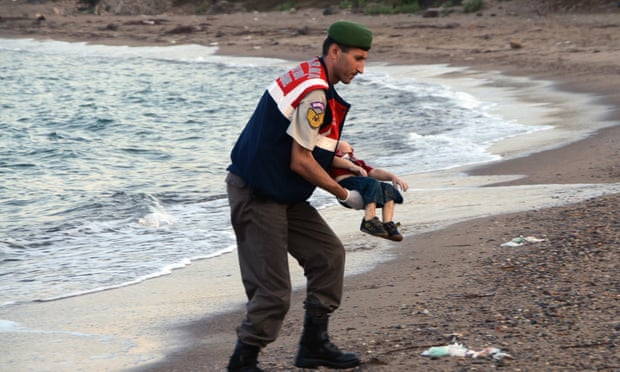
There seems little doubt that the prime minister and his government were caught flat-footed by the outpouring of anger and grief triggered by the decision of several newspapers – including my own – to publish the photograph of the dead Aylan Kurdi on their front pages; yet, hopes that the 20,000 pledge would be enough to see off his critics already seem misplaced. And Cameron’s stance does nothing to deal with the situation facing Europe now.

In many ways, the prime minister is in an unenviable position. On the one hand, he doesn’t want to be seen to be doing anything which might smack of co-operation with our European partners in case it provides any ammunition for those in his own party who want to leave the European Union - many of whom are also prominent campaigners against high immigration. On the other, Mr Cameron will be only too well aware that his EU partners are urging Britain to do more to alleviate the refugee disaster within Europe’s borders and he must fear that his determination to exclude this country from any shared willingness to offer a safe harbour to refugees threatens the progress of any future EU negotiations.

But, as the circumstances change, our response must change. Cameron is right when he says a solution cannot simply be achieved by taking in more refugees. And he is clearly aware that any solution has to be multi-faceted. 

The prime minister may feel sore about his failure in the last parliament to command support for attacking Assad after he used chemical weapons in the conflict in Syria. But, without parliamentary approval, we now learn that action has been taken in Syria anyway, with a fatal drone strike on British terrorists there. International co-operation is essential and enlarged military action of one sort or another – against both Assad and ISIL – now seems increasingly inevitable.

But simultaneously, Cameron might be better to try and rise above the messy political complexities, take a lead in parliament, and respond to the imperative need for human kindness closer to home now.

Those who argue against allowing more refugees into the country, have a favourite question to which they often return, 'well, how many should we take?’ It is an impossible question to answer. The British government has done much to support refugees in the Middle East, spending more there than any other European country. But the crisis has developed and moved. Ignoring the situation in Europe is not part of a solution.

Britain cannot keep on claiming to be an honourable place of refuge on account of the Huguenots who flocked here in the 16th and 17th centuries . It cannot even do that on account of the Kenyan Asians who arrived here from the late 1960s. As Robert Peston has noted, Germany’s motivation to taking so many migrants is not wholly humanitarian; their population is ageing and falling, a boost in younger workers is just what Germany needs.

Similarly, we need to take heart from the very significant benefits this country has accrued from our own, historic refugee influxes and recognise that being properly generous, now, could bring its own reward in the future. But ultimately, the demand to act, to work with our European counterparts to tackle this wretched situation on our doorstep, is a simple one; the humanitarian need is here and now.

Tuesday, 16 June 2015

The Med's refugee crisis shames the country

Theresa May has been attending the latest meeting in Europe where ministers from across the region are trying to come up with a solution for the dreadful problem of thousands of people fleeing north Africa hoping for sanctuary in the relative safety of Europe.

This is what the Home Secretary had to say as she arrived:

‘Of course, the crisis in terms of migrants who cross the Mediterranean is a problem in two ways. First of all, obviously, lives are being put at risk but secondly, as we see in Calais and elsewhere, it’s putting great pressure on European towns and cities which is even reaching to our borders, although we are not part of the borderless Schengen area.

‘To deal with this issue in the long term we need to go after the criminal gangs who are plying a terrible, callous trade in human lives.

‘We also need to break the link between people getting into the boats and reaching Europe. That means returning people to North Africa or elsewhere, or to their homes countries; so that they see that there is no merit in this journey.’

The desperate people so frequently rescued from shabby boats in the Mediterranean Sea are routinely referred to as migrants; this almost suggests their decision to try and escape to Europe is a lifestyle choice. They are rarely called refugees, yet, such is the turmoil in that part of the world, it is almost inevitable than the majority have fled conflicts in Eritrea, Somalia, Sudan, Central African Republic and Libya itself. And, according to aid agencies, increasing numbers of people from Syria, where nine million people are displaced and more than four million people have fled abroad, are arriving to seek passage.

Libya, despite facing immense post-Gaddafi violence, is an obvious place for a migrant/refugee to target such is the coast's proximity with the southern reaches of several European countries. And there is no doubt that many who ultimately get there are victims of people trafficking gangs. Theresa May is right to say they are 'plying a terrible, callous trade in human lives'. But, while, Western nations may have the best of intentions to pursue these gangs, there is no realistic means to do such a thing. No troops are going to be put on the ground in Libya, drones cannot be used; the gangs will continue their trade unmolested for the foreseeable future.

My primary concern, however, with Ms May's statement is the last paragraph which demonstrates that the Home Secretary entered into these negotiations with not only utterly unachievable, but also the wrong, ambitions. Earlier this week Amnesty International released a report on the 'global refugee crisis' highlighting the dangers of the Mediterranean crossing, describing it as the 'most dangerous in the world' and attacking Western governments for their consistent failure to acknowledge and even start addressing the world's largest refugee crisis in Syria.

But even this crisis has competition. Steve Symonds, Amnesty's Refugee Programme director, said: 

'In South East Asia we've seen boats full of desperate and starving people literally pushed back by Indonesia and Malaysia before they were shamed into taking them in.

'This compassion deficit seems to be a global fatigue.'

And the UK could be described as being amongst the most fatigued countires of all.According to Amnesty, out of the four million who have escaped the Syrian civil war, Britain has resettled a pathetic 187.

Theresa May talks of returning people to North Africa, to their home countries, apparently with the intent of proving that 'they see there is no merit in this journey'. This actually means that the British government would rather actively seek to return people to war zones, under the most wretched circumstances, than contemplate the possibility of offering sanctuary. It is reassuring that HMS Bulwark is to continue doing its sterling work rescuing hundreds of people from the sea's waters, but simply trying to return them to their places of origin does nothing to solve the problem. And it's hard to imagine how any Western government could demonstrate to someone fleeing for their lives that there is no 'merit in this journey'. Those undertaking the perilous journey are doing so, not because they fancied a quick jaunt across the Med, but in the hope that they and their families might actually live. Argue with the 'merit' of their journeys as the barrel bombs are falling.

Britain once had a proud heritage of offering sanctuary to the oppressed and desperate, a record governments are eager to invoke. But we do not any longer. Like the Clinton government before, which refused to use the word 'genocide' in reference to the killings in Rwanda just to avoid being obliged to intervene, this government and the coalition before it, refuse to recognise the reality of the situation for parochial, political reasons, which necessitates a refusal to adopt a functional immigration system. Until we do so, the boats will keep coming, will continue sinking & people will try ever more dangerous ways to try find a place they can survive. Britain is shirking its responsibilities and it's a state of affairs which should shame us all.

Friday, 30 August 2013

The government is defeated but no one should celebrate

The vote this evening is a moment of huge political embarrassment for the prime minister. Many will be thrilled the government has been defeated; we are not going to war with Syria. We will not fire a shot in anger, no matter what Bashar al-Assad does to his people in Damascus and elsewhere in that horribly destroyed country.

But in fact, for those who wish British foreign policy to be more than that of Lithuania or Belgium, it is a terrible result. It could well severely hamstring British foreign policy, regardless of which party is in power, for years to come.

Judging from the level of insults emanating from Downing Street officials, it seems pretty clear the decision not to make the vote tonight about authorising the launch of cruise missile strikes was due to Ed Miliband deciding to push to give the UN more time. The Labour leader was a f****** c*** (foolish chap) for tabling his own motion, but he was right to call for a pause. According to the timetable which appeared to be rushed from nowhere into the news schedules, tomorrow or Saturday we were starting to attack. With UN weapons inspectors still on the ground, no one knew why it needed such a short deadline.

The Prime Minister wanted to be strong. Presidents Obama and Hollande were keen to go; we don't have a presidential system. David Cameron knew he couldn't simply go ahead without support. But, he underestimated the bitterness left by Iraq. Like Poe's Raven, the shadow was on the floor; impossible to ignore. MP after MP complained how they were duped by intelligence reports and spin to support the Iraq invasion - forgetting the huge opposition and the multiple reasons why that war was so misguided - and yet the government offered a few flimsy sheets of A4 as evidence of the intelligence services certainty Assad was to blame. It was a hopelessly inept strategy.

Obama and Hollande may well continue with their Syrian adventure. It's hard to imagine a US leader, particularly Obama, rushing for support from Britain for foreign adventures, any time soon. Obama will make tender words but will raise his eyebrows at the farce. The special relationship is nothing more than a general election tag line; it has no contemporary significance.

None of this is any help to the people of Syria. Their suffering will continue. Neither Labour, nor any opponents, were giving succour to Assad but it's hard to think the Syrian leader won't be pleased by the farcical consequences of tonight's vote.

For make no mistake, the atrocities will continue in Syria. Already, there are suggestions a napalm attack has taken place in Syria. We won't flex a muscle. If a Rwandan-style genocide started tomorrow. A finger wouldn't twitch. Cameron won't risk such humiliation again. 

Is this really what we want?

Wednesday, 28 August 2013

Will we be saying 'never again' once more? Part two

* This is an update to an article first published by Metro here

Taking a moral stance, no matter how flawed and imperfect it may be, is sometimes easier than negotiating murky political waters. Being prepared to engage militarily with a state which has used chemical weapons against its own people is the right thing to do; but rushing headlong into such a campaign while the truth of such a heinous attack has not been established as surely as possible would be reckless and a significant failure of leadership.

Understandably David Cameron wanted to be decisive over the Syrian attack. He rushed back from holiday while Nick Clegg cancelled a trip to Afghanistan, where he was due to cheer up our lads on the front. It was fairly clear the recall of parliament was inevitable. And for days, the signals emanating from the government have been that MPs would be expected to decide whether to back armed assault on Bashar al-Assad and his military. And such action could even begin by the weekend.

This is no longer the case. Weapons inspectors on the ground are still trying to verify what actually happened in the Ghouta region, east of Damascus last week. They will not apportion blame. It seems almost certain a nerve gas attack launched by the Syrian regime is to blame; but, while UN inspectors will apportion no blame, it's worth waiting a few days for confirming details.

UN secretary general Ban Ki-moon said inspectors needed four more days on the ground and the Labour opposition indicated it would not support an attack on Syria unless inspectors were given more time.

Some, bizarrely, started to claim Labour were behaving deceitfully and playing politics with a critical situation; but very quickly, once people gave it a moment's thought, waiting a few days seemed an eminently sensible thing to do. Not waiting for the report from UN weapons inspectors did Tony Blair's government no good as they rushed headlong into invading Iraq.

So now we are left with something of an oddity; MPs are returning tomorrow to express their outrage at events in Syria, agree a humanitarian response is necessary and that 'legal, proportionate' military action may be required. 

The motion criticises the UN for its inaction over the horrors of Syria and calls for necessary time to be given to inspectors to carry out their work.

Only the most pacifist will find a word in the document to complain about. Tomorrow's debate and vote has gone from something critical into a pointless charade; there will be no British involvement in action against Syria without a further parliamentary vote.
Full clarity is unlikely to emerge. We will only ever think we know that Assad's regime was responsible for the awful attack. But unless significant doubt is raised about the identity of the perpetrator, we still must take a stand. Our values remain unmoved. Finding political excuses to avoid taking responsibility now will only lead to regret later. 

Tuesday, 27 August 2013

Will we be saying 'never again' once more?

This morning Adam Holloway, the Conservative backbench MP, and former Grenadier Guard, appeared on the Today programme and warned against intervention in Syria.
‘What’s the strategy here?’ he pleaded. ‘Reaction to horror is not a strategy. I would be completely up for a military attack if we could predict what the end state would be, if we knew that a limited strike of the kind that is being described here was going to bring people to the negotiating table.
‘Apart from remaining with our dear friends the Americans, I don’t know what the UK national security interest here is. Can someone tell us?’
It strikes me that Mr Holloway’s comments provide the ultimate excuse never to get involved in any conflict again, unless a direct military threat is felt by these islands. Read more