Showing posts with label Labour. Show all posts

Friday, 8 September 2017

Ignoring student fees isn't an option

Whenever the government feels senior figures from other sectors are earning too much money to be publicly acceptable, it resorts to the spurious comparison with the ‘Prime Minister’s salary’. As Theresa May struggles to make ends meet on a basic wage of around £150,000, this is used as example of what others should consider to be satisfactory remuneration for a year’s labour, regardless of market forces and the status of employment.

That it conveniently ignores the other benefits a prime minister receives, such as a flat in a desirable central London location and a lavish country pile, oddly hasn’t prevented it from being a tool for public embarrassment and blackmail.

And thus, it is now the turn of university vice-chancellors to be subject to this method of public opprobrium, though in this case perhaps with more justification. It follows the campaign by former Labour cabinet minister Lord Andrew Adonis – the architect of student fees in the Blair government – who has been railing against what he perceives as the excessive pay of vice-chancellors as part of a wider mission to see the current students fee system scrapped.
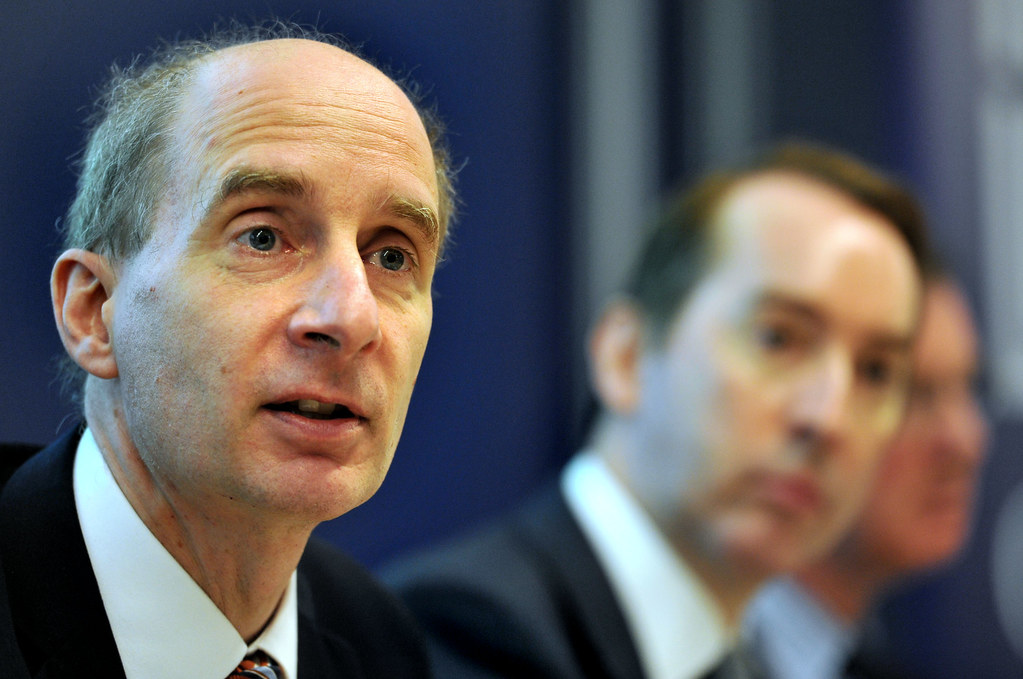
Lord Adonis
As students see their annual fees rise to more than £9,000, with the government promising it will rise with inflation in subsequent years, figures such as Dame Glynis Breakwell, the vice-chancellor of the University of Bath, has seen her annual pay package rise to £451,000. Sir Andrew Likierman, at the London Business School is on £445,000 and Alice Gast at Imperial College is on £430,000. Such figures do appear somewhat eye watering.

According to a study published by the Times Higher Education magazine earlier this year, the average take home package of a vice-chancellor was £257,904 in 2015/16, 2.5 per cent up on the previous year.

Lord Adonis has accused vice chancellors of increasing ‘their own pay and perks as fast as they increased tuition fees’.

In July he wrote:

‘Debt levels for new graduates are now so high that the Institute for Fiscal Studies estimates that three-quarters of graduates will never pay it all back. The Treasury will soon realise it is sitting on a Ponzi scheme.’

And speaking to me yesterday, Lord Adonis predicted that unless universities voluntarily cut their student fees they will be abolished by the next government, regardless of which party is in power. He said:

‘The vice-chancellor pay controversy is directly linked to the tuition fees crisis. The universities have got to start cutting their fees, and they can fund this in part by slashing their bloated senior management salaries and budgets.

'Unless the universities cut their fees, I predict they will be abolished entirely by whichever party is in government after the next election, if not before. The student vote will see to that.’

Perhaps there is an argument that the government has to start somewhere but it currently seems determined to retain the current fees system, dismissing any claims of a crisis, despite students from almost every university now facing the prospect of being lumbered with £50,000 debt after graduating, regardless of the quality of the course. During Jo Johnson’s appearance on the Today programme on Thursday morning is was noticeable the universities minister didn’t raise the matter and was only forced to defend it when it was raised by interviewer Justin Webb.

Universities will face fines unless they are able to justify salaries over £150,000 to the new Office for Students. It’s chief, Nicola Dandridge, was, somewhat hilariously, hired on a salary of £200,000 and has now remarkably ‘volunteered’ to take an 18 per cent pay cut to show the way, reducing her pay to £165,000. (This worthy act of volunteering rather puts me in mind of that old Beyond the Fringe sketch where Peter Cook, playing the role of a senior officer, tells a private: ‘I want you to lay down your life, Perkins. We need a futile gesture at this stage.’)
   
Universities Minister Jo Johnson

Universities, meanwhile, angrily deny any relation between the rocketing of student fees and their own soaring pay packets. They say the pay rates reflect the going rates of the international market and to get the best candidates they must offer the best packages they can.

Pay packets and student fees are hard to separate especially as the standard of courses is so variable and students will increasingly demand a return for the bills many are likely too be paying for the much of rest of their lives. There is a danger the government will be seen to be tinkering around the edges if it only focuses on the salaries of university senior management and doggedly continues to dismiss the problems swirling around tuition fees.

Jeremy Corbyn's intention to scrap the system entirely, mooted before the last general election, may not have been fully thought through and costed but without offering students an alternative, the Conservatives may well, as Lord Adonis predicts, be punished more severely at the ballot box next time.

Wednesday, 5 October 2016

Theresa May; the red and purple Tory PM

Has a prime minister ever had such an opportunity to seize and control the political narrative as Theresa May does currently?

Sure, Margaret Thatcher dominated the political weather of her era but she came pre-loaded with a free market ideology which she applied, with more pragmatism than is remembered, during her time in office. And, of course, Blair swept all aside in his climb to power but, despite the country crying out for a change after 18 years of Conservative rule, he was timid in ambition, still fearful of electoral defeat.

Theresa May, though, is an accidental prime minister and already a lucky one. She is unencumbered by the baggage gathered by David Cameron after a decade of leading his party, emboldened by a Labour Party which seems content for now to wallow in protest populism, meanwhile Ukip seems to be permanently locked in petty, internecine battles. May - who was something of a Teflon-coated Home Secretary - is left clutching a broad, blank, canvas upon which she can paint her own vision for the Conservative Party and the country.

And so, we have her first major keynote speech at a Conservative Party conference as prime minister. Broadly speaking, it was a very successful, clever, speech. Much of it could have been written and said by Ed Miliband, bulked up with a few additions from Nigel Farage, though most of his script had been left with Home Secretary Amber Rudd a day previously. Delivered without fuss from a lectern, Ms May didn't feel the need to display any flashy skills. She didn't take a suit jacket off to show she means business, or memorise the whole speech in an attempt to display her oratorical prowess. Down to earth, unfussy and practical, getting on with the job; that was the message.

While many still struggle to come to terms with the result of the Brexit referendum on June 23rd, Ms May described it as being a symptom of wider issues within society. The vote to leave was about a broader vote for change, 'about a sense - deep, profound and let's face it often justified - that many people have today that the world works well for a privileged few, but not for them'. She went on:

'Our society should work for everyone, but if you can't afford to get on to the property ladder, or your child is stuck in a bad school, it doesn't feel like it's working for you. Our economy should work for everyone, but if your pay has stagnated for several years in a row and fixed items of spending keep going up, it doesn't feel like it's working for you. Our democracy should work for everyone, but if you've been trying to say things need to change for years and your complaints fall on deaf ears, it doesn't feel like it's working for you. And the roots of the revolution run deep. because it wasn't the wealthy who made the biggest sacrifices after the financial crash. but ordinary, working class families.'

Compare and contrast with what Ed Miliband had to say in his conference speech in 2014.

'You see, for all the sound and fury in England, Scotland, Wales, across the United Kingdom, what people are actually saying to us is this country doesn't care about me. Our politics doesn't listen. our economy doesn't work and they're not wrong, they're right....

'Prosperity in one part of Britain, amongst a small elite. A circle that is closed to most, blind to the concerns of people. Sending the message to everyone but a few: you're on your own. See, think about it for a minute. In our economy, it's working people who are made to bear the burden of anxiety, precariousness and insecurity.'

All three paragraphs could easily have come from the same speech. But, while Ed Miliband suffered a humiliating defeat at the last general election, Theresa May is Prime Minister and received a standing ovation. She is busy taking Labour's clothes.

Corbyn himself recognises this. In his own conference speech, he acknowledged that Ms May knew there was a need for change:


The problem Labour and Corbyn faces, though, is that it currently isn't seen as a viable alternative for government. With that in mind, Corbyn is fortunate that Theresa May has ended speculation that she might call an early election for if she did, it seems fairly certain she would be rewarded with an enlarged parliamentary majority. 

Ms May currently faces bigger challenges from within her own party than the official opposition. Many Tory MPs object to the expansion of grammar schools.  There is a cohort of disgruntled Remainers. And the balance of the House of Lords is also still stacked against the Conservative Party. But all this could change. 

The Prime Minister acknowledges that the whole Brexit process will be a 'bumpy' road, the Conservative Party is still split over what Brexit actually means, and if the economy does indeed struggle as many experts fear, it will be this government that is blamed. Moreover, if her fine words remain just fine words and little effort is made to actually seize the centre ground, this will be noticed and Labour could still return there.

The Labour leader has been dismissed many times but he has weathered an almighty battering. It may be hard to imagine now, but, there is no doubt that Jeremy Corbyn has galvanised a movement behind him. Many may not recognise it as the Labour Party they have known for decades, but it is huge in number, over half a million in strength, and could still prove a formidable election fighting machine. The next election, however, remains Theresa May's to lose.

Tuesday, 5 May 2015

The campaign trail to nowhere

This election campaign may have only officially begun at the end of March, but as we approach the final hours, it seems to have lasted many more months and years. And, ultimately, what has been the point? For all the polls have shifted, it might as well have just started at the start of last week. For all the flashy billboards, boisterous though far from spontaneous rallies of the faithful, the personal attacks, the sniping in the press and the plethora of pledges, the polls have barely moved an inch.

For a brief moment last week, the Conservatives appeared, in a couple of polls, to be establishing something of a lead; was clear blue water finally emerging? Well, no. The polls have levelled once more, maybe the Tories holding a slender, but far from firm, lead. A hung parliament is, it seems, an inevitability.

So how have the campaigns gone for each of the main political parties:


Conservatives

The leading member of the coalition had a very leaden, clunking, gloomy start. The messages were dour, warnings of ‘chaos’ tedious beyond belief and the operation slack. The personal attacks on Ed Miliband, such as the backstabbing one from Michael Fallon backfired, and David Cameron failing to acknowledge Ed Miliband as a 'decent man' was jarring and unbecoming of the man. 


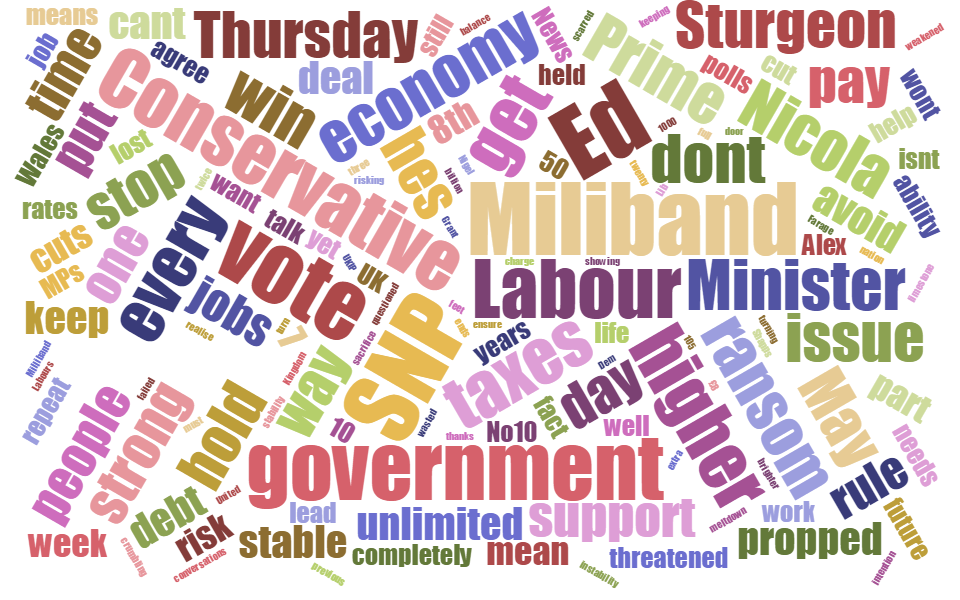
Just from the wordcloud above, using statements made in Conservative Party press releases since Friday, the words 'Nicola', 'Sturgeon', 'SNP' are have been used almost as often as 'Miliband'; 'ransom' is also pretty prominent. For an apparently 'Unionist' party the venom stirred up against Scottish voters has been extraordinary. Stirring up English nationalism may well prove, in the long run, to have been an extremely unwise thing to do.

Then there were pledges, a windfall of them: Inheritance Tax threshold increased to £1million for a couple; 40 per cent Income Tax threshold raised to £50,000; personal allowance up to £12,500; commuter rail fares frozen; £8billion above inflation for the NHS; 30 hours free childcare for 3 and 4 year-olds, What a gold mine; who could possibly suffer from such pledges? The only problem there was little information how any of these would be paid for; they almost appeared like post-election coalition talks. And they came on top of the repeated failure by senior Tory figures to explain '£12billion in welfare cuts' apparently planned for after the election.

In the last week, however, the party has recovered lost momentum, mainly due to David Cameron's own campaigning skills. His 'I'm pumped up' and 'bloody lively' routine sounds absurd but there is something in Dan Hodges' piece from early April which talks about the Prime Minister rolling up his sleeves and hitting the road after a lacklustre campaign start. It's also possible that the constant repetition of the same slogans is finally hitting home.

If Cameron wins a majority, it will be a huge personal success and not a ringing endorsement of Lynton Crosby's election campaign; frankly the Tories should really ask for their money back.


Labour

For some reason Ed Miliband has been routinely underestimated throughout his leadership of the Labour Party. His doggedness has been entirely overlooked. So when it came to the election campaign itself expectations were not high. As a consequence, the fact that Labour launched a coherent, spirited, hungry campaign rather took onlookers by surprise.

Miliband also did well in the debates. In the spin room at the first non-debate, reporters from pro-Tory papers acknowledged to each other that the Labour leader had easily beaten Cameron, who looked utterly terrified when confronted by Jeremy Paxman.

The #edstone
But, in the penultimate week, as the polls appeared to be giving the Tories a slender leader, jitters could be seen. Perhaps this is why Ed Miliband decided that rather than a pledge card, which can be slipped easily into a wallet, he would opt to have his promises engraved on an 8-foot limestone monument; surely the invocation of gravestones or Old Testament tablets inscribed with the Ten Commandments were inevitable? It is as though a member of his team watched The Thick of It thinking it was a template from which to copy rather than a satire. Perhaps, again, evidence of an imported public relations guru not really worth his weight in gold, or even limestone.


Liberal Democrats

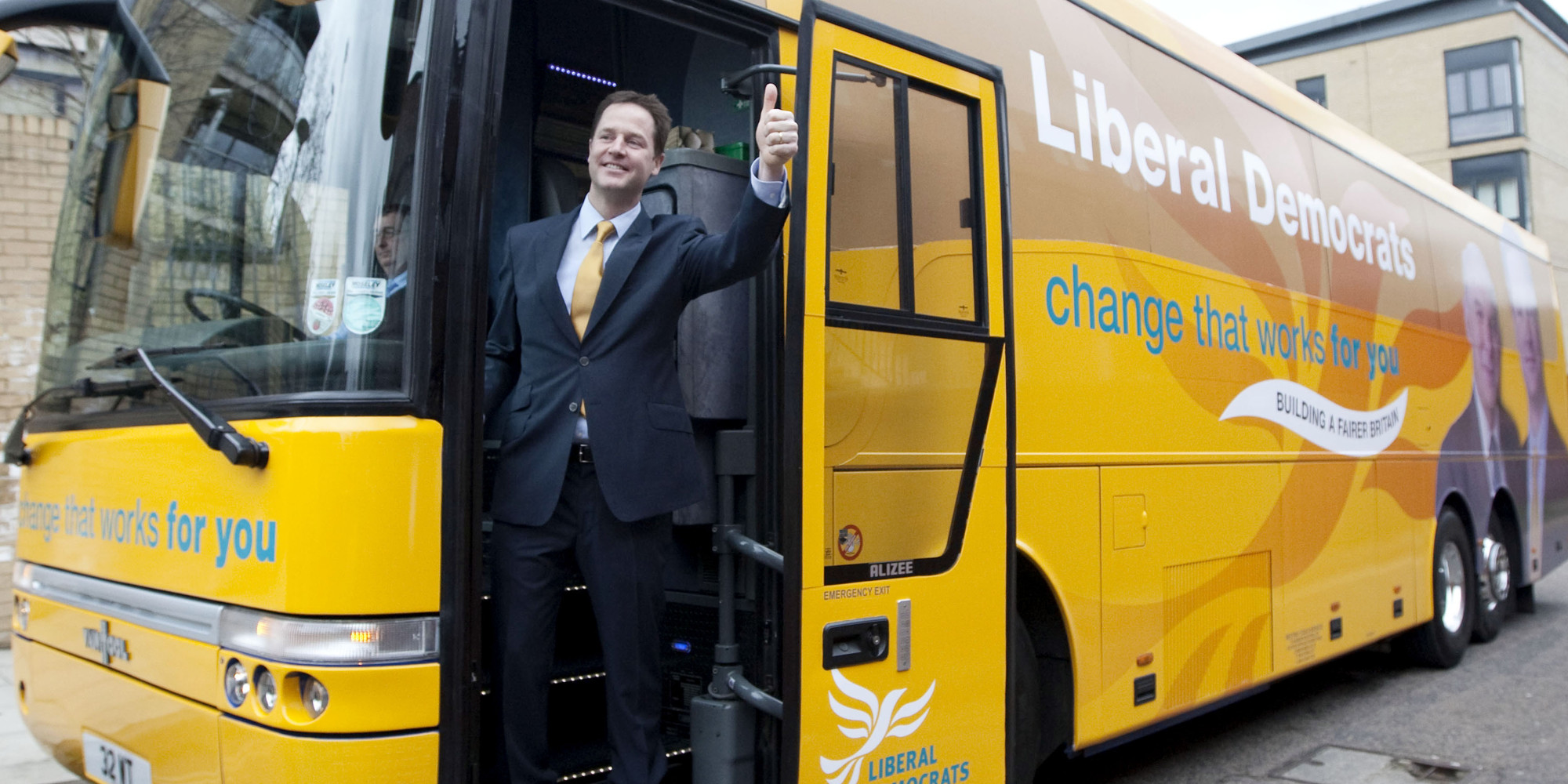
Pitching themselves as a moderating force for both the Conservatives and Labour, this election has been one of consolidation for the Lib Dems. Whatever Nick Clegg says, they will lose seats on Thursday night, probably a lot of them. They may lose so many that he cannot stay as party leader. In many ways this would be a shame as the Lib Dem leader is unquestionably a decent man who was thrust in an invidious position back in 2010. The numbers could have allowed a Labour/Lib Dem coalition but it would have been far from stable and far less so than the Tory/Lib Dem coalition has proved to be.


Danny Alexander's leaking of apparent Tory post-election child benefit plans had the air of someone who knew who was going to lose and didn't care any more. Safe to say that after he loses his Inverness seat - which he almost certainly will - even if Alexander ends up in the Lords, he won't be the first person to whom the Tories turn to join another coalition in the future.


Ukip

Nigel Farage's party has maintained its level in the polls surprisingly well considering what a wretched campaign they have had. It may not be until after the election that the full details of why Ukip's campaign never gained any momentum is known; Farage's health issues with his back are clearly a factor. But, the cancelled events, the comments - whether reasonable or not - about Farage's own lack of appearances in Thanet South where he is standing, have all not helped.

The party also seems to have decided there is a concerted media plot against it. Farage launched a misguided attack on an independently selected audience during a BBC debate complaining it was too left wing, forgetting that, with Cameron's absence, right-wing members of the audience had little to clap for. It isn't actually the media's fault that member after member says or does something stupid or offensive. The latest is the suspension of Robert Blay, a Ukip parliamentary candidate who was caught on camera saying he would 'personally put a bullet between' the eyes of his much-tipped Tory opponent if he were ever to become Britain's first Asian prime minister.

Through the share of the vote they look likely to take, Ukip could still cause the Tories problems but it seems less likely that this will prove a breakthrough election for them; Carswell looks set to win but none other can be as sure.


Greens

Remember the Green surge? Membership shot up, overtaking Ukip and even the Lib Dems but today's poll of polls leave them on five per cent. Caroline Lucas may return for the Brighton Pavilion seat but other gains look very unlikely.

Sadly for Natalie Bennett, the party's surge never really kept going after her 'mental brain fade' on LBC radio back in February, even thought she stood her ground well when she took to the stage on the BBC Challengers' Election debate. We should not forget the fact that this programme featured three effective female politicians - Bennett, Nicola Sturgeon and Leanne Wood. This is possibly the only time women have ever outnumbered men in such a format, and it lent the discussino a novel, even an exciting, edge. It was in this format that Bennett was probably at her best.

Before long, however, fundamental problems faced the party. Because the Greens were now pitching themselves as members of a serious political and less a campaign group, their manifesto faced more scrutiny than ever before. Bennett was repeatedly challenged as to whether she wanted to ban the grand national or outlaw rabbit hutches, or back up the party's economic policy with solid evidence. Perhaps inevitably, while there was no repeat of the 'mind-fade', she continued to struggle in interviews.


Conclusion

The next five years are likely to be troublesome: Britain's membership of the European Union could well be the subject of a referendum; the strength of the Union will be put under enormous strain; the refugee crisis in the Middle East is not going away and its effects will spread further; Russia under Putin is likely to maintain is bellicose stance; global security is shaky; the environment is under threat; and the economy is still vulnerable to shocks. And, yet it seems, if we believe the opinion polls, we may well, after the general election, be left with an unstable, fractious, government with a major party reliant on the support of one, two, even three smaller parties.

It's clear neither the Conservatives nor Labour has presented a vision for the country which has captured the imagination of the public, their campaigning has been narrow, artificial and blinkered. There has been too little discussion about several vital issues during this campaign. Foreign affairs and the environment have barely featured.

From the uncertain melee of this messy, unsatisfactory, campaign, one can hope for a stable government to emerge but if not, we might have to do it all again soon.

Wednesday, 14 May 2014

Labour's strategy; what is it?

As we get closer to the European and local elections, many query whether the Labour Party has a coherent strategy or vision. A few policies have slipped out here and there - such as the energy price freeze and, just this week, plans to enable patients to get a GP appointment in 48 hours - but it is hard to discern a running theme. The squeezed middle and One Nation Labour are there, lacking focus, in the background, and frequently seem to be hiding in the shadows along with the Conservative's Big Society.

For Labour, addressing the question over their strategy becomes ever more important as their opinion lead has dwindled, or even vanished, in recent days. What is the Labour Party actually for? We know, regardless of who wins power at the next general election, that whoever forms the next government will have a mightily tough old time cutting more from public services to bring the deficit down. Essentially, the Labour Party is not offering a substantial alternative to austerity. So, at the same time as doing this, what would they offer that was different?

Ed Miliband, for all his undoubted decency, does appear to be struggling to get his message across. Ed Balls is carrying too much of Gordon Brown's baggage and the overall impression of the shadow cabinet is that they lack enough thrust and verve to put their case forward with any passion.

Step forward John McTernan, former adviser to Tony Blair and a whole host of other Labour figures; after a brief discussion on Twitter as to whether Labour was failing to oppose UKIP sufficiently, he put forward his definition of Labour's strategy. Here it is:


It is by no means a comprehensive list of policies, or a honed vision of government, but, on the hoof, this is a more coherent account offered than by any senior Labour figure. Perhaps it's time for Labour to produce some new pledge cards.

Thursday, 27 March 2014

Will a penny off a pint save the British pub?

Despite strenuous efforts, I have yet to find a publican who has lopped off 1p from the price of a pint of beer following George Osborne’s announcement in the budget last week.

This is surely strange; after all, coalition ministers have been shouting quite a lot about this. Grant Shapps, in the poster of his now infamous tweet, boasted that ‘Cutting the Bingo Tax & Beer duty’ was helping ‘hardworking people do more of the things they enjoy’. And Conservative MP Andrew Griffiths – who represents, some believe with painful irony, Burton, the home of British brewing – has been especially excited, proclaiming the cut proves ‘this is the most beer and pub-friendly government we have seen in a generation’.

Mr Griffiths wrote effervescently about what the chancellor had done in the Publicans’ Morning Advertiser:

‘Last year’s decision to cut a penny off the price of a pint of beer was the first such decision by a chancellor since 1959. Yet it was the decision to scrap Labour’s hated beer-duty escalator that really made the difference to the industry.

‘Ending the year on year ratcheting up of a beer duty, a system which saw it rocket 48% between 2008 and 2012, ended the misery of a system which was bleeding the beer industry dry.

‘The more optimistic of us hoped and campaigned for a freeze in this year’s Budget, but not many expected an historic successive second cut. This of course was followed by scrapping of the alcohol duty escalator, and freezes for Scottish whisky and real cider.

'All in all, this was a beer and pub budget that the whole industry should be thrilled with.’

And Mr Griffiths hasn't held back on Twitter either.


And here he is below, clearly exemplifying responsible drinking:


Now let's not be churlish. It is of course welcome that the government has felt able to make any cut in the price of a pint of beer, especially as drinkers are increasingly lucky to get change from a fiver when buying a pint in the capital these days.

But for anyone to suggest this is the great rescue of the pub trade is, frankly, not taking the issue seriously.

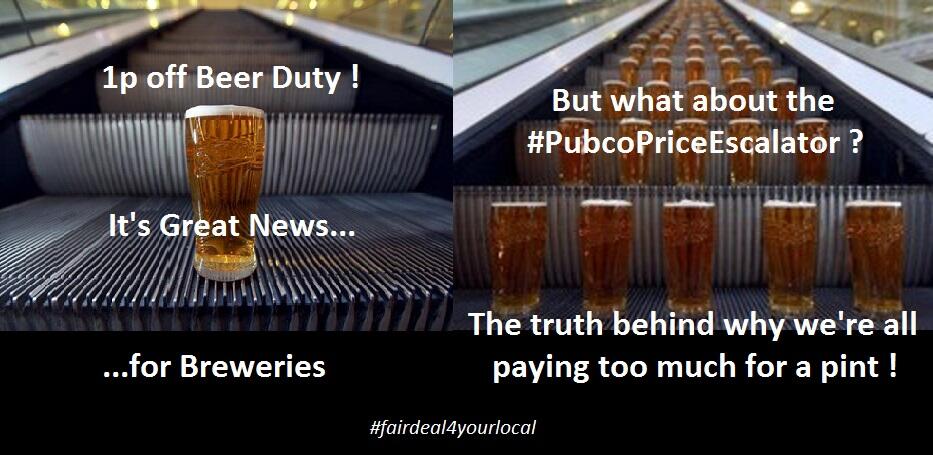
Recent figures from CAMRA suggested the number of pubs closing each week had risen to 28 per week and while many in the pub trade are pleased with the price cut, they have wasted no time in pointing out the government's inaction - despite repeated promises - in tackling pubco reform - offering tenants a chance for a fair rent and an end to the system which sees them hit by high rent costs and high beer costs. Posters such as the one below have quickly appeared:


Simply nothing has happened. There has been no response to the government's consultation on the issue (for more on this delay see here) and it seems likely such reform has been blocked at a high cabinet level and nothing will happen this side of an election. It's worth noting Andrew Griffiths, a self-styled champion of pubs, is curiously opposed to any such reform.

And, in a timely fashion, the latest figure to get involved in the issue is the not insubstantial figure of Tim Martin, the founder of the Wetherspoon's chain. In his company magazine, he writes: 'The main additional reason for pub distress is the high level of debt assumed by some pub companies in the years running up to the credit crunch.' And he names financiers Guy Hands and Hugh Osmond of being the architects of this 'unsustainable', damaging model.

'In essence, Hands and Osmond bought large tenanted pub estates of the major brewers, using borrowed money, and then hiked up the rents and the beer prices paid by the tenants. As a result of the increased income which they generated, they were able, in effect, to remortgage pubs, extracting tens of millions of "profit" for themselves.'

Companies like Enterprise Inns and Punch Taverns were the successors to this and they continued using the same model. Tim Martin goes on:

'When the individual licensees/tenants started to suffer between the hammer of high rents and beer prices and the anvil of tax-subsidised supermarkets, unprecedented numbers of publicans went bankrupt - and the Enterprise and Punch shares plummeted on the stock market to a fraction of their former value.'

And while pub titans old and new, such as Hands, Osmond and Enterprise's former chief Ted Tuppen have showed little sympathy to the 'plight of the tenants', they have been vociferous in their complaints about high personal taxes, specifically Labour's plan to increase the top rate of income tax back up to 50 per cent should they regain power. He concludes, with restrained fury:

'There is a justifiable argument for a reasonable top rate of tax which encourages hard work - Britain did not benefit from the Rolling Stones hiding from the taxman in the south of France in the 1970s. However the disregard of the financial engineers for the plight of their tenants and their egocentric concentration on their own positions, dressed up as national concern, might even have caused Maggie Thatcher to side with Ed Balls.'

So while the government tinkers around the margins, fiddling ineffectively with beer prices, it continues to ignore the hugely damaging pubco model, something which all, but the most stubborn, now recognise needs tackling with urgency. Until the government belatedly takes action, their claims of being the publican's - and the beer drinker's  - friend will largely fall on sceptical and deaf ears.

Tim Martin's full article can be read here.

Friday, 18 October 2013

What if Lord Adonis ran for mayor?

A map from the Abercrombie plan for London

Thus far, the only person to have publicly declared his desire to be Labour’s next London mayoral candidate is the eminent transport writer Christian Wolmar.

Disappointingly, in the first poll assessing the chances of the candidates, Wolmar was not included. While he is a long way from being the favourite, his work on trains is constantly interesting and informed and such is the importance of transport in the London Mayor’s brief he deserves to be taken more seriously.

The poll, published in the Evening Standard, found comedian Eddie Izzard favourite amongst the public, followed by Tessa Jowell, Diane Abbott, David Lammy, Andrew Adonis and Sadiq Khan. Izzard is unlikely to stand, Jowell is a strong candidate, especially after her performance during the Olympics while Abbott has a high profile and has a reputation for outspokenness, which hasn’t proved a political obstacle thus far, in the short existence of the London mayoralty.

While not commanding such a prominent media presence amongst this group, Lord Adonis is perhaps the most interesting potential candidate. Closely linked with Tony Blair, Adonis was the architect of academy schools and HighSpeed 2 (HS2): all these factors might be regarded as politically damaging. But they also reveal a man keen on promoting large, transformative projects, thoughtful and unwilling to play safe.

A few weeks ago, Adonis gave a few hints as to what his ambitions might be, as Mayor, in the annual lecture to the Vauxhall Labour Party. He began:

‘London needs a plan – a plan to become both a bigger world city and also a better working city for Londoners.’

And he continued, highlighting the problems which undeniably face the city. London has five of the 20 local authorities with the highest levels of income deprivation in England, youth unemployment is at 24 per cent, it boasts amongst the lowest apprenticeship take-up rates in the country, a 20-year difference in life expectancy between Oxford Circus and some distant stops on the Docklands Light Railway, as well as housing costs and transport problems.

‘Looming behind all this is a population explosion – caused by London’s success, but making all these problems steadily worse and more urgent.’

Adonis was scathing about Boris’ vapid 2020 Vision:

‘It is a blowing of London’s trumpet and a collection of suggestions to support London’s growth, but with little coherence, or assessment of priorities, timescales or deliverability.

‘We have a Vision without a plan. We have a succession of documents called plans which aren’t plans, some of which promise real plans at some point in the future. Then, depending on which mayoral non-plan you read, there are anything from 19 to 43 areas for priority development across the capital, but only 10 have an actual development plan. And there is a Plan Implementation Plan which promises further work on the key components of what should be included in the plan it is supposed to be implementing.’

‘Well, that’s all clear then,’ he added witheringly.

He compared it with the ‘inspirational’ Abercrombie plan, the first volume published in 1943, the second in 1944. (For more information on this ambitious, but largely unimplemented, project see this excellent piece.)

Sir Patrick Abercrombie
With the air of a philatelist who has stumbled across a particularly spectacular collection of stamps, he continues:

‘In 400 pages, plus dozens of maps, charts and photos, it surveys the historic development of London. Its analysis and recommendations are incisive and panoramic…. the tone throughout is of expertise and passion, tempered by urgency and practicality, summed up by Abercrombie’s opening words “All things are read if our minds be so”.’

He went on:

'London needs a plan for a population of 10 million. Boris hasn't got one. In practical policy, Boris has essentially been implementing parts of Ken Livingstone's unfinished programme - the parts, like Crossrail, that don't offend Tory boroughs - without developing a credible successor plan for a population of 10 million.'

So were he to stand for mayor, what post-Boris plan would Lord Adonis develop? He identified five priorities.

Three new East Thames road crossings: the Thames Gateway bridge; the Silvertown Tunnel; the new lower Thames Crossing.

Facilitating the development of London Gateway Port, which opens next year, helping it become a 'world class logistics centre. He noted that already Marks and Spencer are building a 900,000 square foot distribution centre at the site; and 'impediments stopping others from following suit - including infrastructure, skills and housing' need to be overcome to enable other firms to follow suit.

As well as 'significantly expanding Basildon', Adonis has a vision for another 'successful new town'. Already with good transport links - just 17 minutes from St Pancras via HS1 -  'Ebbsfleet is an obvious candidate.'

'It was, in effect, supposed to be a private-sector new-town but it hasn't happened because the private sector hasn't been able to put in the required infrastructure up front and take on the associated risks.'

Then, Adonis lists the Lower Lea Valley, Stratford, the Royal Docks, London Riverside, Woolwich, the Greenwich peninsula and Canada Water as 'priority areas for substantial housing and community development'.

And finally, he wants to emulate the Victorians and endow London boroughs with 'great parks and cultural attractions'. He mentions a 'serious proposal' of a £2billion Paramount theme park at Ebbsfleet, to rival Paris' Disneyland, and, (perhaps more my cup of tea), 'a kind of new national park covering the wetlands and associated habitats in the Estuary'.

It may well prove to be the case that Lord Adonis lacks the public profile and acknowledgement to carry him to the London mayoralty; too much technocrat, not enough showman. His closeness to the Blairite project may prove to be a hindrance within his own party (it shouldn't but it could). But he displays a knowledge of the capital, of its ways and means, its history and cultures, successes and challenges, to be an invaluable ally and source of inspiration to whomever Labour select as their candidate

In just one speech, Lord Adonis presents a plan for London of much more focus and significance - and much more human and celebratory - than anything Boris has proposed in his six years of office. All that is missing is a clown on a bike.


Note - Further pieces on potential mayoral candidates will appear as and when their vision for the job becomes clearer.

Friday, 30 August 2013

The government is defeated but no one should celebrate

The vote this evening is a moment of huge political embarrassment for the prime minister. Many will be thrilled the government has been defeated; we are not going to war with Syria. We will not fire a shot in anger, no matter what Bashar al-Assad does to his people in Damascus and elsewhere in that horribly destroyed country.

But in fact, for those who wish British foreign policy to be more than that of Lithuania or Belgium, it is a terrible result. It could well severely hamstring British foreign policy, regardless of which party is in power, for years to come.

Judging from the level of insults emanating from Downing Street officials, it seems pretty clear the decision not to make the vote tonight about authorising the launch of cruise missile strikes was due to Ed Miliband deciding to push to give the UN more time. The Labour leader was a f****** c*** (foolish chap) for tabling his own motion, but he was right to call for a pause. According to the timetable which appeared to be rushed from nowhere into the news schedules, tomorrow or Saturday we were starting to attack. With UN weapons inspectors still on the ground, no one knew why it needed such a short deadline.

The Prime Minister wanted to be strong. Presidents Obama and Hollande were keen to go; we don't have a presidential system. David Cameron knew he couldn't simply go ahead without support. But, he underestimated the bitterness left by Iraq. Like Poe's Raven, the shadow was on the floor; impossible to ignore. MP after MP complained how they were duped by intelligence reports and spin to support the Iraq invasion - forgetting the huge opposition and the multiple reasons why that war was so misguided - and yet the government offered a few flimsy sheets of A4 as evidence of the intelligence services certainty Assad was to blame. It was a hopelessly inept strategy.

Obama and Hollande may well continue with their Syrian adventure. It's hard to imagine a US leader, particularly Obama, rushing for support from Britain for foreign adventures, any time soon. Obama will make tender words but will raise his eyebrows at the farce. The special relationship is nothing more than a general election tag line; it has no contemporary significance.

None of this is any help to the people of Syria. Their suffering will continue. Neither Labour, nor any opponents, were giving succour to Assad but it's hard to think the Syrian leader won't be pleased by the farcical consequences of tonight's vote.

For make no mistake, the atrocities will continue in Syria. Already, there are suggestions a napalm attack has taken place in Syria. We won't flex a muscle. If a Rwandan-style genocide started tomorrow. A finger wouldn't twitch. Cameron won't risk such humiliation again. 

Is this really what we want?