Thursday, 9 July 2015

Osborne apes Brown at his barnstorming best


For the best part of ten years, while he was at the Treasury, Gordon Brown dominated the House of Commons and every year he blunderbussed his Budget at an expectant nation.

Growth figures were bombastically rattled through, his hubristic ‘end of boom and bust’ slogan was wheeled out to the delight of his Labour backbenchers, rabbits were theatrically pulled from top hats, elephant traps were carefully laid and the Leader of the Opposition was invariably left on a tricky wicket, clutching a bat broken by the opposing team’s vice-captain.

And the youthful George Osborne clearly watched these performances with a mixture of horror and awe; he may not have agreed with Brown’s policies, but he clearly enjoyed the performance as the former member for Kirkcaldy provides Osborne with his template.

Osborne has been a lucky chancellor. During the coalition government, the economy came mightily close to a double and triple dip recession and growth was painfully stagnant. He missed his own deficit targets time and time again and few but the wealthiest could actually feel the benefits of whatever growth there was.

But, he held his nerve and has been rewarded. The economy is growing at a healthy rate, jobs are being created – albeit too many at too low a wage – and yesterday (July 8) he was able to deliver the first Conservative-only budget since Kenneth Clarke rose up on his hind quarters in November 1996.


Osborne has moved on since his disastrous pasty tax Budget and this was his cleverest yet. While there were the predictable crowd pleasers like the inheritance tax changes, reduction of the benefits cap, defence spending pledges and promising a surplus by 2019/2020, he made quite a bold pitch for the political centre ground.

Osborne’s Living Wage, while not actually at the level of the living wage, was a spectacular rabbit to pluck from the hat; such a whopper it was almost a hare. For those on the minimum wage, aged 25 or over, it means their pay will jump by 70p an hour – to a not insignificant £7.20 – from April and would reach £9-an-hour by 2020. Before the General Election, Labour only pledged that the minimum wage would rise to £8 over the course of this parliament; no wonder George Osborne was being cheered to the rafters by his backbenchers.

Increasing the tax free personal allowance, promising a rise in NHS spending and abolishing non-dom status for people born in Britain to parents domiciled here, could also have come from any party.

Such was the nature of his bravura performance, one would be forgiven for thinking all was fine and dandy with the economy. The clouds over China and the chaos engulfing Greece seemed a long way away and the still fragile nature of the economy could almost be forgotten. Just weeks ago, one Tory MP told me he feared the economy had already reached the crest of the wave now and worried about the next few years, especially considering the country’s enormous debt. But today, these concerns were put to one side.

Yes, while giving with one hand, Osborne was taking with another, like every chancellor before him. Those relying on tax credits will feel the pinch particularly, especially those under 25 years-old; now is not a good time to be young. But again, Labour will struggle to fight against tax credit changes and will not reverse them if and when they get the opportunity.

Unlike Gordon Brown, Osborne is not a Son of the Manse; he isn’t naturally infused with the oratorical skills and moral authority of a church minister. But, with his stature enhanced by the illustrious nature of his office, few are able to command the House of Commons as he does.

Harriet Harman responded for Labour; famously acknowledged as the hardest job of the year for the Leader of the Opposition. She did her best, but one thing she did get absolutely spot on was her acknowledgement that this Budget was as much about Osborne’s ambition to succeed David Cameron as it was the economy. And it is impossible to conceive Boris Johnson delivering as wily and assured package as George Osborne did today. Once again, the likely successor to our current prime minister is his next door neighbour.


Monday, 6 July 2015

Greece versus the prevailing economic hegemony

For ten minutes, over fresh drop scones and orange juice, I almost managed to train my two-year-old daughter to say ‘the Greek vote is counter to the prevailing economic hegemony’. What a great party trick that would be.

Trouble is, she struggled to pronounce ‘economic hegemony’ with any great fluency so it’s a game to be saved for another day.

In Greece, meanwhile, Alexis Tsipras’ left-wing administration has been dealt a remarkable democratic boost following yesterday’s referendum, but it remains to be seen whether this will ultimately help to deal with the ‘prevailing economic hegemony’ with which it is battling. And such is the parlous state of the country’s banks, it has very little time to find a deal.

Yes, there are democratic deficiencies in the whole referendum process; as Peter Kellner of YouGov observes. For such a vote to have true democratic accountability  it needs, he argues to follow these principles:


It is clear the Syriza government in Greece breached many of these; but such was the scale of the victory, Tsipras and his administration have received a huge mandate for their confrontational stance against the Eurozone. As of today (July 6) five parties have rallied behind the prime minister's position, including opposition parties, forming an impressive domestic coalition. Those querying the legality of the vote, such as European Commission vice-president Valdis Dombrovskis, will only play into Syriza's hands further, allowing them to portray Greece as the conspired against victim of the piece.


In truth, Greece finds itself in its current wretched state as a combination of its own long-term, systemic, failings and the complicity and ineptitude of the European Union. Why, for example, was Greece admitted to the Eurozone club back in 2001? Who would have guessed that drenching a country, famous for governmental corruption and woeful levels of tax receipt, with cheap credit would end so disastrously?

In the Financial Times, in December 2000, Tony Barber explained how Greece's admission was more to do with 'political symbolism than economic consequences' and that Greece would:

'serve as a beacon for central and eastern European countries, which hope they will not have to wait long after joining their European Union before they, too, can abandon their national currencies for the euro'.

Efforts to delay Greece's entry on the basis that the country 'did not meet the criteria for low inflation and budgetary discipline in a sustainable way' were swatted aside.

The Greek government's lack of 'budgetary discipline' is legendary. The Economist wrote in a 2012 article that tax evasion was routinely shrugged off by officials as 'a national sport' and it cited a recent study which found that up to €30million of tax revenue went missing annually. As recently as 2010, a study using satellite photographs to count the number of swimming pools in Athens - a measure tax inspectors use to indicate wealth - found that instead of there being 324 as officially declared, there were, in fact, 16,974. Covering pools up with nets still remains a favoured tactic to evade such monitoring. 

In 2012, a list was published of 4,151 Greek celebrities who, collectively, owed the Greek state £12.4billion in unpaid taxes.

And only in recent years has the absurdly generous pensions system been reformed, which once counted jobs such as hairdressing as a hazardous occupation and enabled a barber to retire at the age of just 50. These reforms still have far to go, however.

In the early years of Greece's membership of the Euro, its economy boomed but in every year since 2001, it registered budget deficits of over three per cent, reaching a peak of almost 16% in 2010. In the same period, debt as a percentage of GDP, has risen from 108% in 2001 to almost 180% now. When George Papaconstantinou became finance minister in 2009, he was forced to disclose the budget deficit was almost double the estimates given by the previous right-wing administration; Papandreou's socialist government was thus nobbled from the start.

As the crisis has reached a climax, I've heard comparisons between Greece and the experiences of coping with debt by Iceland and Ireland, but these latter two are blessed with comparatively functional political systems; any such comparisons are, therefore, rendered invalid.

Since their entrance to the euro club, therefore, the dysfunctional country has piled debt upon debt; its credit rating has been shot to pieces; it has received loans and bailouts from the IMF and the EU; and yet growth - the only means by which Greece might escape this mess - has stubbornly refused to accelerate. There have been flickers in the last few years, but nothing more vigorous.

Meanwhile, in June 2013, the IMF admitted they hadn't foreseen how much damage the austerity programme would wreak upon Greece and only last week a report - which the Eurozone tried to block from publication - acknowledged Greece's public finances had no chance of recovery without significant debt relief. 

Grim though it may be for the people of Germany to concede, until the eurozone recognises this reality, Greece will remain in turmoil and will not recover.

Fundamentally, what we are witnessing is a clash between democratic power and harsh economic realities. There is no doubt Tsipras has reinforced his position domestically - and could inspire other left wing movements such as Spain's Podemos - but with a lack of a deal this will fade. The Greek Prime Minster's pledge that a new agreement with the EU would be signed within 48 hours of the referendum seems absurdly optimistic. At the same time, the Eurozone may wish not to acknowledge the power of the people, but ultimately knows it must do to an extent to avoid the very real possibility of Greece plunging into disorder. 

And yet, the Eurozone holds the strongest cards. If the banks have no money, the people of Greece will be unable to buy food, medicine and other essential supplies. Even leaving the eurozone doesn't necessarily prevent this from happening as a new currency would take time to organise. The prevailing economic hegemony, no matter how ugly and discredited, ultimately has the power to drown this nation's democratic voice and set a very worrying precedent indeed.

Tuesday, 16 June 2015

The Labour leadership battle isn't a beauty contest


Debate is good, debate is healthy, debate is just what a political party needs after a hefty election defeat. And some Labour activists need to get a grip as many, with Dan Hodges as the standard bearer, seem to think Jeremy Corbyn's inclusion on the leadership ballot is a sign of an unprofessional party as he is simply 'not ready' to be Prime Minister (Corbyn is, for the record, 66).

It is an absurd, anti-democratic, argument. And even if it were true, it isn't unique to Labour; the Conservatives elected Iain Duncan Smith as leader and even John Redwood had a pop.

Yes, Corbyn only got on the Labour leadership ballot as several of his comradely MPs lent their support and nominated him. But this only recognises, whether certain members like it or not, that he represents a not insignificant body of opinion within the party. Surely the hope of the other candidates is that by including him in the debate his more eccentric ideas can be exposed and anything of value can be swiftly co-opted by a candidate more likely to be successful. And, of course, by having the debate, those on the far left will not feel the need to cut their ties to the party altogether. It's a simple method of securing a few votes in the future.

Those arguing that he shouldn't be on the ballot seem to me to struggle to put forward a coherent argument. Yes, it may be the case that it is indulgent of the Labour Party and it may also be that he would take the party to an even more unelectable position, but these remain matters of opinion, not rules of law. This shouldn't, therefore, deny Corbyn of a voice.

Should he, therefore, be banned from standing? Should he and his supporters be the victims of a purge, like Militant all those years ago?

Some even argue that a leadership contest is not, in fact, a debate at all and here I'm lost. If it's not a debate what is it? Should the leading candidates simply agree on the main issues and let the contest be a judgement on physical beauty instead?

As I've argued before, the Conservatives will have their own problems at the next election as they'll either have a new leader with the baggage of 10 years in government - which rarely does them much good - or they will have a new leader without the personal appeal of David Cameron. The emotional spasms currently afflicting the Labour Party were an inevitability after May 7, but, in the main, they are recoverable (Scotland is a different matter).

Despite the best efforts of a few on the right trying to have a jolly good laugh by ironically signing up as Labour supporters just to give Jeremy Corbyn a boost, the Honourable member for Islington North won't win the Labour leadership. In a few months this will all be largely forgotten by the electorate, who, for the main, have no interest in the internal politics of our major parties. And, if anyone does remember, they'll wonder what all the fuss was about.


The Med's refugee crisis shames the country

Theresa May has been attending the latest meeting in Europe where ministers from across the region are trying to come up with a solution for the dreadful problem of thousands of people fleeing north Africa hoping for sanctuary in the relative safety of Europe.

This is what the Home Secretary had to say as she arrived:

‘Of course, the crisis in terms of migrants who cross the Mediterranean is a problem in two ways. First of all, obviously, lives are being put at risk but secondly, as we see in Calais and elsewhere, it’s putting great pressure on European towns and cities which is even reaching to our borders, although we are not part of the borderless Schengen area.

‘To deal with this issue in the long term we need to go after the criminal gangs who are plying a terrible, callous trade in human lives.

‘We also need to break the link between people getting into the boats and reaching Europe. That means returning people to North Africa or elsewhere, or to their homes countries; so that they see that there is no merit in this journey.’

The desperate people so frequently rescued from shabby boats in the Mediterranean Sea are routinely referred to as migrants; this almost suggests their decision to try and escape to Europe is a lifestyle choice. They are rarely called refugees, yet, such is the turmoil in that part of the world, it is almost inevitable than the majority have fled conflicts in Eritrea, Somalia, Sudan, Central African Republic and Libya itself. And, according to aid agencies, increasing numbers of people from Syria, where nine million people are displaced and more than four million people have fled abroad, are arriving to seek passage.

Libya, despite facing immense post-Gaddafi violence, is an obvious place for a migrant/refugee to target such is the coast's proximity with the southern reaches of several European countries. And there is no doubt that many who ultimately get there are victims of people trafficking gangs. Theresa May is right to say they are 'plying a terrible, callous trade in human lives'. But, while, Western nations may have the best of intentions to pursue these gangs, there is no realistic means to do such a thing. No troops are going to be put on the ground in Libya, drones cannot be used; the gangs will continue their trade unmolested for the foreseeable future.

My primary concern, however, with Ms May's statement is the last paragraph which demonstrates that the Home Secretary entered into these negotiations with not only utterly unachievable, but also the wrong, ambitions. Earlier this week Amnesty International released a report on the 'global refugee crisis' highlighting the dangers of the Mediterranean crossing, describing it as the 'most dangerous in the world' and attacking Western governments for their consistent failure to acknowledge and even start addressing the world's largest refugee crisis in Syria.

But even this crisis has competition. Steve Symonds, Amnesty's Refugee Programme director, said: 

'In South East Asia we've seen boats full of desperate and starving people literally pushed back by Indonesia and Malaysia before they were shamed into taking them in.

'This compassion deficit seems to be a global fatigue.'

And the UK could be described as being amongst the most fatigued countires of all.According to Amnesty, out of the four million who have escaped the Syrian civil war, Britain has resettled a pathetic 187.

Theresa May talks of returning people to North Africa, to their home countries, apparently with the intent of proving that 'they see there is no merit in this journey'. This actually means that the British government would rather actively seek to return people to war zones, under the most wretched circumstances, than contemplate the possibility of offering sanctuary. It is reassuring that HMS Bulwark is to continue doing its sterling work rescuing hundreds of people from the sea's waters, but simply trying to return them to their places of origin does nothing to solve the problem. And it's hard to imagine how any Western government could demonstrate to someone fleeing for their lives that there is no 'merit in this journey'. Those undertaking the perilous journey are doing so, not because they fancied a quick jaunt across the Med, but in the hope that they and their families might actually live. Argue with the 'merit' of their journeys as the barrel bombs are falling.

Britain once had a proud heritage of offering sanctuary to the oppressed and desperate, a record governments are eager to invoke. But we do not any longer. Like the Clinton government before, which refused to use the word 'genocide' in reference to the killings in Rwanda just to avoid being obliged to intervene, this government and the coalition before it, refuse to recognise the reality of the situation for parochial, political reasons, which necessitates a refusal to adopt a functional immigration system. Until we do so, the boats will keep coming, will continue sinking & people will try ever more dangerous ways to try find a place they can survive. Britain is shirking its responsibilities and it's a state of affairs which should shame us all.

Tuesday, 26 May 2015

Reasons to be cheerful, Part 2015

A hefty bit of blood-letting and internecine warfare within the Labour Party was inevitable after their dreadful election result. It would happen in any party. Runners and riders from various party factions, from the Blairites to the Union loyalists, will pop up and talk about the mistakes of the past, how their vision represents the path to tread. Inevitably, it seems, they'll waffle on about ‘aspiration’.

Contrary to some claims, Labour actually had a very good election campaign until the final couple of weeks; it was energetic, released new policies in a timely fashion and appeared to want power more than a lacklustre and gloomy Conservative Party. The last couple of weeks, though, were a mess. Ed Miliband should never have gone to kowtow to the dishonourable member for wasted youth, Russell Brand, and the #edstone, while probably a much needed commission for a stone mason, was utterly ridiculous. It was simply impossible to satirise, such was its absurdity.

Ultimately Labour lost, not because of ideas, but because they picked the wrong leader. Ed Miliband is an eminently decent man – something David Cameron shamefully couldn’t bring himself to admit – but he was simply never leadership material. He was and remains a policy wonk, someone fascinated by political ideas and theories, but not someone to sell a vision or map out a clear direction. Combined with a failure to challenge sufficiently the notion of ‘Labour’s Great Recession’, when it was anything but, and the SNP surge in Scotland, Labour has been left in the political wilderness for another five years.

So yes, Labour will endure bitter, inward-facing days in the months and possibly years to come, especially as they try and make some sort of recovery in Scotland; but judging from some of the reports recently one could be mistaken for thinking the next five years are going to be all sweetness and light for the Tories.

There is much euphoria following their first election victory since 1992. Today (May 27) sees the first Tory-only Queen’s speech since John Major’s days and finally those backbenchers will be able to revel in Tory policies: the Human Rights Act is for the chop; the benefits bill will have to be slashed (but just leave the pensioners alone); an in/out referendum on the EU will be set in motion.

When John Major won the 1992 General Election – like Cameron, largely based on his own popularity and campaigning – the Conservatives had a majority of 21 seats. Cameron has a majority of 12. John Major had his ‘bastards’ including three of them in his own cabinet; Cameron endured the most rebellious backbenchers in history in the last parliament. Yes, they no longer have to suffer the ignominy of having to share power with the Liberal Democrats but anyone who thinks they’ll now be a joy to work with will soon find they will be sorely mistaken.

Already, several prominent ex-ministers – Damien Green, Dominic Grieve, Andrew Mitchell – have indicated they will oppose efforts to replace the Human Rights Act with a new Bill of British rights. And these are far from the usual suspects. The government will struggle to get their plans through the House of Commons and will face an almighty battle in the Lords.

And then there is Europe.

I know some Tories who think the argument in the party is settled. After the bitterest internal political row which has lasted the best part of 30 years, the Tories now have a settled view. This seems remarkably optimistic. Assuming, and it is a big assumption, that David Cameron gets the concessions he wants from our European partners, he will campaign to stay within the union. It is hard to imagine he will be joined in the trenches by the likes of John Redwood, Daniel Hannan or Owen Paterson. They, and much of the parliamentary Conservative Party, will be on the 'out' side of the argument and there is little the Prime Minister can do to convince them otherwise.

Managing a small majority, therefore, is likely to be a tough, pretty wretched experience for Cameron, much as it was for the hapless Major. And, as governing parties frequently lose by-elections between general elections, his majority is likely to be whittled down further, perhaps even into a minority government as Major’s was.

There is one thing that Cameron and his opponents can look forward to; he won’t be standing at the next election. Contrary to his claims, the Prime Minister simply cannot serve every day of a second term, waltzing off to a wine bar singing when the 2020 General Election comes around. He must either change his mind and decide to stick around anyway, or he has to leave giving sufficient time for his successor to bed-in before the next vote. His potential successors will spend much of their time in this government jostling for the best position and once they get there may find they are seen as used and tired goods by the electorate. Labour and the Lib Dems will, by contrast, have a new leader and one not tainted by years in government or links to Tony Blair or Gordon Brown.

Labour supporters have little choice but to grin and bear it for now; and if that fails they can at least console themselves that they're not the Lib Dems.


Tuesday, 5 May 2015

The campaign trail to nowhere

This election campaign may have only officially begun at the end of March, but as we approach the final hours, it seems to have lasted many more months and years. And, ultimately, what has been the point? For all the polls have shifted, it might as well have just started at the start of last week. For all the flashy billboards, boisterous though far from spontaneous rallies of the faithful, the personal attacks, the sniping in the press and the plethora of pledges, the polls have barely moved an inch.

For a brief moment last week, the Conservatives appeared, in a couple of polls, to be establishing something of a lead; was clear blue water finally emerging? Well, no. The polls have levelled once more, maybe the Tories holding a slender, but far from firm, lead. A hung parliament is, it seems, an inevitability.

So how have the campaigns gone for each of the main political parties:


Conservatives

The leading member of the coalition had a very leaden, clunking, gloomy start. The messages were dour, warnings of ‘chaos’ tedious beyond belief and the operation slack. The personal attacks on Ed Miliband, such as the backstabbing one from Michael Fallon backfired, and David Cameron failing to acknowledge Ed Miliband as a 'decent man' was jarring and unbecoming of the man. 


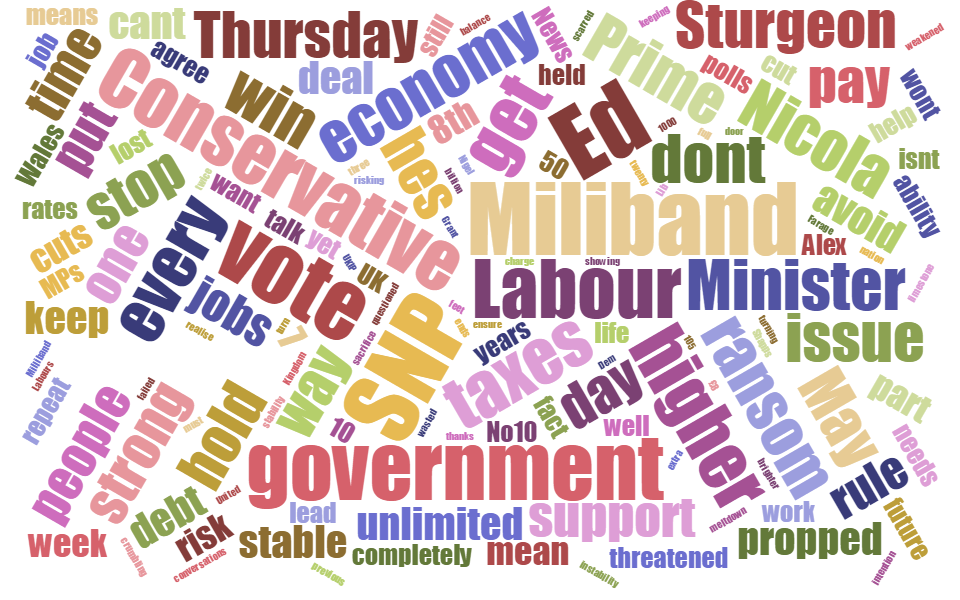
Just from the wordcloud above, using statements made in Conservative Party press releases since Friday, the words 'Nicola', 'Sturgeon', 'SNP' are have been used almost as often as 'Miliband'; 'ransom' is also pretty prominent. For an apparently 'Unionist' party the venom stirred up against Scottish voters has been extraordinary. Stirring up English nationalism may well prove, in the long run, to have been an extremely unwise thing to do.

Then there were pledges, a windfall of them: Inheritance Tax threshold increased to £1million for a couple; 40 per cent Income Tax threshold raised to £50,000; personal allowance up to £12,500; commuter rail fares frozen; £8billion above inflation for the NHS; 30 hours free childcare for 3 and 4 year-olds, What a gold mine; who could possibly suffer from such pledges? The only problem there was little information how any of these would be paid for; they almost appeared like post-election coalition talks. And they came on top of the repeated failure by senior Tory figures to explain '£12billion in welfare cuts' apparently planned for after the election.

In the last week, however, the party has recovered lost momentum, mainly due to David Cameron's own campaigning skills. His 'I'm pumped up' and 'bloody lively' routine sounds absurd but there is something in Dan Hodges' piece from early April which talks about the Prime Minister rolling up his sleeves and hitting the road after a lacklustre campaign start. It's also possible that the constant repetition of the same slogans is finally hitting home.

If Cameron wins a majority, it will be a huge personal success and not a ringing endorsement of Lynton Crosby's election campaign; frankly the Tories should really ask for their money back.


Labour

For some reason Ed Miliband has been routinely underestimated throughout his leadership of the Labour Party. His doggedness has been entirely overlooked. So when it came to the election campaign itself expectations were not high. As a consequence, the fact that Labour launched a coherent, spirited, hungry campaign rather took onlookers by surprise.

Miliband also did well in the debates. In the spin room at the first non-debate, reporters from pro-Tory papers acknowledged to each other that the Labour leader had easily beaten Cameron, who looked utterly terrified when confronted by Jeremy Paxman.

The #edstone
But, in the penultimate week, as the polls appeared to be giving the Tories a slender leader, jitters could be seen. Perhaps this is why Ed Miliband decided that rather than a pledge card, which can be slipped easily into a wallet, he would opt to have his promises engraved on an 8-foot limestone monument; surely the invocation of gravestones or Old Testament tablets inscribed with the Ten Commandments were inevitable? It is as though a member of his team watched The Thick of It thinking it was a template from which to copy rather than a satire. Perhaps, again, evidence of an imported public relations guru not really worth his weight in gold, or even limestone.


Liberal Democrats

Pitching themselves as a moderating force for both the Conservatives and Labour, this election has been one of consolidation for the Lib Dems. Whatever Nick Clegg says, they will lose seats on Thursday night, probably a lot of them. They may lose so many that he cannot stay as party leader. In many ways this would be a shame as the Lib Dem leader is unquestionably a decent man who was thrust in an invidious position back in 2010. The numbers could have allowed a Labour/Lib Dem coalition but it would have been far from stable and far less so than the Tory/Lib Dem coalition has proved to be.


Danny Alexander's leaking of apparent Tory post-election child benefit plans had the air of someone who knew who was going to lose and didn't care any more. Safe to say that after he loses his Inverness seat - which he almost certainly will - even if Alexander ends up in the Lords, he won't be the first person to whom the Tories turn to join another coalition in the future.


Ukip

Nigel Farage's party has maintained its level in the polls surprisingly well considering what a wretched campaign they have had. It may not be until after the election that the full details of why Ukip's campaign never gained any momentum is known; Farage's health issues with his back are clearly a factor. But, the cancelled events, the comments - whether reasonable or not - about Farage's own lack of appearances in Thanet South where he is standing, have all not helped.

The party also seems to have decided there is a concerted media plot against it. Farage launched a misguided attack on an independently selected audience during a BBC debate complaining it was too left wing, forgetting that, with Cameron's absence, right-wing members of the audience had little to clap for. It isn't actually the media's fault that member after member says or does something stupid or offensive. The latest is the suspension of Robert Blay, a Ukip parliamentary candidate who was caught on camera saying he would 'personally put a bullet between' the eyes of his much-tipped Tory opponent if he were ever to become Britain's first Asian prime minister.

Through the share of the vote they look likely to take, Ukip could still cause the Tories problems but it seems less likely that this will prove a breakthrough election for them; Carswell looks set to win but none other can be as sure.


Greens

Remember the Green surge? Membership shot up, overtaking Ukip and even the Lib Dems but today's poll of polls leave them on five per cent. Caroline Lucas may return for the Brighton Pavilion seat but other gains look very unlikely.

Sadly for Natalie Bennett, the party's surge never really kept going after her 'mental brain fade' on LBC radio back in February, even thought she stood her ground well when she took to the stage on the BBC Challengers' Election debate. We should not forget the fact that this programme featured three effective female politicians - Bennett, Nicola Sturgeon and Leanne Wood. This is possibly the only time women have ever outnumbered men in such a format, and it lent the discussino a novel, even an exciting, edge. It was in this format that Bennett was probably at her best.

Before long, however, fundamental problems faced the party. Because the Greens were now pitching themselves as members of a serious political and less a campaign group, their manifesto faced more scrutiny than ever before. Bennett was repeatedly challenged as to whether she wanted to ban the grand national or outlaw rabbit hutches, or back up the party's economic policy with solid evidence. Perhaps inevitably, while there was no repeat of the 'mind-fade', she continued to struggle in interviews.


Conclusion

The next five years are likely to be troublesome: Britain's membership of the European Union could well be the subject of a referendum; the strength of the Union will be put under enormous strain; the refugee crisis in the Middle East is not going away and its effects will spread further; Russia under Putin is likely to maintain is bellicose stance; global security is shaky; the environment is under threat; and the economy is still vulnerable to shocks. And, yet it seems, if we believe the opinion polls, we may well, after the general election, be left with an unstable, fractious, government with a major party reliant on the support of one, two, even three smaller parties.

It's clear neither the Conservatives nor Labour has presented a vision for the country which has captured the imagination of the public, their campaigning has been narrow, artificial and blinkered. There has been too little discussion about several vital issues during this campaign. Foreign affairs and the environment have barely featured.

From the uncertain melee of this messy, unsatisfactory, campaign, one can hope for a stable government to emerge but if not, we might have to do it all again soon.

Sunday, 12 April 2015

Wolf in Sheep's clothing - or the other way around?

The country has suffered the greatest recession in living memory, every party admits more painful austerity is on the way after May's election and this state of affairs will have to continue throughout the next parliament if there is a vague chance of wiping out the deficit, let alone the national debt. And yet, judging by their actions of the last few days, the various parties think they're living in clover.

The Conservative Party is acting like a chap who thinks he's the latest Euromillions winner, flashing the cash with abandon, promising his mates all the gifts they could want; only to discover later he got the numbers wrong.

The giveaways have come in a rush: regulated rail fares will be pegged with RPI throughout the lifetime of the next parliament; the NHS will receive the £8billion a year by 2020 which independent experts reckon it needs to keep up with our ageing population; and the next Tory government - somewhat failing to understand the principle of volunteering - would offer 15million workers the opportunity of three days' leave every year to volunteer.

All this is being offered at the same time as the party rules out raising National Insurance and VAT and offers another tax cut to the extremely wealthy through its Inheritance Tax plans.

This is not to suggest these are unpopular ideas (indeed, two of them could benefit me personally hugely - than you George!) but nothing has been offered, by way of explanation, as to how the country would pay for such perks.

And they all come on top of the Conservatives failing to say where £1billion of welfare cuts will come from after the vote. Some might think this would be a rather crucial nugget of detail before deciding which way to swing when voters finally enter the polling booth on May 7,

This campaign of giveaways emerged suddenly after a few days of negative attacks, and negative press especially in the case of Michael Fallon's ferocious attempt at knifing Ed Miliband's character. Perhaps this timing was always the tactic but it does seem abrupt; some commentators have not shied away from calling it panicky. And, there is little doubt, it comes in stark contrast to the fiscal discipline to which George Osborne has consistently claimed his party adhered.

For instance, when Labour suggested a 'tough cap' on rail fares in August 2014, Transport Secretary Patrick McLoughlin denounced it as 'yet another unfunded spending promise' that 'would cost £1.8bn over the lifetime of the next parliament and be paid for by more borrowing and higher taxes'.

When Andrew Marr challenged Chancellor of the Exchequer to explain where the extra NHS funds would come from, all George Osborne would say was that it was 'part of our balanced plan'. So far, all the weight is on one side of the economic see-saw.

Also, as some clever person pointed out on Twitter, if the Conservatives were planning this move, why not actually commit to such spending in the most recent Budget?

Labour has not been much better. Savings have been promised but not nearly amounting to the levels needed to have a credible attempt at tackling the deficit.

In a brazen attempt to steal the Conservative Party's clothes, Ed Miliband will, at the launch of Labour's manifesto tomorrow, commit a Labour government to a new 'Budget Responsibility Lock'.

This, the party explains, will ensure that 'every policy... will be paid for without requiring any additional borrowing' and all parties 'in the future will have their spending and tax commitments independently audited by the Office for Budget Responsibility before a General Election'.

Launching the manifesto, Ed Miliband will declare:

'The very start of our manifesto is different to previous elections. It does not do what most manifestos do. It isn't a shopping list of spending policies. It does something different: its very first page sets out a vow to protect our nation's finances; a clear commitment that every policy in this Manifesto is paid for without a single penny of extra borrowing.'

And he is set to go on, rounding on the Tories for their apparently generous spending commitments.

'In recent days you have seen the Conservatives throwing spending promises around with no idea of where the money is coming from, promises which are unfunded, unfair and unbelievable.

'That approach is bad for the nation's books. And nothing is more dangerous to our NHS than saying you will protect it without being able to say where the money is coming from. You can't help the NHS with an IOU.'

Considering the state of the economy when Labour last left office, it is an audacious bid even to attempt to claim the economic moral high ground. For five years, the Conservatives and Liberal Democrats have called - whether reasonably or not - for Ed Balls and Ed Miliband to apologise for Labour's economic record. That being so it is fairly remarkable that the Labour Party has been given the opportunity to swoop on to this political battle ground and attempt a rebrand. Will it persuade ordinary voters that Labour is suddenly fiscally responsible? Its promise of no extra borrowing is surely a position no government could really maintain if faced with tricky economic circumstances.

Moreover, the insistence on rectitude and the refusal of any 'extra borrowing' neatly overlooks the significant distinction between deficit and debt; and this after we have been carefully introduced, in recent years, to some of the economic and linguistic distinctions nestling within these terms. it is all very perplexing.

The Conservative manifesto is being published on Tuesday; they might need to start offering some answers to all the questions.

All concerned should be aware that Paul Johnson, the Director of the Institute for Fiscal Studies, told The World This Weekend that all parties were 'making up numbers'.

'I've found this entire debate from all the parties really deeply depressing. You've had the main parties ruling out whole hosts of relatively straightforward ways of increasing tax, talking about raising tax from some other group, be they the rich or the non-doms or the tax avoiders, but this is all real money and has real effects on the economy, and no sense from anybody about a serious way forward for the tax system.'