Monday, 27 January 2014

David and Jeremy really don't want 'your kids to die'

There are reports coming from North Korea suggesting Kim Jong-un has ordered the execution of every blood relative of his uncle – himself purged and killed last month – including women and children.

In November last year, the Oxford Research Group estimated more than 11,000 children had been killed in the conflict in Syria.

Across large parts of Africa, militias specialising in terror, such as the Lord’s Resistance Army, abduct, drug and force children to fight, rape and pillage. The statistics are blood-chilling.  Reports suggest tens of thousands of children have been abducted by the LRA in countries including Uganda, the Democratic Republic of Congo, the Central African Republic and South Sudan.

In too many conflicts, children are seen as disposable, cheap cannon fodder; expendable. And, in all the cases above, it can be argued that those responsible for these deaths genuinely do not care other people’s children are dying.
                                                                     
Now consider this headline:

David and Jeremy want your kids to die (unless you’re rich)

It appears above a blog by comedian Rufus Hound in which he talks about his decision to stand as an MEP for the National Health Action Party. Evidently, Hound feels passionately about the NHS and is furious about what the coalition is doing with it. He deserves credit for wanting to stand for election and actually try and do something about it, rather than being a chatshow-sofa and stage bound dilettante comedian like Russell Brand.

But it’s also very clear that while David [Cameron] and Jeremy [Hunt] may well be making an enormous hash of the NHS with their exceedingly top-down and bureaucratic reforms, they do not want anyone’s ‘kids to die’. I know it's hyperbole but it’s an absurd, ad hominem, attack which does Hound no credit at all and is unlikely to be the message the NHAP really wants communicating. 

Too often in political discourse, sensible debate gets sidelined and replaced by lazy stereotypes and cheap bribes. For example, it isn’t ‘class war’ to raise the top income tax band to 50p; voting for the Labour Party is not akin to supporting the gulags and terror of Stalin and supporting the Conservative Party does not equate to being a fascist. If Hound wants to command serious attention, he should let the details of his blog do the talking and not resort to such a crude, simplistic, headline. 

It’s well known that the prime minister lost his son Ivan back in 2009, after suffering from cerebral palsy and epilepsy. At the time, David Cameron paid very heartfelt tributes to the efforts of the NHS. Hound may profoundly disagree with the government’s reforms – and even the most generous critic can find much to question – but to suggest Cameron ‘wants’ other parents to suffer the heartache and pain he went through is particularly unpleasant. 

Wednesday, 22 January 2014

The sanitisation of Soho

Walker's Court
Soho looks its best at night when it’s raining. The neon lights glisten with greater intensity; the corners become darker adding a hint of danger. Noise and laughter emanate from pubs; the flashy, drinkers, stragglers, queens and strays carouse through the narrow, low level streets, all hunting their next party. It can feel as though you are walking through a John Deakin photograph or witnessing a Julian McClaren-Ross story brought to life. Its romantic history becomes tangible; a rich legacy of immigration with bustling, vivid, delis and cafes, restaurants and bars, strip clubs and revue bars, basement clubs and drinking dens; all smells and steam and chatter and sweat, following the steps once walked by Francis Bacon, Lucien Freud, George Melly, Nina Hamnett, Henrietta Mories, Muriel Belcher, Soho Pam, Jeffrey Bernard, Dylan Thomas.

But the square mile of sin, already a shadow of what it was even ten years ago, is in very real danger of losing even more of its historic saucy charm, of being sanitised out of existence and becoming much like any other district of London. At the end of last year, Westminster Council gave the go-ahead to let bulldozers roll in and flatten much of the block surrounding Walker's Court, perhaps the seediest little backstreet in London, but one close to the heart of Soho’s reputation as London’s red light district.

There are good aspects of the application; the lights of the Raymond Revue Bar will be restored and an ‘off-Broadway’ theatre would open. But in almost every respect the redevelopment is an example of arrogant philistinism, showing utter disregard for the area’s history, architecture and spirit - and people.


The new buildings from Rupert Street

In its wisdom, Westminster Council thinks removing the ‘sex-related uses’ around the streets outweighs the cultural and social harm of demolishing these buildings. Robert Davis, the deputy leader of the council, even went so far as to welcome the new building’s use of glass for its transparent quality. No secret sex, there, then.

After telling members of the English Collective of Prostitutes, protesting at the planning meeting, to be quiet as it’s 'not the way we do things here’, Mr Davis voted in favour of the plan.

He said: 

’The new designs are very exciting. They are very open and I like the idea of a lot of glass because it does allow a great transparency in the area. I’ve no problems with the height, the design or the demolition of the new buildings.’

The lack of architectural, cultural and historical knowledge on display is quite extraordinary - let alone the apparent glossing-over of what happens to the current denizens of the area. The idea that Walker's Court will become a ’transparent’ area with ’a lot of glass’ seems both perfunctory and inappropriate.

Permission was granted to the application despite failing planning guidelines in a number of ways. In their report, planning officers acknowledged the excess height of the proposed buildings, the failure to replace buildings of merit with anything worthy in the design of the new buildings and the lack of mix in the residential plans. Only the ultra-rich need apply, even for studio flats.


How Walker's Court will look


The council report describes many of the current buildings as lacking architectural merit, though it recognises the character of two unlisted blocks. One of the few great legacies of Paul Raymond is he did little to alter the fabric of Soho streets. Individual buildings themselves may not, strictly speaking, have ’architectural merit’, but collectively, the retention of a mainly seventeenth, eighteenth and nineteenth century streetscape is of huge significance. Soho derives much of its character and vitality from its architecture and of, course, from the historic pattern of its warren of streets; the collective is of huge architectural significance. English Heritage acknowledged this but its objection to the scheme was overlooked.


The view of the new plan from Berwick Street


The green light to the plan has more intense, individual implications. Earlier this month, police raided brothels around the area, insisting this had nothing to do with emptying the buildings after the planning application was passed. Well, they would say that wouldn't they? One of curious aspects of Soho is the solidarity shown by local residents with the women who work in the brothels. Indeed, many of the more than 50 letters of objection to the redevelopment plan worried about the consequences of forcing these women on to the streets, where they are more at risk of violence and exploitation. Rupert Everett wrote movingly about this in The Observer on Sunday.


Elizabeth Valad

Take the case of Elizabeth Valad, for example. She worked in a Soho brothel, on Windmill Street according to a friend, but was forced on to the streets after Westminster Council ’enforced closure orders on premises used as brothels’. Tragically, she later became one of serial killer Anthony - the Camden Ripper - Hardy’s victims; her dismembered body found stuffed in bin bags, discarded in bins after Christmas, 2002, reportedly found by a homeless man in a cowboy hat. The implications for these women seems to be blithely ignored.

This isn't a plea for no renovation, redevelopment or refurbishment, much as shabby chic - at which Soho excels - is in. But developers and the council must show knowledge, sympathy, intelligence.

Soho has long posed a problem for such an officious organisation as Westminster Council. The area's determinedly relaxed individuality is a counterpoint to the council's ruthless desire for efficiency and squeezing as much as it can from the city, a geographically tight - but extraordinarily valuable - area. Paul Raymond certainly allowed aspects of Soho's fabric to decay, yet his resistance to redevelopment protected its character. But, despite at one stage being Britain's richest man, it doesn't appear his granddaughter Fawn James intends to follow his example. 

Postscript

There's a pertinent little passage by Piloti in this fortnight's Private Eye. While refereeing to Oxford, it remains relevant:

'To Oxford - and yet another example of the ineptitude of so many modern architects when having to deal with an older building.

'Faced with a problem, all they can do is introduce large sheets of glass. In fact, they almost seem to worship glass as they drivel on about "light" and "space". They do this partly because they have no understanding of historical languages of form and are uncomfortable handling traditional materials; but also because they fall for the delusion that glass is invisible. It isn't. It reflects, and it gets scratched and dirty.'


Monday, 20 January 2014

A brief chat with the pubs minister

The government's consultation on pubco reform ended on June 14th. The Department of Business, Innovation and Skills (BIS) at first insisted it would respond in the autumn, but as autumn turned into winter, there was nothing but silence. In December, Jo Swinson insisted a response would come 'very soon' but claimed the volume of responses had been 'staggering' and they needed more time to plough through them.

There were more than 8,100 responses in the consultation; being generous let's say 8,200. The consultation closed exactly 220 days (as of January 20). This means BIS has to go through just over 37 responses a day. As of March 2013, BIS employed 3,112 civil servants, but this is apparently not enough to tackle this task of studying with sufficient efficiency to ensure legislation can pass through the Houses of Parliament before the next election. Time is running out.

Pubs minister Brandon Lewis, who has been very quiet on the whole issue of pubco reform, has given an interview to the Publican's Morning Advertiser and manages to devote one line to the subject. He says he can see the 'logic' of the delay but in the article doesn't expand on this.

But, in a brief chat on Twitter, he did a go a little further on the issue.


And, like Jo Swinson, he blames the volume of responses:


More than 8,000 responses is a big consultation - though, by way of comparison, the equal marriage consultation received a record 228,000 replies and, comparatively, these were considered with much greater speed than the pubco reform study. Perfectly reasonably, Mr Lewis also explains he isn't responsible for the editing of the story. 


And, despite being pubs minister, it wasn't his consultation anyway, as he is a minister in the Department for Communities and Local Government.


Sadly though, as of yet, there has been no response to either the point above, about the lack of time, or the questions below:


The government is in very great danger of giving the responses so much 'consideration' that they end up doing nothing, which may well now be the intention. 

Thursday, 16 January 2014

Time running out for pubco reform

The Alexandra in Penge; now closed but locals hope it will reopen

It is just over a year ago since Vince Cable unveiled his reform plans for large pub companies (pubcos), broadly along the lines for which campaigners had spent years lobbying.

After repeated select committee reviews, the business secretary said: 

‘We gave pub companies every chance to get their house in order, but despite four select committee reports over almost a decade highlighting the problems faced by publicans, it is clear the voluntary approach isn't working.

‘Pubs are small businesses under a great deal of pressure, many of which have had to close. Much of that pressure has come from the powerful pub companies and our plans are designed to rebalance this relationship.’

Under Mr Cable’s plans an independent adjudicator was to be appointed to study unfair practices in the industry, as well a statutory code introduced (for those unfamiliar to the topic, background on the pubco reform campaign can be found here). Many publicans celebrated; finally, they hoped, the pressures coming from the likes of Enterprise and Punch Taverns, would be relieved.

A consultation process began in Spring last year and the government gave every impression legislation would be published by the end of 2013 or early 2014.  

But what has happened? Er, nothing. Barely a word. The results of the consultation have not yet been published  - minister Jo Swinson blames a greater number of responses than they expected - and the government is rapidly running out of time to get any proposed legislation on the statute books; it would be left to a successive government to decide what to do, no doubt setting any reform back by several more years.

It’s no surprise to see a petition has been launched to try and get the issue moving against in parliament. Already, more than 12,000 people have signed their name to the call for the government to legislate; it can be seen here.

But, considering pubco reform has such wide support from across all parties in Parliament - a quick glance at Early Day Motions on the subject and this is clear - why the delay?

There is no doubt pubcos have lobbied hard against any reform and campaigners have highlighted a core of politicians who they claim have blocked the reform moving forward; pubs minister Brandon Lewis and Chancellor of the Exchequer George Osborne the favourite suspects. It sounds plausible enough. Lewis has been very quiet on the topic and, as Vince Cable was initially pushing for reform, his Tory coalition colleagues might well stymie what they may view as Lib Dem legislation.

Labour are trying to seize on this inaction and have tabled an Opposition Day Debate on the proposed reforms, set to take place on January 21st. When the debate was announced, Toby Perkins MP, the shadow pubs minister, said this: 

'It is becoming an annual event that Parliament debates the issue of pubs in January.  In January 2012 the House voted unanimously for a statutory code to regulate large pub companies as recommended by the BIS Select Committee.  In January 2013 after Labour called another debate on the subject, the Tory-led government agreed to introduce a statutory code.

'Twelve months on, despite a lengthy consultation, nothing has changed in legal terms to help struggling pubs and publicans.'

What impact the debate will have is open to speculation. I fear it may already be too late and senior figures have vetoed pubco reform in this parliament. I wait to be pleasantly surprised.


Final point

While this is not strictly lobbying - as it claims to be an independent report - the financial consultancy group London Economics published a report at the end of last year on what might happen to jobs in the sector were the pubco reforms enacted. Such were its findings that it could have been commissioned by pubcos - it wasn't, the Department for Business ordered the study.

In a worst case scenario, it warned that introduction of reform could lead to the closure of more than 6,000 pubs, taking with them up to 40,000 jobs. Its conclusions were in stark contrast to earlier studies - such as this from the Federation of Small Business - which indicated publicans planned to expand if they were freed from the tie.

However, the London Economics report seems to me to be somewhat hampered by some major flaws. The most significant failing was that it failed to take into account the financial stability, or otherwise, of the pubcos (only yesterday the perilous position of Punch Taverns was exposed yet again as warned it could default on its debt if its latest restructure is blocked by bondholders). The debts of pubcos appears not to be mentioned anywhere in the document's 34 pages. And it fails to take into account a pubco may deliberately run down a pub to sell on simply to service its debts. Pubcos may deny such a practice occurs but it is a very familiar story.

Moreover, while London Economics received much of its data from the pubcos themselves, it seems not to have spoken to any pub reform campaigners, or studied their literature; I certainly didn't find any reference to either. 

The study also makes claims which appear not to be the case, such as pubcos being 'responsible for capital costs ie maintenance'. It only takes a brief conversation with tied publicans to discover they can be liable for a whole range of capital costs. And it makes the completely unfounded assumption that 60 per cent of drinkers whose pub shots move to another pub; there is no evidence to support this figure and for drinkers in cities it seems extraordinarily low.

There are at least two sides to every debate, of course, but in this case asking for the contributions of a wide range of voices, would seem to be a prerequisite for any worthwhile, 'independent' report. 


Thursday, 9 January 2014

Reward Offered!

A notice has been taped to trees and lamp posts around where I live in recent days, headlined with the familiar cry ’Reward Offered’. This time, though, it is not there in the hope that a helpful neighbour will successfully find a much-loved family dog or cat, or recover expensive lost valuables, or as a promise of some kind of get-rich-quick scam. This reward is offered for anyone who sells the leafleteer a home.


The advert reads:

’Reward offered!
Do you think of selling your property?
But without the hazzle (sic) that comes with the viewings?
Get a reward instead of paying the agent’s fees?
And take the kudos for helping a local family on the property ladder.
Then please contact us! We are a family of four, looking to buy a 2+ bedroom property in this area for up to £150,000. If the flat needs refurbishment it's not a problem!
We are first time buyers and have a mortgage pre-agreement, so transfer will be quick and easy.
As little “Thank You” we will pay for a lovely weekend away for two of you!’

A mobile phone number is then given below.

It's an endearing appeal, if somewhat naive. And it seems highly likely to be borne out of desperation. The posters have been placed in Penge, south east London, in zone four, which, despite notable improvements, has proved to be stubbornly resistant to mass gentrification. One presumes the desire to live in the area is due to work reasons, perhaps schools. Yet, £150,000 will buy very little.

A quick look on Rightmove shows there are just five properties going for under £150,000 in the SE20 area and all of them are one-bedroom only. A bit cramped for a family of four. In an ideal world, at least a three-bed house would be appropriate but property prices in Penge have, as in the rest of London, rocketed over the last 15 years.

Back in 1999, £116,000 would have enabled a family to buy a modest three-bedroom house in the area. By 2002, it was £159,000, and by 2006, £232,000. After the crash, prices stagnated somewhat but in the last 12 months have soared once more, with prices ranging from £360,000 and even breaching the £400,000 mark.

So, while the money this family has may no longer be enough to buy a decent property, perhaps it is enough to access ’affordable housing’?

Affordable housing covers a range of options (a definition can be found here) but while rental options are available there is not much to buy in the area. Affinity Sutton have two houses for sale but both are well clear of £200,000. There may well be other properties available but the choice is clearly not huge. A working couple would need a combined income of at least £50,000 to secure a decent mortgage, and that's assuming a reasonably hefty deposit. For all too many, buying an 'affordable' house is way beyond their means. Perhaps this is just the sort of family who might benefit from the coalition government's controversial Help to Buy scheme; though, judging by their tactics, they are perhaps unaware of any assistance it might be able to provide.

Completely unrelated to this tale, but by way of contrast, eight minutes on the train line towards London is Herne Hill. Obviously, it's a much smarter place, blessed - Thames Water floods permitting - with a plethora of decent shops, some lovely pubs and restaurants and a thriving community. A farmers' market has prospered in Herne Hill since launching a year or so ago; the one in Penge sadly only survived a few weeks.

Yet, Herne Hill is part of Brixton and still has problems. For several months it has the most obvious and active drugs dealing den I've ever seen in London and until recently while property prices were high, there was a level of accessibility.


Like Penge, however, in the last couple of years house prices have soared. And it's hard to sum this up better than with an advert which appeared at Winkworth estate agents towards the end of last year. Displaying a £799,500 property, equipped with five bedrooms, three shower rooms, three reception rooms and two kitchens (?!) it was described, with all the sincerity an estate agent can muster, as a family house apparently 'ideal for first time buyers':


Obviously not for our very hopeful first time buyers of Penge.

Tuesday, 17 December 2013

Rape; an all too common weapon of war

The Central African Republic is the latest casualty. Sadly mentioned only in passing by the much of the media - with the very honourable exception of excellent work by Alex Thomson of Channel Four News - the country is disintegrating, verging on a genocidal disaster, continuing to pay for the crimes of colonialism, post-colonial excess, corruption and exploitation.


Seleka rebels

The country has been a desperate case for years of course and has been pretty much forgotten by the rest of the world. It suffered under the flamboyant, cartoonishly self-indulgent, grotesquely bloody, regime of ‘Emperor’ Bokassa and, as coup has followed coup, its government has barely improved since. A failed state, scarred by corruption, instability and violence - both within the country and overspill from neighbouring conflicts - with hundreds of thousands of people displaced. It has amongst the lowest healthcare professionals-to-population ratios in the world, with just three midwives to every 1,000 live births and 0.5 doctors to every 1,000 people.

Violence begets violence and the latest conflict sprung up in CAR last December. Séléka, a disparate coalition of rebel groups, took on and deposed François Bozizé's government, himself imposed by a French-backed coup. This coalition has now disintegrated and both the UN and the French - who have dispatched troops - warn the country is on the verge of genocide as Muslim and Christian militias confront one another.

With this violence comes a horribly ugly feature that seems to occur all too frequently; rape as a weapon of war. A Human Rights Watch study in May reported this:

‘I was in my house, where I live with my younger sister … when many Seleka fighters entered the quarter. I am 33 years old and my sister is 23. She was eight months pregnant when they raped us on March 25. They were shooting in the air in front of our house. Two armed men entered the house, threatened us, and forced us to get undressed and lay down on the ground. … They both raped us, one after the other. They were shouting bad words in Sango and in Arabic. One of them was shouting the Arabic word charmouta (prostitute in Arabic) while raping me. Then, they left the house. Our neighbor took us to the community hospital, where my sister lost her baby the day after.’

Another witness report read:

’I was at home with my children when a large number of armed men arrived in pick-up vehicles in front of my house. Three of them came into my house, pointed their rifles at me, tied me up in front of my children, and raped me. After they had raped me, they looted my house and left. I’m now alone with my children. My husband abandoned me the day after the rape. I feel pains in my body.’

It all sounds horrifically familiar. South of the Central African Republic is the Democratic Republic of Congo, a country which has been raped and pillaged literally, figuratively, metaphorically and continually.

A study earlier this year found 12 per cent of Congo’s female population had been raped, with roughly 1,152 victims suffering every day - 48 victims every hour. Women are not the only targets; children, men, even babies, are not safe. To read the detailed reports by human rights’ observers is a glimpse into a level of violence one would hope had been left in mediaeval times. It's a dehumanised state; a country broken after two hundred years where excessive, gratuitous, tortuous, casually brutal violence has been a daily norm. Under the rule of Belgium’s King Leopold II, a slave who failed to collect sufficient levels of rubber would lose their hand; now militias threaten rape, disfigurement by machete and, what Anthony Burgess would call, ’ultraviolent’ death.


King Leopold II's violent legacy

Reports of rape as a weapon of war now emerge from most of the world’s war zones and violent hotspots; Syria, Afghanistan, Mexico, Egypt. 

The horrific attacks in India – it is in fact the anniversary of the fatal attack on the 23-year-old medical student who was targeted on a bus by a gang as she returned home – have focused attention on attitudes towards women there, only too late for too many victims.


Demonstrations in India calling for action to tackle rape

It is worth taking time, at this point, to pause and salute Foreign Secretary William Hague, who, with the high profile support of Angelina Jolie, is pressing the world’s governments and the UN to focus more on these horrors.

In The Times last year Mr Hague wrote (£):

’From Bosnia to the Democratic Republic of Congo we have seen rape used as a terrifying weapon of war. Inflicted systematically and sometimes to order from the highest levels, it is as much a means of waging war as are bullets or tanks. And more often than not it is carried out not by invading armies but by one group against another: deliberately to destroy, degrade, humiliate and scar political opponents or entire ethnic and religious groups.

’The number of victims involved is utterly chilling. In Rwanda alone, up to 400,000 women are estimated to have been raped in the 100-day genocide of 1994. The vast majority of victims are women and children, but men are often targeted too.

‘Guilt lies with those who commit these crimes, but the shame falls on the whole world. For we have failed to act in a concerted way against this problem and have allowed a culture of impunity to develop. The shocking truth is that very few perpetrators have ever been put on trial for rape in conflict and even fewer have gone to prison. In wartime Bosnia, up to 50,000 women were raped, but only 30 men have ever been convicted. Given this record, the government forces and militia committing rape in Syria today probably expect they will simply get away with it.’

It's a thankless task. And it won't be an election winning issue but it’s the right thing to do and needs applauding and supporting. Certainly, Hague, as foreign secretary, has confirmed he is a thoughtful and able politician, with the gravitas of age and experience, a long way from the baseball cap of leadership.

Next year London will host a summit on this painful issue; the UN is throwing its weight behind the campaign. It won’t succeed. These awful crimes will tragically continue. But Hague and his campaign may start to make a difference, to send the message that such violation isn't an acceptable battlefield tactic of terror, to help start holding those committing these crimes responsible. We can but hope it becomes the exception rather than a normal aspect of war – or, indeed, a common feature of a destabilised state.

Friday, 6 December 2013

When Mandela came to Camden Town


Plaque unveilings to the great and the good are frequent enough occasions. If planners are lucky, a photographer from the local press might turn up to take a few quick shots of the curtain being pulled to gentle applause from a small gathering of friends and fans of a once famous comedian, writer or artist.

Rarely do they attract international statesmen, crowds of hundreds, singers and a paparazzi pack that wouldn’t be out of place at the Cannes Film Festival.

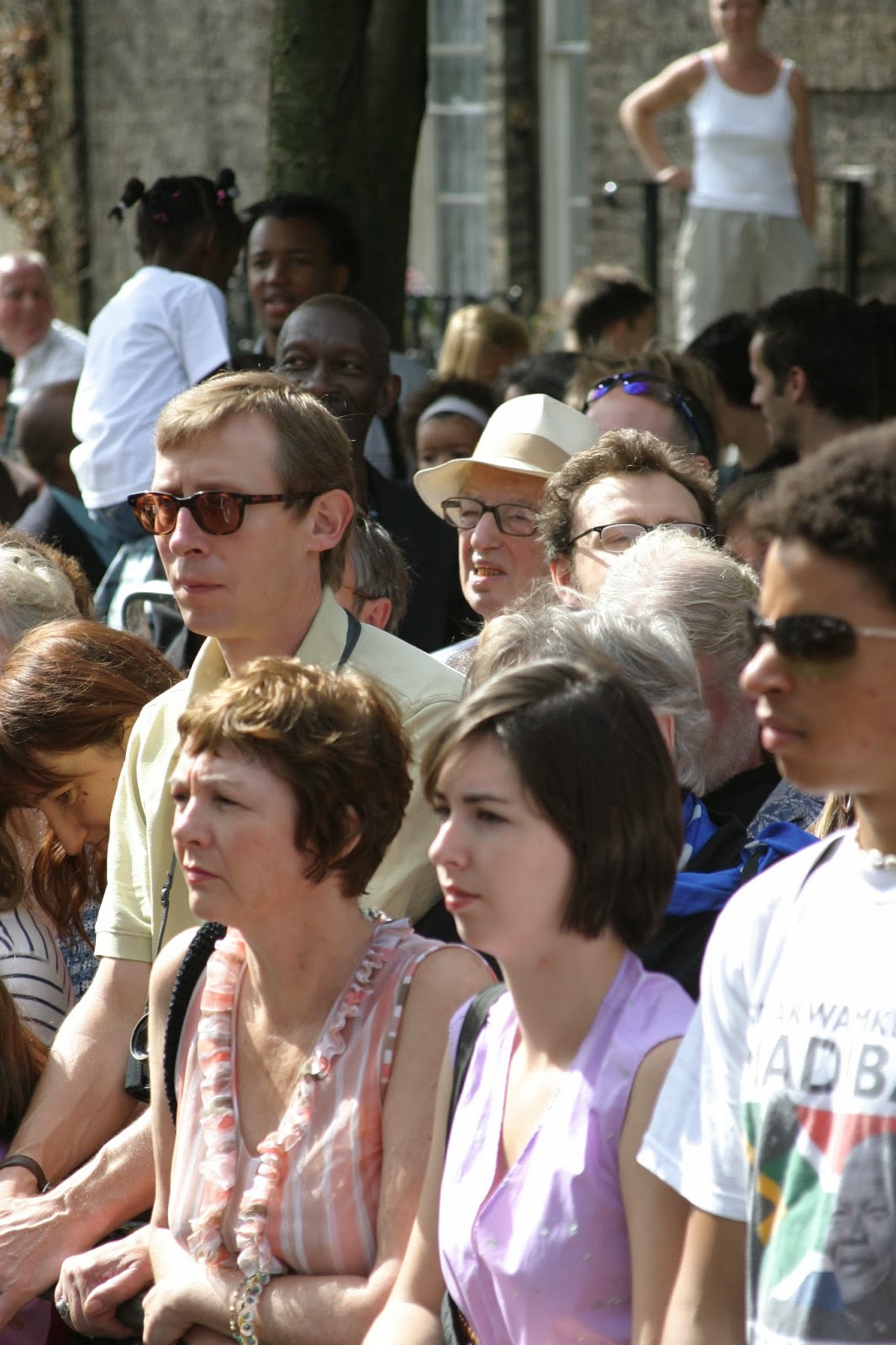
But early on a bright, warm July morning in 2003, Lyme Street, Camden Town, was the stage for this special English Heritage occasion. Nelson Mandela, in London ahead of this 85th birthday, rearranged his schedule so he could be there, to remove a curtain to reveal the plaque dedicated to anti-apartheid campaigners Joe Slovo and Ruth First, who lived in the terraced house between 1966 and 1978.

At the time I was working for the Camden New Journal*. It was a far bigger picture job than I was normally used to but when the editor, Eric Gordon, asked for a volunteer I jumped at the chance. Despite its being a press night the evening before, I was up before six and was in Camden Town just after 7am. I’d borrowed a step ladder from a colleague and found my way to Lyme Street.

Hardened paparazzi photographers were already there, but there was sufficient space for me to erect the stepladder and squeeze it along the front row by the railings, just a few yards from a little rectangular red drape, behind which was the plaque.

Several colleagues from the paper turned up, not to do any work but to experience something unique. Eric sauntered along, in a fedora, and chirpy despite the early hour; it wasn’t a time we often saw him. The accountant and the head of advertising had also made the short journey down the road. And while the unveiling hadn’t been widely publicised, it was clear the message of what was happening that Friday morning was echoing around the area; at first there were tens of people, soon there were hundreds.

Marxist historian Eric Hobsbawm appears to have been among the crowds

Sash windows in houses on the other side of the road were open fully and in some people sat precariously on sills, legs dangling beneath them. Parents carried their children on their shoulders; people climbed on top of walls and up poles to try and get a glimpse of what was happening. Behind railings near the plaque dignitaries were arriving. Frank Dobson MP was joined by Loyd Grossman – his role was, remarkably, compere of the occasion. Doreen Lawrence was there. Somewhere around was Alastair Campbell, as I later discovered when we bumped into each as the crowd dispersed.

The young Camden mayor Nasim Ali arrived, resplendent in robes and adorned with the traditional gold chain. He was effervescent. He bounded over and asked me to get a good photograph of himself with Nelson Mandela; later, as he hugged the former president, I tried to get the shot but found too many heads in the way. I always regretted not supplying the perfect shot for him though looking at the pictures now there are several shots he would enjoy.

Mayor Nash Ali greeting Mandela, under the watchful eye of Zelda la Grange

Many in the crowd were getting a bit agitated; they could see little of what was about to happen with so many photographers on ladders. A cry went up 'get down, get out the way'. The photographers were unwilling to move, but such became the pressure eventually we all got to the ground.

Soon, police wearing hi-vis jackets appeared at the corner by Camden Road, a series of cars turned the corner and there, was Nelson Mandela, walking with a stick, accompanied by his reliable - and fearsomely protective aide Zelda la Grange. He was first greeted by Gillian Slovo, the writer and daughter of Joe Slovo and Ruth First.


Mandela's speech wasn't long, but it was witty, affectionate towards his old comrades in arms and full of cheek. Ruth First, he recalled, was a 'sharp lady' who didn't suffer fools gladly. He still had the 'scars' on his back to prove it.

When Mandela pulled the cord, to loud whoops and applause (had this noise ever happened at an English Heritage plaque unveiling before?), and, on stairs leading up to the front door of a neighbouring house, a South African choir, singing with gusto, all with broad smiles.

There was security of course. Hefty numbers of police marked the street, English Heritage officials stood by the railings and Mandela's own easily identifiable guards - hair hard cropped, sunglasses, all white - watched attentively. But it wasn't overbearing.  People danced and waved, jumped with joy, yelled out Mandela's name with glee. The former president himself smiled, waved and joined in with the merriment. He left to music, laughter and joy. He was probably on the scene for no longer than 20 minutes, but it was a moment no-one there would forget the occasion. I felt privileged just to see the man and take his photograph.

*The Camden New Journal's report of the day can be found here.


A final aside

While the majority of the photographers were in the pen with me, some, like The Guardian's David Sillitoe, looked for different angles. Below is the picture which ran in his paper:


Towards the left hand side, I'm one of the few members of the press pack who can be identified, with my long blonde hair, I'm captured just looking to my right.

For some reason, we got hold of an international edition of The Guardian that week and the same photograph ran. Except, there appears to have been a bit of a cropping error. While I can still be seen looking in the wrong direction, Nelson Mandela has been removed from the image almost entirely; just his right hand survived the chop.  Oops!