Tuesday, 26 November 2013

Pub closure figures; a brief return

‘Free-of-tie pubs are closing at a faster rate than tied pubs. That is evidence. It is real evidence. It comes out of a number of surveys taken over a whole period of years’

This is what Brigid Simmonds, chief executive of the British Beer and Pub Association, told the Business, Innovation and Skills committee in June earlier this year (see question 53). As I waded through the immense volume of information regarding pubcos and the campaign for reform, it was a claim which always struck me as slightly odd. I couldn’t work out how it quite added up. After all, the numbers of independent pubs reached more than 20,000 in 2012, up 1600 in ten years, as more than 10,000 pubs closed in the same period. How could the sector be growing while shrinking faster than pubcos?

Well, it turns out, the reason is quite clear; according to a new report published last week, it simply isn’t the case.

Pub Closures: the truth, published by the All Party Parliamentary Group last week, pretty compellingly shows how the leased/tenanted sector has seen many more pubs close than those of independent freehouses. It’s quite a significant detail as it counters what has been a core argument against pubco reform.

The figures upon which the BBPA rely are, it seems, CGA figures, which don’t actually track the closure of pubs at all but seek to ‘provide brand owners (and other suppliers to the on trade) with an up-to-date and accurate database of all currently trading on trade outlets’.

But according to those figures, the numbers of independent, free-of-tie pubs which closed between December 2005 and March 2014 is 2,131 pubs, while 5,117 'non-managed pubs' (mainly leased and tenanted) closed in the same period. 

The figures also omit the numbers of pubs which temporarily close following the failure of a licensee, but subsequently reopen under new management within a couple of weeks. This process is known as 'churn' and it simply isn't acknowledged in the CGA figures. So, for example, had The Alma reopened under new management, the failure of Kirsty Valentine's tenureship there simply wouldn't be acknowledged.

According to the report, in leaked figures from Punch Taverns, 'around a third of their pubs would churn in a year'. The report quotes a similar figure for Enterprise Inns.

And, oddly, the figures I quote at the top about the proportion of oubs which are free and independent or tied and managed are from the BBPA itself. So quite how does Brigid Simmonds justifies her statements to the BIS committee, I'm not really clear. 

The MP's report is unsurprisingly scathing in its conclusions:

'It is clear that the reality of trends in the pub sector, particularly where the main problem lies, has been misinterpreted by, or misrepresented to, a succession of government and parliamentary bodies, the Office of Fair Trading, select committees and Business, Innovations and Skills department have regularly quote, and relied upon, data which purports to represent the picture of pub closures.'

And the report ends with a plea to Vince Cable, who has been noticeable by his silence on this issue recently:

'Not only the BBPA myth based on misrepresentation of the CGA figures no longer a reason not to introduce the much needed statutory code with the all important market rent only option in it - but the clear and real evidence of pub ownership trends, pubco disposal figures and documented churn are all key reasons why BIS MUST (the report's emphasis) now do this.'

It is no surprise to see the BBPA are reacting rigorously against the report, eager to refute any suggestion they are spinning the figures or misleading the committee.


A piece in the Publican’s Morning Advertiser published this morning (November 26) said the BBPA was trying to correct ‘false and misleading’ statements about their interpretation of pub closure figures, adding that they would write to the BIS committee to ‘set out the facts’. Their rebuttal includes the lines: 'The accusation that the BBPA claims the free-of-tie sector has seen many more net closures is false' and 'Tied pubs are closing in larger numbers than free-of-tie pubs'. The full piece can be found here.

Meanwhile, I've noticed a new Twitter handle has appeared for The Alma. @TheAlma_N1 appeared over the last few days and has announced that the Stoke Newington pub will be reopening soon. Inevitably, the supporters of the previous landlady will have mixed feelings about this development. But, the new tenant is blameless for the situation in which Kirsty Valentine finds herself and an open pub is better than a closed pub.

Wednesday, 13 November 2013

The new United Nations Human Rights Council

The world can rest easy. Overnight the United Nations elected a new Human Rights Council which is 'responsible for the promotion and protection of all human rights around the globe'. It's just as well they all have such personal experience and knowledge:

South Africa

Prisoners suffer abuse by prison guards - employed by outsourcing favourite G4S - including forced injections and electric shocks.

Algeria

The Algerian government's own human rights authority published a report earlier this year detailing bribery and corruption allegations, as well as failures in children's education and state muzzling of the press.

Morocco

There is much concern over the Moroccan government's treatment of the Saharawi territories, whose people have campaigned for self-determination. Earlier this year mass graves of Saharawis were found, including children, dating back to 1976, but the persecution continues. And in June, Human Rights Watch called on Moroccan judges to stop jailing people who had confessed, apparently after torture  

Namibia

Nowhere near the worst offender, but Namibia continues to worry human rights organisations because of continuing discrimination against minorities, violence against women, prison conditions and the rights of peaceful assembly.

Vietnam

Just a couple of weeks ago a campaigner was jailed after calling for his brother to be released on Facebook. Dinh Nhat Uy called for the release of Dinh Nguyen Kha on the social network site; he is currently serving four years for 'propaganda against the state'. Dinh Nhat Uy has promptly been jailed for 15 months for his trouble.

China

One of the several global human rights abuse specialists to have been elected to this UN committee. Blimey, the list of abuses is endless:

Amnesty International estimates 500,000 are locked up in punitive detention, yet to face any charge and in August, The Guardian reported that Chinese police were to get extra powers to detain people for up to six months without charge and without telling their families where they were.

It is estimated as many as 3,000 people are executed every year in China, more than the rest of the planet combined.

Uighurs and Tibetans are among the many ethnic minorities who have suffered persecution lasting decades.

And of course this is before we get to the totalitarian nature of the Chinese state, the lack of freedom of speech, the lack of voting, etc. etc.

China is the world class expert in human rights abuse.

Maldives

This honeymoon idyll captured the headlines in February when a court ruled a 15-year-old girl should be flogged for having extra-marital sex. The extra-marital sex in question was being raped by her stepfather. Thankfully, in August, after an international outcry, the sentence was annulled. But the Minivan News reports about the culture of flogging in the Maldives and here you can watch a 17-year-old girl being flogged with a wooden paddle in March this year.

Saudi Arabia

Probably the world's second leading human rights abuser behind China.

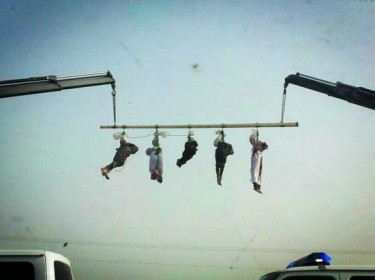
There are the obvious crimes, the public executions and crucifixions, with bodies subsequently hanged from lampposts as warnings to all.


Human Rights Watch's world report on Saudi Arabia is very long. The arbitrary arrests of anyone, including children, the routine torture, the horrendous abuses against alleged criminals and the lack of rights for migrant workers are all listed.

And then of course is the lack of rights for women. HRW write:

'Under the discriminatory Saudi guardianship system, girls and women are forbidden from traveling, conducing official business, or undergoing certain medical procedures without permission from their male guardians.'

And this Reuters article gives harrowing insight into the sort of abuses women regularly suffer in the country.

So the human rights of women world wide are evidently now in safe hands. 

Macedonia

'Macedonia is a source, transit and destination country for men, women and children subjected to sex trafficking and forced labour'. 

So says the US Department of State 'Trafficking in Persons Report 2013', published in June this year. To be fair Macedonia has been lauded in its efforts to stamp out this hideous trade but it remains an intractable problem.

Amnesty International highlights homophobic abuse that is still widespread in the country. 

Russia

Like China and Saudi Arabia, Russia is excellent at abusing human rights, regardless of international concern.

Greenpeace activists, and an accompanying journalist, are currently locked up awaiting trial, charged with hooliganism and face seven years in jail. 

Their treatment follows the jailing of Pussy Riot, one of whose members just showed up in a Siberian prison camp several thousand miles away from Moscow and her home and family.

Recently, anti-propaganda laws have been introduced against homosexuality, despite the impending Sochi games. Putin says homosexuals are welcome, but presumably as long as they don't tell anyone or, horror, kiss their partners. 

And dare one mention Georgia and Chechnya, on whose soil the most appalling atrocities have been carried out with either Russia's connivance or knowledge.

Cuba

HRW's world report on Cuba begins

'Cuba remains the only country in Latin America that represses virtually all forms of political dissent. In 2012, the government of Raul Castro continued to enforce political conformity using short-term detentions, beatings, public acts of repudiation, travel restrictions and forced exile.'

It may be the darling of some on the left, with Fidel Castro a hero, but its human rights record continues to be woeful.

Mexico

Few countries in the world have suffered more as a consequence of the misguided and counterproductive 'war on drugs'. As part of the security services' campaign to tackle narcotics, thousands of people have gone missing, been tortured or have been killed.

HRW reports that between January 2007 until mid-November 2012, Mexico's National Human Rights Commission issued reports on '109 cases in which it found that members of the army had committed serious human rights violations, and received complaints of 7,350 military abuses'. Soldiers who commit such abuses 'are virtually never brought to justice'.

France

Despite its membership of the EU and civilisation, it doesn't escape criticism from bodies including Amnesty International. In its 2013 report, it highlights the problems of deaths in custody, particularly amongst ethnic minorities, it questions its stance against torture in custody and says there is discrimination against ethnic minorities and LGBTI people.

Amnesty also criticises France's eviction of Roma camps:

'Camps and makeshift homes inhabited by Roma continued to be dismantled in forced evictions throughout the year. According to NGO estimates, 9,040 Roma were forcibly evicted throughout France in the first three quarters of 2012.'

United Kingdom

And before we give ourselves a pat on the back, and with relief exclaim 'well, we're not as bad as that lot', well no, we may not be, but then Britain is not an angel either. Since 2011, at least 61 journalists have been arrested in connection with payments to public officials. At least 12 have been cleared of any wrong doing, 23 remain on bail - some for more than a year, a disgraceful amount of time. None of these arrests are strictly human rights abuses but it remains extraordinary.

Oh, and Britain has a long and proud record of selling arms to China, Saudi Arabia and Iran. In fact, it's quite a surprise Iran has failed to be elected to this august body.


_________________________________________________________

It's not the first time the UN Human Rights Council has been a joke and it won't be the last. To make way for many of these countries places like Angola, Libya and Malaysia have left the council.  These countries join, for a three-year term, and 33 others states like India, the US, Brazil, Congo, Kazakhstan continue on the council.  But is it any wonder human rights abuses continue with such vigour when the body tasked with monitoring and protecting rights is packed full of countries guilty of such atrocities?

Friday, 8 November 2013

The last moments of The Alma


Kirsty Valentine outside The Alma on eviction day

It’s 9.20am on a Friday morning and the Alma pub, recently crowned as North London Cider pub of the year by Camra, is busy. It isn’t open. The only drinks being consumed are tea and coffee. Everyone there, locals, friends and supporters, local MP Jeremy Corbyn, writer Pete Brown, are not there to toast landlady’s Kirsty Valentine’s success, but to be with her and offer support as bailiffs are expected at any moment to turf her out.


It’s the culmination of four years of fighting with owners, Enterprise Inns, the pub company (pubco) which own the pub. Kirsty has vigorously campaigned to reduce the rent, claiming it was impossible for her to make decent standard of living; conversely Enterprise claim they have tried to help find a solution.


But the time for negotiation ended on Thursday when Kirsty lost in court.


At 9.30, a representative from Enterprise is standing outside the locked doors of the pub with a man in a hi-vis jacket; he’s the man who will fix shutters to the doors and windows when the bailiff arrives.
Enterprise representative, plus 'shutters man' arrive


A locksmith appears. He looks somewhat surprised at the sight inside. ‘I was told this was a non-confrontational job, look at ‘em. There’s dozens in there. No one wants to lose their local.’ He speaks in a friendly manner, with an energetic, north-London ‘geezer’ accent.


When he does arrive, the bailiff is quiet, evidently keen not to be drawn into a confrontation. Still, two police officers pull up in a marked car, there to ensure there is no breach of the peace. Inside the pub, Kirsty is locked in conversations with lawyers trying desperately to come up with a last minute offer which might satisfy Enterprise’s demands. I’m told that Enterprise have said they will not accept any offer and just want her out (Enterprise dispute this).


Just after ten, the bailiff and Kirsty go to a back room of the pub to discuss matters. It’s agreed that they will leave the pub; there is no need for police, and bags of possessions, heaped on the floor start to be taken out.


With tears welling up, Kirsty goes behind the bar one final time and beckons her supporters to come and join her. They line up and hug; one final act of defiance before becoming a statistic, one of the 26 pubs which shut every week. The Alma is now closed.
Kirsty goes behind the bar one final time


________________________________________________


Enterprise insist they are very keen to reopen The Alma as soon as possible, countering fears that it could become a block of flats or a supermarket. In a statement, the company describe the Newington Green site as ‘a great pub with a fantastic community spirit and we want it to continue to thrive’. They also claim that the dispute actually is ‘a clear example where the tied pub model…. has provided extraordinary levels of support, flexibility and ultimately direct financial assistance to a tenant'.

They add: ‘Regrettably therefore, we have been left with no alternative but to revoke her tenancy and will seek to put in place a new operator as soon as possible.’


As for Kirsty, she has lost her home – she lived above the pub – her business and livelihood – ‘they’ve wiped me out in 12 hours’ she says. Friends have rallied round and offered her places to stay while she continues her next move.


‘I can’t even begin to consider anything much because I’m just so, I’m just in shock. It’s a mixture of shock and relief that it’s finally all over.'

As for whether she will return to the pub trade, she is very unsure.

'I need to go away and sit in the corner for a very long time and contemplate things.'

But considering the tumultuous events of the day, she sounds remarkably chipper and stoical; buoyed by the impressive support during her final moments at the pub.

'I was so thrilled, it's made it so much easier to deal with. For many many months, I have wondered what his moment would feel like that and it's nothing like my greatest fears.I don't feel ashamed and I don't feel embarrassed. I feel extremely proud and honoured that everyone stuck by my side. I'm extremely proud I'm going out with my head held high. My staff are very loyal and are extremely upset. It's a very sad day, but at the same token it's made it very much easier to know I'm very loved and respected.'

For more background on the argument between publicans and pubcos, and the campaign for pubco reform, visit here.

Note - for legal reasons any comments left under this piece will be treated with particular caution. Thanks

Tuesday, 5 November 2013

Pulling their last pint?

One night the barman at the pub at the bottom of my road was still pulling pints; the next morning he had gone.
Steel shutters were stapled securely to windows and doors, each pinned with notices warning any would-be trespassers to stay clear. A few weeks later the site has been sold, to whom no one knows. and what will happen to this once thriving community pub remains a mystery. Read more

Friday, 18 October 2013

What if Lord Adonis ran for mayor?

A map from the Abercrombie plan for London

Thus far, the only person to have publicly declared his desire to be Labour’s next London mayoral candidate is the eminent transport writer Christian Wolmar.

Disappointingly, in the first poll assessing the chances of the candidates, Wolmar was not included. While he is a long way from being the favourite, his work on trains is constantly interesting and informed and such is the importance of transport in the London Mayor’s brief he deserves to be taken more seriously.

The poll, published in the Evening Standard, found comedian Eddie Izzard favourite amongst the public, followed by Tessa Jowell, Diane Abbott, David Lammy, Andrew Adonis and Sadiq Khan. Izzard is unlikely to stand, Jowell is a strong candidate, especially after her performance during the Olympics while Abbott has a high profile and has a reputation for outspokenness, which hasn’t proved a political obstacle thus far, in the short existence of the London mayoralty.

While not commanding such a prominent media presence amongst this group, Lord Adonis is perhaps the most interesting potential candidate. Closely linked with Tony Blair, Adonis was the architect of academy schools and HighSpeed 2 (HS2): all these factors might be regarded as politically damaging. But they also reveal a man keen on promoting large, transformative projects, thoughtful and unwilling to play safe.

A few weeks ago, Adonis gave a few hints as to what his ambitions might be, as Mayor, in the annual lecture to the Vauxhall Labour Party. He began:

‘London needs a plan – a plan to become both a bigger world city and also a better working city for Londoners.’

And he continued, highlighting the problems which undeniably face the city. London has five of the 20 local authorities with the highest levels of income deprivation in England, youth unemployment is at 24 per cent, it boasts amongst the lowest apprenticeship take-up rates in the country, a 20-year difference in life expectancy between Oxford Circus and some distant stops on the Docklands Light Railway, as well as housing costs and transport problems.

‘Looming behind all this is a population explosion – caused by London’s success, but making all these problems steadily worse and more urgent.’

Adonis was scathing about Boris’ vapid 2020 Vision:

‘It is a blowing of London’s trumpet and a collection of suggestions to support London’s growth, but with little coherence, or assessment of priorities, timescales or deliverability.

‘We have a Vision without a plan. We have a succession of documents called plans which aren’t plans, some of which promise real plans at some point in the future. Then, depending on which mayoral non-plan you read, there are anything from 19 to 43 areas for priority development across the capital, but only 10 have an actual development plan. And there is a Plan Implementation Plan which promises further work on the key components of what should be included in the plan it is supposed to be implementing.’

‘Well, that’s all clear then,’ he added witheringly.

He compared it with the ‘inspirational’ Abercrombie plan, the first volume published in 1943, the second in 1944. (For more information on this ambitious, but largely unimplemented, project see this excellent piece.)

Sir Patrick Abercrombie
With the air of a philatelist who has stumbled across a particularly spectacular collection of stamps, he continues:

‘In 400 pages, plus dozens of maps, charts and photos, it surveys the historic development of London. Its analysis and recommendations are incisive and panoramic…. the tone throughout is of expertise and passion, tempered by urgency and practicality, summed up by Abercrombie’s opening words “All things are read if our minds be so”.’

He went on:

'London needs a plan for a population of 10 million. Boris hasn't got one. In practical policy, Boris has essentially been implementing parts of Ken Livingstone's unfinished programme - the parts, like Crossrail, that don't offend Tory boroughs - without developing a credible successor plan for a population of 10 million.'

So were he to stand for mayor, what post-Boris plan would Lord Adonis develop? He identified five priorities.

Three new East Thames road crossings: the Thames Gateway bridge; the Silvertown Tunnel; the new lower Thames Crossing.

Facilitating the development of London Gateway Port, which opens next year, helping it become a 'world class logistics centre. He noted that already Marks and Spencer are building a 900,000 square foot distribution centre at the site; and 'impediments stopping others from following suit - including infrastructure, skills and housing' need to be overcome to enable other firms to follow suit.

As well as 'significantly expanding Basildon', Adonis has a vision for another 'successful new town'. Already with good transport links - just 17 minutes from St Pancras via HS1 -  'Ebbsfleet is an obvious candidate.'

'It was, in effect, supposed to be a private-sector new-town but it hasn't happened because the private sector hasn't been able to put in the required infrastructure up front and take on the associated risks.'

Then, Adonis lists the Lower Lea Valley, Stratford, the Royal Docks, London Riverside, Woolwich, the Greenwich peninsula and Canada Water as 'priority areas for substantial housing and community development'.

And finally, he wants to emulate the Victorians and endow London boroughs with 'great parks and cultural attractions'. He mentions a 'serious proposal' of a £2billion Paramount theme park at Ebbsfleet, to rival Paris' Disneyland, and, (perhaps more my cup of tea), 'a kind of new national park covering the wetlands and associated habitats in the Estuary'.

It may well prove to be the case that Lord Adonis lacks the public profile and acknowledgement to carry him to the London mayoralty; too much technocrat, not enough showman. His closeness to the Blairite project may prove to be a hindrance within his own party (it shouldn't but it could). But he displays a knowledge of the capital, of its ways and means, its history and cultures, successes and challenges, to be an invaluable ally and source of inspiration to whomever Labour select as their candidate

In just one speech, Lord Adonis presents a plan for London of much more focus and significance - and much more human and celebratory - than anything Boris has proposed in his six years of office. All that is missing is a clown on a bike.


Note - Further pieces on potential mayoral candidates will appear as and when their vision for the job becomes clearer.

Thursday, 17 October 2013

'Piloti' backs the new Crystal Palace


Private Eye's architectural writer, Piloti, doesn't often praise a scheme preferring to target nefarious, crude, developers, but in this fortnight's edition he is effusive about the prospect of a new Crystal Palace, invoking John Betjeman. He writes:

The site of the Crystal Palace on top of Sydenham Hill must be the most desolate and sad in Britain. 
    Proposals to build there ahve been unsatisfactory and come to nothing. but now, surprisingly, a Chinese billionaire, Ni Zhaoxing, of the developer ZhongRong holdings, proposes to recreate Paxton's iron and glass creation on the site (with a modern interior). Opposition has already emerged, both from ideologues who disapprove of replicas and from people who think the present rubbish on the site is worth retaining. But surely this is a wonderful idea - provided the 1854 structure is rebuilt accurately and in its entirety.
    'Let's Build Another One!' wrote John Betjeman, sainted founder of this column, in 1936 after the fire that destroyed the Crystal Palace. 'It is an emblem of all that was best in the great Victorian age, when England was prosperous and full of hope; when she was bolder than she is now...There would be nothing sentimental in rebuilding this greatest of Victorian cathedrals.' Quite so.

Piloti's voice is not just a lonely shout from the wilderness. These plans do have local support, and plenty of detractors, as I have found speaking to locals and also peaking at  forums such as this. Here's a few examples:

The white flag is quickly raised: 'Time to emigrate' was an early cry but others quickly issued a call to action, 'Time to fight', seemingly winning the argument as the first worrier replied 'wouldn't emigrate without fighting.'

Some are prepared for it to be given a chance:

'I think people are too quick off the mark to condemn this project, without knowing exactly what the plans are.
'Crystal Palace today (as well as the name) would not be anything like it is today without the 'delapitedated' (sic) palace mentioned.
The traffic concerns are completely without evidence. How many people drive to museums in London? Really.
I think this would be miles better than any other scenario, no housing, check. No need for funding for upkeep of the park, check. Keeping to the original footprint, check.
Crystal Palace IS the Crystal Palace. If well done, we should not stand in the way of good progress.
Wait and see before poo pooing it. It's not a cinema, a flying saucer or a 'Westfield'. Be careful what you wish for.'

While another said:

'As long as it's done with consideration and minimal disruption, then it should be supported. Will have a good effect on the house prices too, and good for tackling crime; they would have to bring in more police and security. More money in the local economy is a good thing overall. They should have rebuilt it before. If the only bit they're gonna rebuild is on the old Palace footprint, then that's great. If they improve public transport, that's great. Don't torpedo the idea. Help to shape it and make sure it serves local interests.

But there's a hefty dose of scepticism:

'We need to see what are these plans for CP. If the financial model (occupancy/returns etc) make sense. The impact on the community (traffic pollution, jobs etc). Then we can draw some conclusions.
At the moment I can only see some shady way to present this project to the media as if it was a done deal, no local consultation and sketchy information about the structure itself.... on the basis of current (limited) information the building makes very little sense.....'

And local councillor John Getgood falls into this category:

'There are so many unanswered questions. I am just musing at the moment, trying to put it all together. Anyone who remembers the debate on the Master Plan will know that once I have adopted a position, I will argue firmly for it but we cannot be said to be at the stage here yet. I have asked for clarification from the council on the ownership issues. They are not clear.'

Others have made their minds up:

'Trouble is, it's not just going to be a museum, the plans include shopping, a hotel, eateries of various types, I really do think traffic is going to be a problem. 
Also the original footprint includes some the current bus station, so I wonder what they'll do about that.
I'm not being a nimby, and I'm certainly not a pointless poopooer (is that even a word? - Ed), but I work in the construction industry, and I know how much of an environmental impact this will have on the park, as it's built, and I also know what much plans change between the 'pretty CGI pictures' stage, and the 'bog standard piece of shit' eventuality, I've see it happen.
Personally, I'd like to see a good clean up and reforestry sort of thing on the top terraces, keep it green, basically.'

And there are some who really hope it will all help the local football club:

'The devil is in the detail I guess but generally I think I'm for it in principle - that part of the park has been left to rot for a long time and lot of it hasn't been accessible to the public for many years....think overall it will be good for the local economy and put South London a bit more on the map. Maybe he will double up and Buy CPFC aswell!

Note:  Today Bromley Council gave exclusive rights for 16 months to the developers to give them an opportunity to move on with their plans. This means, they will have until February 2015 to amplify their ideas and consult with the community, before they submit a planning application. There's more information here.

Friday, 11 October 2013

All parties to blame for England's educational failings

There was understandable consternation and concern when the OECD published a report this week which showed 16 to 24-year-olds in England have amongst the worst numeracy and literacy skills in Europe.
The study placed England 21st for numeracy and 22nd for literacy out of 24 countries. This is undeniably damning and poses a serious threat to the long term health of Britain's economy and social fabric.
But the following comment from the fiercely tribal education minister Matthew Hancock was palpably stupid and unhelpful:
‘These are Labour's children, educated under a Labour government and force-fed a diet of dumbing down and low expectations.’
The simple fact is that it is far too soon to say what long term impact Labour had on the education system. Any child born in 1998 and after, therefore not starting full-time schooling until 2003, is not covered at all by this survey. And children born as far back as 1989, starting their schooling during the crucially formative early years in 1994, are included.
It is quite true that, between 1997 and 2010, Labour introduced a dizzying number of educational reforms. Please bear with me, this is a bit of a long list. 

  • Their first Education Act gained Royal Assent in 1997. It abolished the Assisted Places Scheme.  
  • Beacon Schools were introduced in 1998, Ofsted inspections of education authorities began, national targets for key stages 1-4 established.
  • In 1999, National Literacy and Numeracy Strategies started. 
  •  In 2000 we had the Learning and Skills Act in which the concept of Academy Schools emerged, the first opening in 2002.
  • Another Education Act passed in 2002 with vocational GCSEs replacing GNVQs and Ofsted was given enhanced powers.
  • In 2003, we saw the National Agreement on Raising Standards and in 2004 a five-year-strategy for children and learners. The Tomlinson Review of 14-19 year-olds’ education and skills was published and Building Schools for the Future started.
  • And another Education Act followed in 2005. This reformed teacher training and gave the Secretary of State greater powers of intervention in failing schools.
  • Not yet done, in 2006 the Education and Inspections Act passed. Ofsted got more powers and LEAs greater statutory responsibility for ensuring standards.
  • The following year was relatively quiet but in 2008 the Education and Skills Act passed. This major piece of legislation raised the school leaving age from 16 to 18 by 2015, A* grades for A Level was introduced and 16-18 year-olds were required to be in work, education or training.
  • The Apprenticeships, Skills, Children and Learning Act passed in 2009.
  •  - and in 2010, well, Labour lost power
 Phew! It's exhausting just listing the highlights of their activities.

Labour suffered legislative diarrhoea when it came to education in the 13 years they held office, though perhaps this is not surprising considering their ‘education, education, education’ mantra. And it would be perfectly reasonable to argue that their meddling was counterproductive and hindered teachers’ ability to teach. 
But Labour, of course, was not the first or the last government to tinker enthusiastically with education. During the previous 18 years of Conservative rule we saw the introduction of the National Curriculum, the replacement of O-levels with GCSEs, the emergence of the Assisted Places Scheme and National Vocational Qualifications. All significant, but it is fair to say the Tories during these years were less zealous than their New Labour successors.
The other major detail in the OECD report is that young people were no better at the tests used in the survey than people aged between 55 and 65. England was the only country in the survey where the older age category did better than the younger. This indicates standards have been falling for several decades, under governments of all parties.
Even as I did my GCSEs, more than 20 years ago, many critics argued they lacked the rigour and challenge of the O-levels they replaced. Subsequent grade inflation - which really must be acknowledged and not foolishly denied - has not improved the situation. Lifelong learning provision in this country is inadequate. And, most concerning of all, poverty and social background is far too great an indicator of later educational achievement. 

With the expansion of academies under this government, what is now emerging is a very erratic pattern of education, where the notion of a National Curriculum - and with it, perhaps, the communication of a coherent cultural and social understanding - no longer needs to apply. Some of these academies will be outstanding while others will be narrow and fail. Just watching the problems at the Al Madinah free school recently highlights the dangers. 

And while there are now 3,364 academies in England, with a rising birth rate we still face the prosepct of too few schools for too many children; this could mean that we could fare even worse in a future, similar, OECD, study.
Rather than resort to the sort of cheap, shallow, remarks displayed by Matthew Hancock, parties of all colours need honestly to accept their mistakes, study how those countries at the top of the tables maintain such high standards and do their best to emulate their models. At the same time, they should also bear in mind the damaging impact of perpetual change. Education is just too important an issue for political point scoring.