Showing posts with label FairDeal4YourLocal. Show all posts

Thursday, 27 March 2014

Will a penny off a pint save the British pub?

Despite strenuous efforts, I have yet to find a publican who has lopped off 1p from the price of a pint of beer following George Osborne’s announcement in the budget last week.

This is surely strange; after all, coalition ministers have been shouting quite a lot about this. Grant Shapps, in the poster of his now infamous tweet, boasted that ‘Cutting the Bingo Tax & Beer duty’ was helping ‘hardworking people do more of the things they enjoy’. And Conservative MP Andrew Griffiths – who represents, some believe with painful irony, Burton, the home of British brewing – has been especially excited, proclaiming the cut proves ‘this is the most beer and pub-friendly government we have seen in a generation’.

Mr Griffiths wrote effervescently about what the chancellor had done in the Publicans’ Morning Advertiser:

‘Last year’s decision to cut a penny off the price of a pint of beer was the first such decision by a chancellor since 1959. Yet it was the decision to scrap Labour’s hated beer-duty escalator that really made the difference to the industry.

‘Ending the year on year ratcheting up of a beer duty, a system which saw it rocket 48% between 2008 and 2012, ended the misery of a system which was bleeding the beer industry dry.

‘The more optimistic of us hoped and campaigned for a freeze in this year’s Budget, but not many expected an historic successive second cut. This of course was followed by scrapping of the alcohol duty escalator, and freezes for Scottish whisky and real cider.

'All in all, this was a beer and pub budget that the whole industry should be thrilled with.’

And Mr Griffiths hasn't held back on Twitter either.


And here he is below, clearly exemplifying responsible drinking:


Now let's not be churlish. It is of course welcome that the government has felt able to make any cut in the price of a pint of beer, especially as drinkers are increasingly lucky to get change from a fiver when buying a pint in the capital these days.

But for anyone to suggest this is the great rescue of the pub trade is, frankly, not taking the issue seriously.

Recent figures from CAMRA suggested the number of pubs closing each week had risen to 28 per week and while many in the pub trade are pleased with the price cut, they have wasted no time in pointing out the government's inaction - despite repeated promises - in tackling pubco reform - offering tenants a chance for a fair rent and an end to the system which sees them hit by high rent costs and high beer costs. Posters such as the one below have quickly appeared:
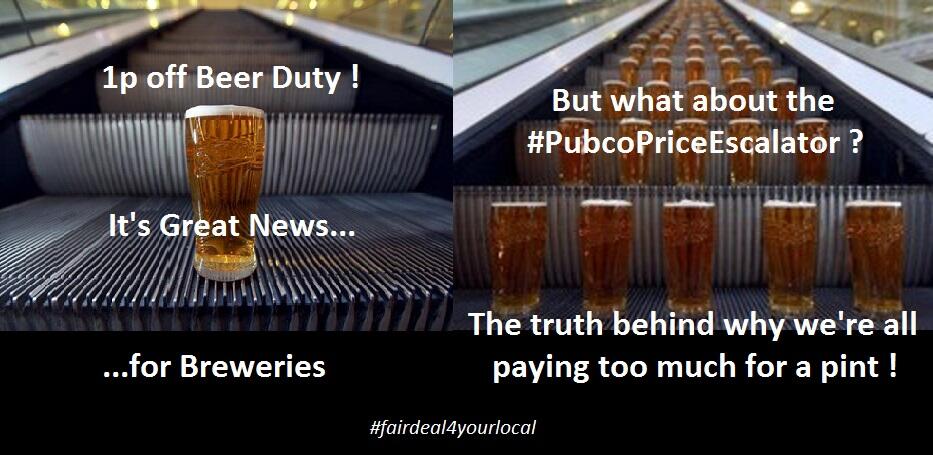


Simply nothing has happened. There has been no response to the government's consultation on the issue (for more on this delay see here) and it seems likely such reform has been blocked at a high cabinet level and nothing will happen this side of an election. It's worth noting Andrew Griffiths, a self-styled champion of pubs, is curiously opposed to any such reform.

And, in a timely fashion, the latest figure to get involved in the issue is the not insubstantial figure of Tim Martin, the founder of the Wetherspoon's chain. In his company magazine, he writes: 'The main additional reason for pub distress is the high level of debt assumed by some pub companies in the years running up to the credit crunch.' And he names financiers Guy Hands and Hugh Osmond of being the architects of this 'unsustainable', damaging model.

'In essence, Hands and Osmond bought large tenanted pub estates of the major brewers, using borrowed money, and then hiked up the rents and the beer prices paid by the tenants. As a result of the increased income which they generated, they were able, in effect, to remortgage pubs, extracting tens of millions of "profit" for themselves.'

Companies like Enterprise Inns and Punch Taverns were the successors to this and they continued using the same model. Tim Martin goes on:

'When the individual licensees/tenants started to suffer between the hammer of high rents and beer prices and the anvil of tax-subsidised supermarkets, unprecedented numbers of publicans went bankrupt - and the Enterprise and Punch shares plummeted on the stock market to a fraction of their former value.'

And while pub titans old and new, such as Hands, Osmond and Enterprise's former chief Ted Tuppen have showed little sympathy to the 'plight of the tenants', they have been vociferous in their complaints about high personal taxes, specifically Labour's plan to increase the top rate of income tax back up to 50 per cent should they regain power. He concludes, with restrained fury:

'There is a justifiable argument for a reasonable top rate of tax which encourages hard work - Britain did not benefit from the Rolling Stones hiding from the taxman in the south of France in the 1970s. However the disregard of the financial engineers for the plight of their tenants and their egocentric concentration on their own positions, dressed up as national concern, might even have caused Maggie Thatcher to side with Ed Balls.'

So while the government tinkers around the margins, fiddling ineffectively with beer prices, it continues to ignore the hugely damaging pubco model, something which all, but the most stubborn, now recognise needs tackling with urgency. Until the government belatedly takes action, their claims of being the publican's - and the beer drinker's  - friend will largely fall on sceptical and deaf ears.

Tim Martin's full article can be read here.

Monday, 20 January 2014

A brief chat with the pubs minister

The government's consultation on pubco reform ended on June 14th. The Department of Business, Innovation and Skills (BIS) at first insisted it would respond in the autumn, but as autumn turned into winter, there was nothing but silence. In December, Jo Swinson insisted a response would come 'very soon' but claimed the volume of responses had been 'staggering' and they needed more time to plough through them.

There were more than 8,100 responses in the consultation; being generous let's say 8,200. The consultation closed exactly 220 days (as of January 20). This means BIS has to go through just over 37 responses a day. As of March 2013, BIS employed 3,112 civil servants, but this is apparently not enough to tackle this task of studying with sufficient efficiency to ensure legislation can pass through the Houses of Parliament before the next election. Time is running out.

Pubs minister Brandon Lewis, who has been very quiet on the whole issue of pubco reform, has given an interview to the Publican's Morning Advertiser and manages to devote one line to the subject. He says he can see the 'logic' of the delay but in the article doesn't expand on this.

But, in a brief chat on Twitter, he did a go a little further on the issue.


And, like Jo Swinson, he blames the volume of responses:


More than 8,000 responses is a big consultation - though, by way of comparison, the equal marriage consultation received a record 228,000 replies and, comparatively, these were considered with much greater speed than the pubco reform study. Perfectly reasonably, Mr Lewis also explains he isn't responsible for the editing of the story. 


And, despite being pubs minister, it wasn't his consultation anyway, as he is a minister in the Department for Communities and Local Government.


Sadly though, as of yet, there has been no response to either the point above, about the lack of time, or the questions below:


The government is in very great danger of giving the responses so much 'consideration' that they end up doing nothing, which may well now be the intention. 

Tuesday, 4 June 2013

Time for a Fair Deal for your local

For those who love pubs, it has been described as a ‘last call to arms’.

Today publicans from across the country, with their loyal supporters and locals behind them, will descend on parliament to demand a Fair Deal for Your Local, an impassioned plea for the government to act to help save them.

For pubcos – combined with a series of poor short-sighted measures introduced by a series of governments, the smoking ban and the bargain-basement prices supermarkets charge for cheap, nasty lager –  threaten to make the sight of your familiar, welcoming local a thing of the past.

The all-too-frequently exploitative relationship between large pub companies – organisations like Enterprise Inns, Punch Taverns and Green King – and their tenants is something which has been allowed to fester for far too long.

About 20,000 pub tenants across the country have to purchase their beers, wines and spirits exclusively from their pubcos, and in exchange, they are supposed to benefit from lower rents.

Instead, far too frequently tenants are hit with above market-level rents, making their costs crippling forcing them out of business. A good recent example is the Chequers Inn in Whitney, the Prime Minister’s constituency. After twelve years landlord Simon Moore called it a day in May. While his annual turnover averaged around £230,000 a year, his rent to Enterprise Inns amounted to almost 40 per cent of this.

The reasons for these sky-high rents are various but a key factor is pubcos realised the inherent value of their property stock during the boom years and leveraged absurdly to expand their portfolios. When the credit crunch hit they were left with huge debts to manage.

But it is not just high rents which has heaped pressure on pubs. Selling pubs is frequently seen as a way out by pubcos. Tales of pubs being allowed to decay, driving away punters, until they are no longer financially viable, are legion. And the sector keenest to take advantage of this fire sale have been supermarkets.

It is not the fault of the likes of Sainsbury’s or Tesco’s. Why wouldn’t they be keen to get hold of prominent landmark buildings, well known locally and crowbar in a convenience store?

An edition of the London Drinker last year, the CAMRA magazine which can be found in many of the capital’s good pubs, highlighted this problem. The piece, by Roger Warhurst, began by saying: ‘Fifty London pubs have been converted or redeveloped for supermarket convenience stores since 2010, generally without the need for owners to seek planning permission for change of use.’

A pub’s licences are the real beauty for supermarkets. Large pubs frequently have all that is required – especially alcohol licences.

A recent victim of this loophole is the beautiful George IV pub in Brixton which Lambeth Council’s planning committee narrowly voted in favour of allowing to be turned into a Tesco Metro in May.

The only aspect of the application councillors could really object to was the installation of a disabled ramp – described by one as ‘zigzagging across the front of the building like a mark of Zorro' – and whether it was in keeping with a fine Victorian building. Of course it wasn’t, but as a pub is currently not viewed as viable the committee was left with the choice of an empty building or a shop. That the pub had been registered as a community asset as part of the government’s risible ‘localism’ agenda was of little import.

Today CAMRA have published research providing more evidence how pubcos are squeezing the life out of publicans. As many as 60 per cent of licensees tied to the big pub companies earn less than £10,000 a year, compared to only 25 per cent of the free of tie lessees. And at the other end of the scale, only one in a hundred tied pub licensees earn a salary of more than £45,000 a year, compared with one in five who run free of tie pubs.

So today, the pub trade gather. The government proposes reforms which could ensure tied lessees would be no worse off than those not tied, applying to all pub firms that have more than 500 pubs. It could be the start of a revival. With their parliamentary champions, like Liberal Democrat MP Greg Mulholland and indefatigable campaigners like @Lifelandlady , we should stand beside them and make sure the coalition delivers on its promises.