Showing posts with label UKIP. Show all posts

Wednesday, 5 October 2016

Theresa May; the red and purple Tory PM

Has a prime minister ever had such an opportunity to seize and control the political narrative as Theresa May does currently?

Sure, Margaret Thatcher dominated the political weather of her era but she came pre-loaded with a free market ideology which she applied, with more pragmatism than is remembered, during her time in office. And, of course, Blair swept all aside in his climb to power but, despite the country crying out for a change after 18 years of Conservative rule, he was timid in ambition, still fearful of electoral defeat.

Theresa May, though, is an accidental prime minister and already a lucky one. She is unencumbered by the baggage gathered by David Cameron after a decade of leading his party, emboldened by a Labour Party which seems content for now to wallow in protest populism, meanwhile Ukip seems to be permanently locked in petty, internecine battles. May - who was something of a Teflon-coated Home Secretary - is left clutching a broad, blank, canvas upon which she can paint her own vision for the Conservative Party and the country.

And so, we have her first major keynote speech at a Conservative Party conference as prime minister. Broadly speaking, it was a very successful, clever, speech. Much of it could have been written and said by Ed Miliband, bulked up with a few additions from Nigel Farage, though most of his script had been left with Home Secretary Amber Rudd a day previously. Delivered without fuss from a lectern, Ms May didn't feel the need to display any flashy skills. She didn't take a suit jacket off to show she means business, or memorise the whole speech in an attempt to display her oratorical prowess. Down to earth, unfussy and practical, getting on with the job; that was the message.

While many still struggle to come to terms with the result of the Brexit referendum on June 23rd, Ms May described it as being a symptom of wider issues within society. The vote to leave was about a broader vote for change, 'about a sense - deep, profound and let's face it often justified - that many people have today that the world works well for a privileged few, but not for them'. She went on:

'Our society should work for everyone, but if you can't afford to get on to the property ladder, or your child is stuck in a bad school, it doesn't feel like it's working for you. Our economy should work for everyone, but if your pay has stagnated for several years in a row and fixed items of spending keep going up, it doesn't feel like it's working for you. Our democracy should work for everyone, but if you've been trying to say things need to change for years and your complaints fall on deaf ears, it doesn't feel like it's working for you. And the roots of the revolution run deep. because it wasn't the wealthy who made the biggest sacrifices after the financial crash. but ordinary, working class families.'

Compare and contrast with what Ed Miliband had to say in his conference speech in 2014.

'You see, for all the sound and fury in England, Scotland, Wales, across the United Kingdom, what people are actually saying to us is this country doesn't care about me. Our politics doesn't listen. our economy doesn't work and they're not wrong, they're right....

'Prosperity in one part of Britain, amongst a small elite. A circle that is closed to most, blind to the concerns of people. Sending the message to everyone but a few: you're on your own. See, think about it for a minute. In our economy, it's working people who are made to bear the burden of anxiety, precariousness and insecurity.'

All three paragraphs could easily have come from the same speech. But, while Ed Miliband suffered a humiliating defeat at the last general election, Theresa May is Prime Minister and received a standing ovation. She is busy taking Labour's clothes.

Corbyn himself recognises this. In his own conference speech, he acknowledged that Ms May knew there was a need for change:


The problem Labour and Corbyn faces, though, is that it currently isn't seen as a viable alternative for government. With that in mind, Corbyn is fortunate that Theresa May has ended speculation that she might call an early election for if she did, it seems fairly certain she would be rewarded with an enlarged parliamentary majority. 

Ms May currently faces bigger challenges from within her own party than the official opposition. Many Tory MPs object to the expansion of grammar schools.  There is a cohort of disgruntled Remainers. And the balance of the House of Lords is also still stacked against the Conservative Party. But all this could change. 

The Prime Minister acknowledges that the whole Brexit process will be a 'bumpy' road, the Conservative Party is still split over what Brexit actually means, and if the economy does indeed struggle as many experts fear, it will be this government that is blamed. Moreover, if her fine words remain just fine words and little effort is made to actually seize the centre ground, this will be noticed and Labour could still return there.

The Labour leader has been dismissed many times but he has weathered an almighty battering. It may be hard to imagine now, but, there is no doubt that Jeremy Corbyn has galvanised a movement behind him. Many may not recognise it as the Labour Party they have known for decades, but it is huge in number, over half a million in strength, and could still prove a formidable election fighting machine. The next election, however, remains Theresa May's to lose.

Tuesday, 5 May 2015

The campaign trail to nowhere

This election campaign may have only officially begun at the end of March, but as we approach the final hours, it seems to have lasted many more months and years. And, ultimately, what has been the point? For all the polls have shifted, it might as well have just started at the start of last week. For all the flashy billboards, boisterous though far from spontaneous rallies of the faithful, the personal attacks, the sniping in the press and the plethora of pledges, the polls have barely moved an inch.

For a brief moment last week, the Conservatives appeared, in a couple of polls, to be establishing something of a lead; was clear blue water finally emerging? Well, no. The polls have levelled once more, maybe the Tories holding a slender, but far from firm, lead. A hung parliament is, it seems, an inevitability.

So how have the campaigns gone for each of the main political parties:


Conservatives

The leading member of the coalition had a very leaden, clunking, gloomy start. The messages were dour, warnings of ‘chaos’ tedious beyond belief and the operation slack. The personal attacks on Ed Miliband, such as the backstabbing one from Michael Fallon backfired, and David Cameron failing to acknowledge Ed Miliband as a 'decent man' was jarring and unbecoming of the man. 


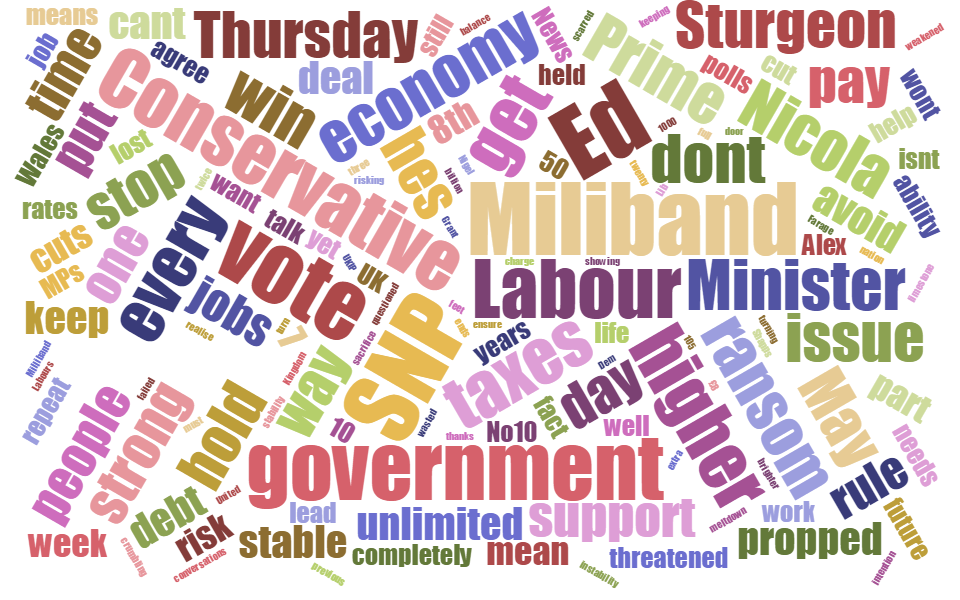
Just from the wordcloud above, using statements made in Conservative Party press releases since Friday, the words 'Nicola', 'Sturgeon', 'SNP' are have been used almost as often as 'Miliband'; 'ransom' is also pretty prominent. For an apparently 'Unionist' party the venom stirred up against Scottish voters has been extraordinary. Stirring up English nationalism may well prove, in the long run, to have been an extremely unwise thing to do.

Then there were pledges, a windfall of them: Inheritance Tax threshold increased to £1million for a couple; 40 per cent Income Tax threshold raised to £50,000; personal allowance up to £12,500; commuter rail fares frozen; £8billion above inflation for the NHS; 30 hours free childcare for 3 and 4 year-olds, What a gold mine; who could possibly suffer from such pledges? The only problem there was little information how any of these would be paid for; they almost appeared like post-election coalition talks. And they came on top of the repeated failure by senior Tory figures to explain '£12billion in welfare cuts' apparently planned for after the election.

In the last week, however, the party has recovered lost momentum, mainly due to David Cameron's own campaigning skills. His 'I'm pumped up' and 'bloody lively' routine sounds absurd but there is something in Dan Hodges' piece from early April which talks about the Prime Minister rolling up his sleeves and hitting the road after a lacklustre campaign start. It's also possible that the constant repetition of the same slogans is finally hitting home.

If Cameron wins a majority, it will be a huge personal success and not a ringing endorsement of Lynton Crosby's election campaign; frankly the Tories should really ask for their money back.


Labour

For some reason Ed Miliband has been routinely underestimated throughout his leadership of the Labour Party. His doggedness has been entirely overlooked. So when it came to the election campaign itself expectations were not high. As a consequence, the fact that Labour launched a coherent, spirited, hungry campaign rather took onlookers by surprise.

Miliband also did well in the debates. In the spin room at the first non-debate, reporters from pro-Tory papers acknowledged to each other that the Labour leader had easily beaten Cameron, who looked utterly terrified when confronted by Jeremy Paxman.

The #edstone
But, in the penultimate week, as the polls appeared to be giving the Tories a slender leader, jitters could be seen. Perhaps this is why Ed Miliband decided that rather than a pledge card, which can be slipped easily into a wallet, he would opt to have his promises engraved on an 8-foot limestone monument; surely the invocation of gravestones or Old Testament tablets inscribed with the Ten Commandments were inevitable? It is as though a member of his team watched The Thick of It thinking it was a template from which to copy rather than a satire. Perhaps, again, evidence of an imported public relations guru not really worth his weight in gold, or even limestone.


Liberal Democrats

Pitching themselves as a moderating force for both the Conservatives and Labour, this election has been one of consolidation for the Lib Dems. Whatever Nick Clegg says, they will lose seats on Thursday night, probably a lot of them. They may lose so many that he cannot stay as party leader. In many ways this would be a shame as the Lib Dem leader is unquestionably a decent man who was thrust in an invidious position back in 2010. The numbers could have allowed a Labour/Lib Dem coalition but it would have been far from stable and far less so than the Tory/Lib Dem coalition has proved to be.


Danny Alexander's leaking of apparent Tory post-election child benefit plans had the air of someone who knew who was going to lose and didn't care any more. Safe to say that after he loses his Inverness seat - which he almost certainly will - even if Alexander ends up in the Lords, he won't be the first person to whom the Tories turn to join another coalition in the future.


Ukip

Nigel Farage's party has maintained its level in the polls surprisingly well considering what a wretched campaign they have had. It may not be until after the election that the full details of why Ukip's campaign never gained any momentum is known; Farage's health issues with his back are clearly a factor. But, the cancelled events, the comments - whether reasonable or not - about Farage's own lack of appearances in Thanet South where he is standing, have all not helped.

The party also seems to have decided there is a concerted media plot against it. Farage launched a misguided attack on an independently selected audience during a BBC debate complaining it was too left wing, forgetting that, with Cameron's absence, right-wing members of the audience had little to clap for. It isn't actually the media's fault that member after member says or does something stupid or offensive. The latest is the suspension of Robert Blay, a Ukip parliamentary candidate who was caught on camera saying he would 'personally put a bullet between' the eyes of his much-tipped Tory opponent if he were ever to become Britain's first Asian prime minister.

Through the share of the vote they look likely to take, Ukip could still cause the Tories problems but it seems less likely that this will prove a breakthrough election for them; Carswell looks set to win but none other can be as sure.


Greens

Remember the Green surge? Membership shot up, overtaking Ukip and even the Lib Dems but today's poll of polls leave them on five per cent. Caroline Lucas may return for the Brighton Pavilion seat but other gains look very unlikely.

Sadly for Natalie Bennett, the party's surge never really kept going after her 'mental brain fade' on LBC radio back in February, even thought she stood her ground well when she took to the stage on the BBC Challengers' Election debate. We should not forget the fact that this programme featured three effective female politicians - Bennett, Nicola Sturgeon and Leanne Wood. This is possibly the only time women have ever outnumbered men in such a format, and it lent the discussino a novel, even an exciting, edge. It was in this format that Bennett was probably at her best.

Before long, however, fundamental problems faced the party. Because the Greens were now pitching themselves as members of a serious political and less a campaign group, their manifesto faced more scrutiny than ever before. Bennett was repeatedly challenged as to whether she wanted to ban the grand national or outlaw rabbit hutches, or back up the party's economic policy with solid evidence. Perhaps inevitably, while there was no repeat of the 'mind-fade', she continued to struggle in interviews.


Conclusion

The next five years are likely to be troublesome: Britain's membership of the European Union could well be the subject of a referendum; the strength of the Union will be put under enormous strain; the refugee crisis in the Middle East is not going away and its effects will spread further; Russia under Putin is likely to maintain is bellicose stance; global security is shaky; the environment is under threat; and the economy is still vulnerable to shocks. And, yet it seems, if we believe the opinion polls, we may well, after the general election, be left with an unstable, fractious, government with a major party reliant on the support of one, two, even three smaller parties.

It's clear neither the Conservatives nor Labour has presented a vision for the country which has captured the imagination of the public, their campaigning has been narrow, artificial and blinkered. There has been too little discussion about several vital issues during this campaign. Foreign affairs and the environment have barely featured.

From the uncertain melee of this messy, unsatisfactory, campaign, one can hope for a stable government to emerge but if not, we might have to do it all again soon.

Sunday, 28 September 2014

Mark Reckless = Gluttering Snodgripe

A gluttering snodgripe, recently

Mark Reckless is a ‘gluttering snodgripe’, a ‘flouty pelmvessle’ who should be ‘hodded into solulence’. Not my words, but those of the 'legendary Jim Hill', or @jamesworse, who appeared briefly in a Michael Crick film on Channel 4 News this evening after being asked about the former Tory MP for Rochester and Strood who has defected to those 'agents of change', Ukip. It can be seen here, the best bit starts 34 seconds in).

And really, it's hard to disagree with the sentiments. It is all very well for Grant Shapps to tell the Conservative Party Conference that Reckless ‘lied and lied and lied again’ – and coming from Michael Green, some might think this is a bit rich anyway – but had the Tory party chairman used the language above he would have garnered a bit more attention.

For James Worse, with these nonsense words and neologisms (think Jabberwocky, William Archibald Spooner and Polari), expressed the opinion of the Tories, and so many other people, much more succinctly and accurately than anyone else. Forever, to me, Reckless will be a 'gluttering snodgripe' (a twist on 'sodding guttersnipe' perhaps?) no other comment, worthy or otherwise, can hope compete. It should appear on his political epitaph.

And as he told me earlier this evening:


For all the brutal cunning of Denis 'like being savaged by a dead sheep' Healey and lyrical theatricality of Michael 'semi-house trained polecat' Foot, this must ranks as one of the most dismissive, contemptuous, descriptions of any MP ever uttered.

Far more nonsensical than any of these phrases is Mark Reckless' belief that his dream of leaving the EU is likely to be brought forward by joining UKIP, than if he had stayed with the Tories. His defection, along with Douglas Carswell's, paint a picture of a political party that is still fracturing from a fissure that has been painfully widening now for more than 20 years. More than ever, it looks like Ed Miliband's Labour Party will win the next election more by accident than by design, and if the recent polling by Lord Ashcroft and the latest from ComRes for ITV News is anything to go by, with a majority. 

As for, Mr Worse - who performs 'experimental sound improvisation like 'Shrivelled Mole' below -  according to his Facebook page, he is 'writing an on-going epic, entitled "Flark of the Dandibus"' which he hopes never to publish, but 'instead for it to exist only in performance - like they used to do by the fire in longhouses, in the good old days'. I can't wait to attend such an occasion.


Update

We've just had to endure George Osborne's speech and this is what Mr Worse thinks of the Chancellor of the Exchequer:


Thursday, 27 February 2014

Dave's immigration woes are of his own making

A more cunning prime minister would have been able to boast about today’s immigration figures. ‘Look’, he would say, ‘our economy is on the up, more people are in work than ever before and more of those jobs are going to hardworking Britons.
‘With careful handling of our finances, we have begun the task of tackling the economic disaster we inherited, saved it from the abyss and now we are focusing on securing the economy.
‘On top of all of this, people from across Europe are now flocking to our shores, seeing us as a place of security, of resilience, of vitality, coming here eager to work and build our economy, helping to secure the prosperity that we all want.’
But whatever he is, David Cameron is not a cunning prime minister. Playing the anti-immigration card is an easy election ploy, especially in the midst of the deepest recession for a century. It pleases his backbenchers and taps into the public’s unease; providing voters with a more realistic immigration policy was never really on the cards.
So, instead, as more net migration hits more than 212,000, David Cameron’s pledge to reduce this to below 100,000 looks completely unachievable and it will be for others, UKIP and his increasingly restless backbenchers, to take the spoils.
It was ever going to be thus. The largest number of migrants coming to this country come from the European Union and the government has practically no power to restrict this movement (the restrictions that did limit Romanian and Bulgarian migration lifted at the start of this year). The prime minister can talk as much as he wants about renegotiating our relationship with Europe but this isn’t going to make any significant progress before the next election.
The government know this is happening. In an interview published this week in Total Politics magazine, David Willetts, minister for universities and science, while claiming there was a surge of students from China, admitted the curbs had ‘played disappointingly badly’ in India with numbers falling by 38 per cent between 2011 and 2012.
So it leaves the government vulnerable from all sides on immigration. Those who believe in the free movement of people and think immigration has and continues to enrich Britain attack the government for harming universities with their restrictions and deterring people who could contribute. While anti-immigration voices and those on the right, from MigrationWatch and UKIP, shout louder about leaving the EU and call for stricter controls to be introduced.
And everyone, in unison, can accuse the government of losing control of their own policy.

Tuesday, 24 September 2013

When is a resignation not a resignation?

I’m aware it’s not the biggest political story of the day, what with publisher Iain Dale’s comical sumo bout with a veteran anti-nuclear protester (speech, what speech?) but good old Godfrey Bloom from Ukip has succeeded once again in putting smiles on faces. Read more

Wednesday, 7 August 2013

Godfrey Bloom tries to shock, SHOCK

The outrage that has greeted Godfrey Bloom’s ‘bongo bongo land’ comments is understandable – though his remarks will come as no surprise to anyone who has paid the slightest interest in his career.
His casually racist comments follow a litany of similarly unpleasant and dim asides which have pockmarked his political life. Bloom is an attention seeker who pops up like a whack-a-mole puppet, equipped with opinions – frequently underpinned by heroic levels of ignorance – on often difficult subjects, consistently reducing conversations to levels which normally occur only after a few pints. Read more

Friday, 7 June 2013

Only 'lazy council tenants' get pests

Andrew Parkes, the editor of News Shopper, the paper which drops through letter boxes around Bromley every Thursday, may be a very charming man, brimming with generosity of spirit and forgiveness. But if he is, he certainly keeps it well hidden from view. For his weekly editorials portray a cantankerous, brooding, chippie chap, determinedly convinced the world is plotting against him.

This week, like most others, Mr Parkes has decided to round on council tenants as he is convinced pest infestations only occur in council and rental properties as the inhabitants live in idle squalor.

He writes:

'Is it just me or is it the case whenever there's a "horror" story about an infestation of nasties or fungus breeding from damp it just about always involves people in council or housing association properties.

What can't these people scrub down a wall or put down a few traps like the rest of us?

'Of course anyone seriously wishing to rid themselves of a mouse infestation knows poison is the only real answer, but why doesn't this information filter through to people in rental property?

'It seems to me this feeling that everything is someone else' problem has infected them worse than damp or mice ever could.'

There is probably barely a Victorian property throughout the land which doesn't suffer from damp and few stately homes without an issue with mice. But hey ho, what does that matter? It's much more fun having a pop at those feral, feckless council tenants, with fridges in their gardens and paint peeling from the walls.

Of course, it's not the first time - nor will it be the last - Andrew Parkes uses stereotype and anecdote to casually stir resentment towards 'lazy tenants' or seeks controversy.

In April he pondered whether some people should be neutered 'for the general good of society'. One was a mother who helped her two killer sons, the other was a mother who spent £1,200 on a baby buggy.

And it's clear he enjoys the notoriety and to an extent it's fun to read his frothing prose. Elsewhere in this week's comment he rails against the 'ever-more nannying state' which tried to prevent the annual cheese rolling event in Gloucestershire. 'The race has been run since the early 19th Century,' he wails, 'and die-hard runners refused to give in to this politically-correct nonsense'. At which point he presumably wants us to roundly cheer.

In fact, the more I read his comment pieces, the more he reminds me of professional pub politician Nigel Farage. It would be no surprise if Mr Parkes was soon to be using his editorials to cheer lead for UKIP; they seem a perfect fit.